
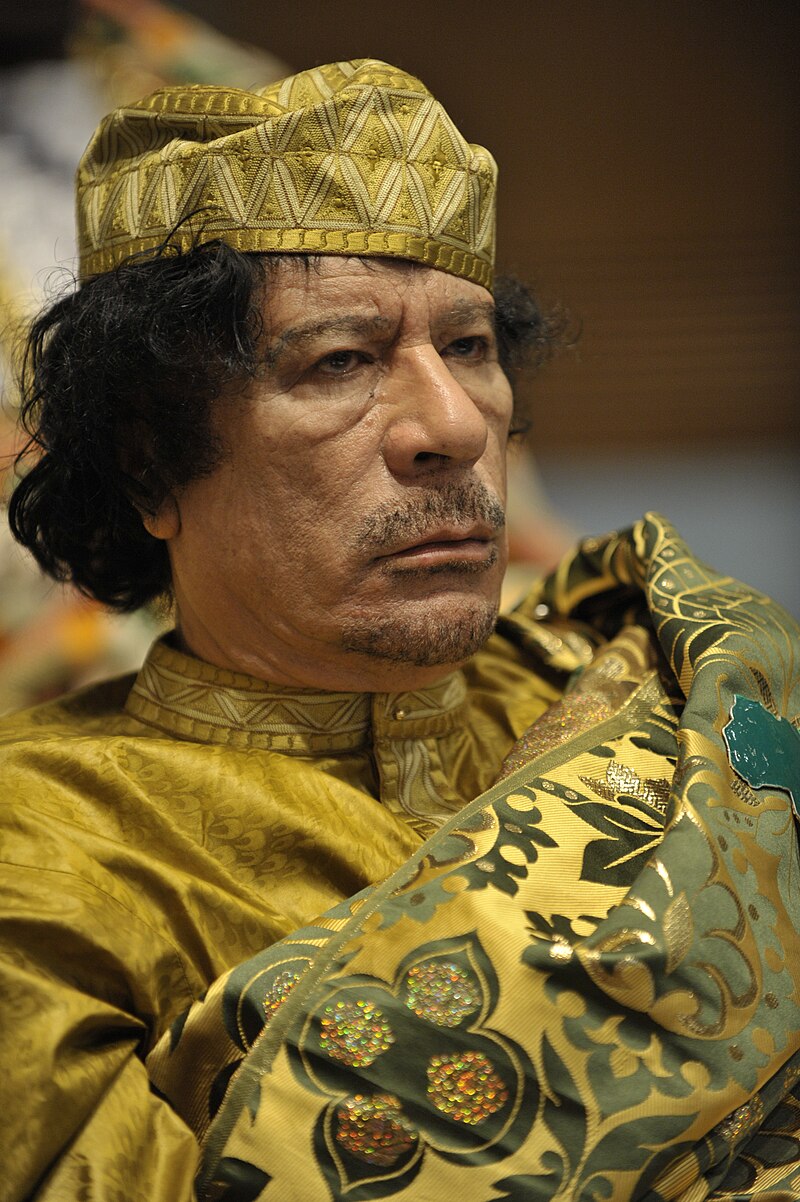
Muammar Gaddafi, born on June 7, 1942, in Sirte, Libya, was a figure of immense significance in the history of North Africa and the broader Arab world. Known as the leader who held absolute power over Libya for more than four decades, Gaddafi’s life and rule were marked by revolutionary zeal, controversial policies, and a complex legacy that continues to spark debate. This article provides a comprehensive look into the life of Muammar Gaddafi, exploring his rise to power, his governance, and the events leading to his downfall.
Early Life and Background
Muammar Gaddafi was born into a humble Bedouin family in the coastal city of Sirte, at a time when Libya was under Italian colonial rule. His upbringing in a traditional, nomadic environment had a profound impact on his worldview, instilling in him a deep sense of pride in his Arab and Islamic heritage. Growing up in the desert, young Gaddafi was exposed to the harsh realities of life in a region shaped by colonialism, poverty, and social inequalities.
Despite his modest beginnings, Gaddafi was determined to rise above his circumstances. His early education was rooted in Islamic teachings, as he attended a Quranic school in Sirte before moving on to further his education in Fezzan, a remote desert region. This early education in Islamic doctrine would later influence his political ideology and the governance model he sought to impose on Libya.
Military Education and Political Awakening
Gaddafi’s political consciousness began to take shape during his time at the military academy in Benghazi, where he enrolled in the early 1960s. His military training was further enhanced by specialized courses in Beaconsfield, England, in 1968. It was during these formative years that Gaddafi became deeply influenced by the ideals of pan-Arabism, particularly those espoused by Egyptian President Gamal Abdel Nasser, who was a leading figure in the Arab nationalist movement.
Nasser’s vision of a united Arab world, free from Western influence and domination, resonated strongly with Gaddafi. He viewed Libya’s monarchy under King Idris I as corrupt and subservient to Western powers, particularly the United States and Britain, which maintained military bases in Libya. Gaddafi’s growing disillusionment with the monarchy, coupled with his pan-Arab nationalist ideals, set the stage for his future revolutionary activities.
The 1969 Coup d’État: The Birth of a Revolutionary Leader
On September 1, 1969, Gaddafi, then a young and ambitious army officer, led a successful coup d’état against King Idris I, who was abroad receiving medical treatment. The bloodless coup, which was supported by a group of fellow officers known as the Free Officers Movement, marked the beginning of a new era in Libyan history. The monarchy was abolished, and Libya was declared a “Free, Socialist, and Democratic Republic.”
Gaddafi, who was only 27 years old at the time, quickly emerged as the de facto leader of the new regime. Although he held no official title initially, he adopted the honorific title of “Brotherly Leader and Guide of the Revolution,” a position that allowed him to wield absolute power without the constraints of formal government roles. The coup was widely supported within Libya and received immediate recognition from other Arab states, as well as cautious acknowledgment from Western powers.
Gaddafi’s Vision: The Green Book and the Third Universal Theory
One of Gaddafi’s most significant contributions to political thought was his “Green Book,” published in 1976. This work outlined his “Third Universal Theory,” which was intended as an alternative to both capitalism and communism. The Green Book is divided into three parts, each addressing different aspects of governance, economy, and social organization.
-
The Political Sphere: Gaddafi advocated for what he termed “direct democracy,” where decisions would be made by the people through local popular committees and congresses, rather than through elected representatives. This was intended to prevent the rise of a ruling elite and ensure that power remained with the people. However, in practice, this system centralized power in Gaddafi’s hands.
-
The Economic Sphere: Gaddafi’s economic vision was rooted in the idea of “Islamic socialism,” which combined state control of key industries with the principles of Islamic finance, such as the prohibition of interest. He nationalized Libya’s oil industry, which became the backbone of the country’s economy, and used oil revenues to fund massive infrastructure projects, including schools, hospitals, and housing.
-
The Social Sphere: Gaddafi promoted a conservative social agenda based on Islamic values, including the prohibition of alcohol and the enforcement of traditional gender roles. However, he also advocated for certain progressive measures, such as the education and employment of women, albeit within a strictly controlled framework.
Gaddafi’s Rule: From Revolutionary to Dictator
Gaddafi’s rule was characterized by a mix of revolutionary fervor and authoritarianism. His government invested heavily in education, healthcare, and infrastructure, leading to significant improvements in the quality of life for many Libyans. However, his regime also became increasingly repressive over time, with widespread reports of human rights abuses, including arbitrary arrests, torture, and extrajudicial killings.
Gaddafi’s foreign policy was equally controversial. He positioned himself as a champion of anti-imperialism and supported a wide range of liberation movements around the world, from the Irish Republican Army (IRA) to various African independence movements. This earned him the enmity of many Western nations, particularly the United States, which accused him of sponsoring terrorism.
One of the most infamous incidents associated with Gaddafi’s regime was the bombing of Pan Am Flight 103 over Lockerbie, Scotland, in 1988, which resulted in the deaths of 270 people. Libya’s alleged involvement in the bombing led to international sanctions and further isolation of Gaddafi’s regime.
The Decline: Sanctions, Isolation, and Internal Unrest
Throughout the 1990s, Gaddafi’s regime faced increasing international pressure. The imposition of United Nations sanctions in response to the Lockerbie bombing severely affected Libya’s economy and further isolated the country on the world stage. Gaddafi attempted to break out of this isolation by making overtures to the West, including agreeing to compensate the families of the Lockerbie victims and dismantling Libya’s weapons of mass destruction programs.
These moves led to a thaw in relations with the West, particularly after the 2003 invasion of Iraq. Gaddafi sought to reposition Libya as a cooperative partner in the global fight against terrorism, and in 2004, then-British Prime Minister Tony Blair visited Libya, signaling a significant diplomatic shift.
Despite these efforts, internal dissent was growing within Libya. Economic mismanagement, corruption, and the concentration of wealth among Gaddafi’s inner circle led to widespread dissatisfaction. The regime’s reliance on brutal repression to maintain control only deepened the resentment among the population.
The Arab Spring and Gaddafi’s Downfall
The wave of uprisings that swept across the Arab world in 2011, known as the Arab Spring, eventually reached Libya. Protests against Gaddafi’s regime began in February 2011 in the eastern city of Benghazi. The government’s violent crackdown on demonstrators only fueled the unrest, leading to a full-scale civil war.
As the conflict escalated, the international community intervened. In March 2011, the United Nations Security Council passed a resolution authorizing military intervention in Libya to protect civilians. A NATO-led coalition launched airstrikes against Gaddafi’s forces, significantly weakening the regime’s ability to maintain control.
By August 2011, rebel forces had captured the capital, Tripoli, forcing Gaddafi into hiding. His final stronghold was his hometown of Sirte, where he attempted to rally his remaining supporters. However, on October 20, 2011, Gaddafi was captured by rebel fighters while trying to flee Sirte. He was killed shortly after his capture, marking the end of his 42-year rule.
Legacy: A Controversial Figure
Muammar Gaddafi’s legacy is one of profound complexity. To some, he was a revolutionary leader who sought to liberate Libya from colonialism and build a society based on Islamic and socialist principles. His government’s investments in infrastructure, education, and healthcare brought tangible improvements to many Libyans’ lives.
However, Gaddafi’s regime was also marked by authoritarianism, repression, and human rights abuses. His support for international terrorism and his erratic behavior on the global stage made him a pariah in the eyes of many Western nations. The latter years of his rule were characterized by increasing isolation, both domestically and internationally, culminating in his violent downfall.
The post-Gaddafi era in Libya has been fraught with instability, as the country has struggled to establish a functioning government and has been plagued by ongoing conflict. This instability has led some to view Gaddafi’s rule with a degree of nostalgia, particularly in light of the chaos that has followed his removal.
Conclusion
Muammar Gaddafi was a figure who defied easy categorization. His life was a blend of revolutionary ideals, dictatorial practices, and controversial policies that left an indelible mark on Libya and the world. His rise to power, his governance, and his eventual downfall reflect the complex interplay of ideology, ambition, and the harsh realities of political power.
Gaddafi’s story is a cautionary tale of how revolutionary leaders can become the very tyrants they once sought to overthrow. It also serves as a reminder of the dangers of unchecked power and the challenges of building a just and equitable society in the face of entrenched interests and external pressures.
As Libya continues to grapple with the legacy of Gaddafi’s rule, the world watches closely, hoping that the lessons of the past will guide the country toward a more stable and prosperous future.


