
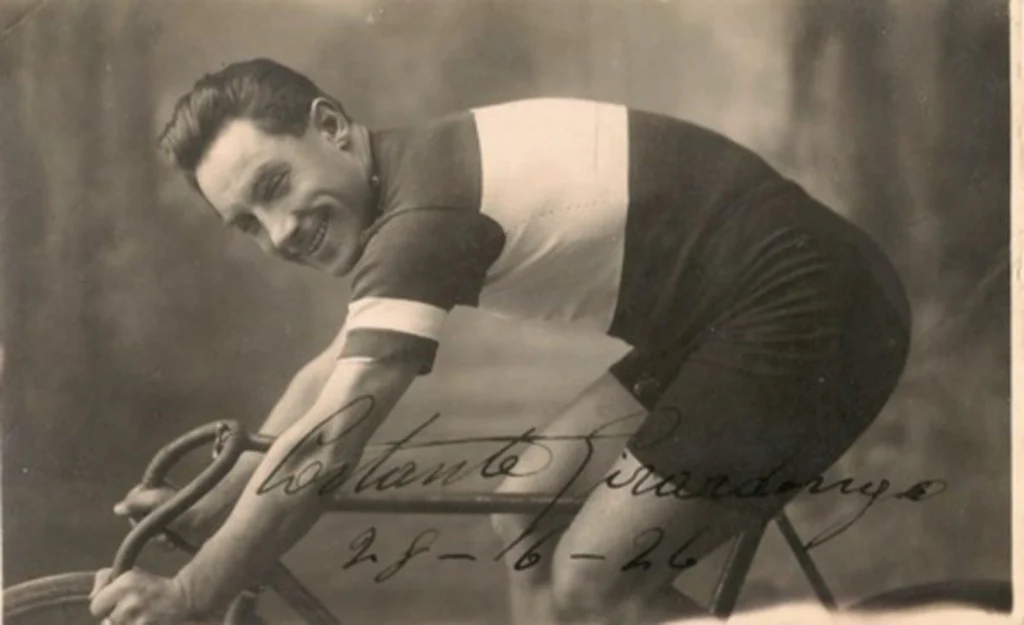
Costante Girardengo, born on March 18, 1893, in Novi Ligure, Piedmont, Italy, is one of the most iconic figures in the history of cycling. Known as the “Super Campionissimo,” Girardengo’s career spanned over two decades, during which he established himself as a dominant force in the world of professional cycling. His life and achievements on the bike have left an indelible mark on the sport, making him a revered figure in the annals of cycling history. This article explores the life, fame, and key highlights of Costante Girardengo’s illustrious career.
Early Life and Entry into Professional Cycling
Costante Girardengo was born into a modest family in the small town of Novi Ligure in the province of Alessandria, Italy. From a young age, he showed an interest in cycling, a sport that was rapidly gaining popularity in Italy at the time. His early exposure to cycling, combined with his natural talent and determination, set the stage for what would become one of the most successful careers in the sport.
Girardengo turned professional in 1912, at the age of 19. His debut year saw him finishing ninth in the prestigious Giro di Lombardia, a race that would become one of his many successes in the years to come. His first major victory came in 1913 when he won the Italian National Road Race Championship, a title he would go on to claim nine times throughout his career, solidifying his status as one of Italy’s top cyclists.
The Rise of a Champion: Pre-World War I Successes
The years leading up to World War I saw Girardengo rapidly rise to prominence in the world of cycling. In 1913, he also finished sixth in the Giro d’Italia, winning a stage and making his mark as a strong contender in stage races. That same year, he won the grueling 610-kilometer Roma-Napoli-Roma race, showcasing his endurance and versatility as a rider.
In 1914, Girardengo further cemented his reputation by winning another Italian national title and achieving a remarkable feat in the Giro d’Italia by winning the longest stage in the race’s history—the 430-kilometer Lucca-Rome stage. However, the outbreak of World War I in 1914 brought a temporary halt to his racing career, as it did for many athletes of the time.
Post-War Dominance and the Birth of the “Campionissimo”
After the war, Girardengo returned to cycling with a renewed vigor. In 1917, he narrowly missed out on victory at the Milano-Sanremo, finishing second. The following year, he claimed his first win in the same race, which would become one of his signature achievements. By the end of his career, Girardengo had won the Milano-Sanremo six times, a record that would stand for 50 years until it was broken by the legendary Eddy Merckx.
The year 1919 was particularly significant for Girardengo. He not only won his third Italian national title but also dominated the Giro d’Italia, wearing the leader’s pink jersey (maglia rosa) from the first to the last stage and winning seven stages along the way. His performance in the 1919 Giro was so commanding that he earned the nickname “Campionissimo” (Champion of Champions), a title that would later be shared with another Italian cycling legend, Fausto Coppi.
The Golden Years: 1920-1925
The early 1920s were the peak of Girardengo’s career. He continued to dominate Italian cycling, winning numerous national titles and major races. In 1921, he won all the first four stages of the Giro d’Italia, an unprecedented feat that further solidified his status as the top cyclist of his era. Although he was forced to retire from the Giro before the final stage due to illness, his achievements during the race were enough to secure his legendary status.
In 1923, Girardengo won his third Milano-Sanremo and claimed his second overall victory in the Giro d’Italia, along with eight stage wins. This period of his career was marked by a series of impressive victories in both one-day classics and stage races, showcasing his versatility and endurance as a cyclist.
The year 1925 saw Girardengo win his ninth Italian national title, as well as his fourth Milano-Sanremo. Despite being 32 years old, an age considered advanced for a professional cyclist, he continued to demonstrate his ability to compete at the highest level. That same year, he finished second in the Giro d’Italia, behind the emerging star Alfredo Binda, but still managed to win six stages, proving that he remained a formidable competitor.
The Transition: From Champion to Mentor
The mid-1920s marked a turning point in Girardengo’s career. In 1926, after winning his fifth Milano-Sanremo, he began to pass the mantle to younger riders. That year, he lost his Italian national title to Alfredo Binda, who would go on to become one of the greatest cyclists of all time. The rivalry between Girardengo and Binda symbolized the transition of Italian cycling from one era to another.
In 1927, Girardengo competed in the inaugural World Road Race Championship, held at the Nürburgring in Germany. Although he finished behind Binda, his participation in this historic event highlighted his enduring commitment to the sport.
Girardengo officially retired from professional cycling in 1936, leaving behind a legacy of 106 victories in road races and 965 wins on the track. His achievements set the standard for future generations of cyclists and earned him a place among the greatest athletes in the history of the sport.
Life After Cycling: The Legacy of Costante Girardengo
Following his retirement, Girardengo remained deeply involved in the world of cycling. He lent his name to a brand of bicycles, which became popular among both amateur and professional cyclists. The Girardengo brand also supported a professional cycling team, with Girardengo himself serving as a mentor and advisor to the riders.
In 1938, Girardengo took on the role of Commissario Tecnico (technical commissioner) of the Italian national cycling team. In this capacity, he played a crucial role in guiding Gino Bartali to victory in the 1938 Tour de France, further cementing his influence on the sport.
The Bandit and the Champion: A Legendary Friendship
One of the most intriguing aspects of Girardengo’s life outside of cycling was his rumored friendship with Sante Pollastri, a notorious Italian bandit from Novi Ligure. Pollastri, who was also an ardent fan of Girardengo, fled to Paris to escape the authorities. It was during a cycling race in the French capital that Pollastri allegedly met Girardengo. The encounter reportedly led to Pollastri’s capture and extradition to Italy, where he stood trial.
The story of Girardengo and Pollastri became the subject of a popular Italian ballad, “Il bandito e il campione” (“The Bandit and the Champion”), written by Luigi Grechi and later popularized by the singer-songwriter Francesco De Gregori. The tale was also adapted into a television miniseries by Rai in 2010, with Beppe Fiorello portraying Sante Pollastri and Simone Gandolfo playing Costante Girardengo.
Death and Legacy
Costante Girardengo passed away on February 9, 1978, in Cassano Spinola, a small town in the province of Alessandria, Italy. His death marked the end of an era for Italian cycling, but his legacy lived on. Girardengo is remembered not only for his incredible achievements on the bike but also for his role in shaping the sport in Italy and beyond.
His influence can be seen in the continued success of Italian cycling, which has produced numerous champions who have followed in his footsteps. The “Super Campionissimo” set the bar high for future generations, and his dedication, sportsmanship, and enduring passion for cycling continue to inspire cyclists around the world.
Conclusion
Costante Girardengo’s life and career embody the spirit of cycling during its golden age. From his early successes before World War I to his dominance in the 1920s, Girardengo’s achievements on the road and track made him a national hero in Italy and a legendary figure in the sport. His story is one of perseverance, excellence, and the pursuit of greatness, qualities that remain central to the ethos of professional cycling.
Girardengo’s legacy is not only preserved in the record books but also in the stories, songs, and memories that continue to celebrate his contributions to the sport. As the first true “Campionissimo,” Costante Girardengo’s name will forever be associated with the highest standards of cycling excellence.


