
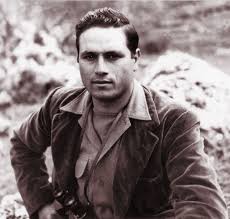
Salvatore Giuliano, often referred to as the last bandit of Sicily, is a figure who has captured the imagination of many through his complex and controversial life. Born on September 22, 1922, in Montelepre, a small town in the province of Palermo, Sicily, Giuliano’s life was marked by violence, rebellion, and a reputation that oscillated between that of a folk hero and a ruthless criminal. This article explores the life of Salvatore Giuliano, delving into his early years, rise to notoriety, and the circumstances that led to his ultimate demise.
Early Life and the Birth of a Bandit
Salvatore Giuliano was born into a family of modest means, with his parents working as peasants in the harsh Sicilian landscape. Raised with traditional values of faith and hard work, Giuliano’s early life was typical of many young men in rural Sicily at the time. However, his life took a dramatic turn on September 2, 1943, when a seemingly ordinary encounter with law enforcement set him on the path to becoming one of Italy’s most infamous outlaws.
On that fateful day, Giuliano was transporting two sacks of wheat, purchased on the black market, when he was stopped by a patrol of carabinieri (Italian military police). With World War II still raging, and Sicily under the strain of wartime shortages, contraband was common, but also heavily policed. Faced with arrest, Giuliano fled, but was shot at by the officers. In the ensuing gunfight, Giuliano fatally shot one of the carabinieri and managed to escape into the nearby woods. This incident marked the beginning of his life as a fugitive.
Severely wounded, Giuliano sought refuge in an abandoned house in Palermo, where he was cared for by sympathetic locals. During his convalescence, he was introduced to separatist ideologies by a local professor, Michele Purpura, who espoused the cause of Sicilian independence from Italy. This influence would later shape Giuliano’s political motivations, though his actions would soon be driven more by survival and power than by any coherent political ideology.
Rise to Notoriety: From Fugitive to Folk Hero
Upon recovering from his injuries, Giuliano returned to Montelepre, but his life as a free man was effectively over. The carabinieri were relentless in their pursuit, and Giuliano was forced to take refuge in the rugged mountains of western Sicily. It was here that he began to gather a group of fellow outlaws, forming a band that would carry out numerous robberies, kidnappings, and attacks on the authorities.
Despite his criminal activities, Giuliano quickly gained a reputation among the local population as a sort of Robin Hood figure. Sicily, long marginalized by the central Italian government and plagued by poverty and corruption, was fertile ground for a folk hero. Giuliano’s band distributed some of their ill-gotten gains to the poor, and his defiance of the authorities won him admiration in a region where resentment against the state was deeply ingrained.
By 1945, Giuliano’s notoriety had grown to such an extent that he was appointed a colonel in the separatist army of the Movimento Indipendentista Siciliano (MIS), a group that sought independence for Sicily. Although his involvement with the MIS was brief and largely symbolic, it added a political dimension to his already complex identity. Giuliano’s name became synonymous with the struggle for Sicilian autonomy, even as his actions increasingly blurred the line between political insurgent and criminal.
The Portella della Ginestra Massacre: A Turning Point
One of the most infamous episodes in Salvatore Giuliano’s life occurred on May 1, 1947, at Portella della Ginestra. On this day, a large group of peasants had gathered to celebrate May Day, the international day of workers, in the open countryside near Palermo. The event, organized by the local Communist Party, was intended as a peaceful celebration of labor rights and the recent electoral success of leftist parties in Sicily.
However, the celebration turned into a bloodbath when Giuliano and his band opened fire on the crowd, killing 11 people, including two children, and wounding 27 others. The Portella della Ginestra massacre shocked the nation and marked a turning point in Giuliano’s life. While the exact motives behind the attack remain unclear, it is widely believed that Giuliano was acting under the influence of powerful landowners, right-wing political forces, and possibly even the Mafia, all of whom had a vested interest in suppressing the rising tide of communism in Sicily.
The massacre triggered a massive crackdown on banditry in Sicily, with the Italian government deploying thousands of troops and police in an effort to capture Giuliano and dismantle his network. Despite the intense pressure, Giuliano managed to evade capture for several more years, continuing his life of crime while maintaining a complex web of alliances with various political and criminal elements.
The Fall of Salvatore Giuliano: Betrayal and Death
As the hunt for Salvatore Giuliano intensified, his situation became increasingly precarious. The post-war political landscape in Italy was shifting, and the forces that had once protected and used him as a tool against communism were now distancing themselves from the notorious bandit. The Mafia, which had initially supported Giuliano, began to view him as a liability, and rumors of betrayal grew.
On July 5, 1950, Salvatore Giuliano was found dead in the town of Castelvetrano, near Palermo. The official account stated that he was killed in a shootout with the carabinieri, led by Captain Antonio Perenze. However, many believe that Giuliano was betrayed by his cousin and right-hand man, Gaspare Pisciotta, who may have been acting on orders from higher powers within the Mafia or the state.
The circumstances surrounding Giuliano’s death have remained shrouded in mystery and controversy. Some have even suggested that the body found in Castelvetrano was not Giuliano’s, and that the bandit may have escaped to live out his days in hiding. While these theories are largely speculative, they reflect the enduring fascination with Giuliano’s life and the mythos that grew around him.
Gaspare Pisciotta, who was later arrested and imprisoned, made several statements implicating various figures in the Italian government and the Mafia in the events leading to Giuliano’s death and the Portella della Ginestra massacre. However, Pisciotta was poisoned in his prison cell in 1954 before he could testify fully, further fueling suspicions of a broader conspiracy.
Legacy: Hero or Villain?
Salvatore Giuliano’s life and death have left an indelible mark on the history and culture of Sicily. To some, he remains a folk hero—a symbol of resistance against a corrupt and oppressive state. His acts of defiance, his generosity to the poor, and his audacious escapes from the authorities have cemented his place in the popular imagination.
However, Giuliano’s legacy is also one of violence and ambiguity. The Portella della Ginestra massacre, in particular, casts a long shadow over his reputation, raising uncomfortable questions about his true motivations and the forces that shaped his actions. Was Giuliano a freedom fighter, a pawn of the Mafia, or simply a criminal who exploited the turbulent post-war period for his own gain? The answer likely lies somewhere in between, reflecting the complexities of a man who lived—and died—on the edge of society.
In the years following his death, Giuliano’s story has been the subject of numerous books, films, and songs, each offering a different perspective on his life. His name continues to evoke strong emotions in Sicily, where the memory of his exploits and the unresolved mysteries surrounding his life remain a part of the island’s cultural fabric.
Conclusion: Salvatore Giuliano – The Last Bandit of Sicily
Salvatore Giuliano’s life was a microcosm of the broader struggles and contradictions that defined Sicily in the mid-20th century. Born into poverty, he rose to become one of the most infamous figures in Italian history, straddling the line between hero and villain, rebel and criminal. His story is one of defiance, survival, and the search for identity in a world where the lines between right and wrong were often blurred.
As the last of the great Sicilian bandits, Giuliano’s legacy is a complex and multifaceted one. He embodied the spirit of rebellion that has long characterized Sicily, but his life also serves as a cautionary tale about the dangers of violence and the seductive allure of power. Whether remembered as a hero, a villain, or something in between, Salvatore Giuliano’s story is one that continues to captivate and challenge our understanding of justice, loyalty, and the human condition.


