
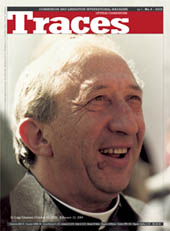
Luigi Giussani, a towering figure in the Catholic Church, is best known as the founder of the influential movement, Comunione e Liberazione (Communion and Liberation). His life and work have left an indelible mark on the religious, cultural, and intellectual landscape of Italy and beyond. This article provides an in-depth look at Giussani’s life, his rise to prominence, and the enduring legacy of his teachings.
Early Life and Background
Luigi Giovanni Giussani was born on October 15, 1922, in Desio, a small town in the Brianza area north of Milan. He grew up in a family that blended deep religious faith with intellectual curiosity. His mother, Angela Gelosa, was a devout Catholic, while his father, Beniamino Giussani, was a socialist with anarchist leanings, instilling in young Luigi a respect for both religious devotion and critical thinking. Beniamino was also an artisan, a skilled woodcarver, and a music enthusiast, which further enriched Luigi’s upbringing.
This unique combination of influences would shape Giussani’s approach to faith and life, making him a figure who could engage with the world’s complexities while remaining deeply rooted in his Christian beliefs. His early education began at the local elementary school in Desio, and in 1933, at the age of eleven, he entered the diocesan seminary of San Pietro Martire in Seveso. This step marked the beginning of his lifelong commitment to the priesthood and theological study.
Seminary Life and Theological Formation
Giussani’s years in the seminary were formative, not only in terms of his religious education but also in his exposure to the broader cultural and intellectual currents of the time. In 1937, he moved to the seminary in Venegono, where he completed his secondary education and began his theological studies in earnest. Here, he studied under renowned teachers like Gaetano Corti and Giovanni Colombo, who would later become the Archbishop of Milan.
During this period, Giussani developed a deep appreciation for literature, music, and the arts, recognizing their profound connection to the religious experience. The works of poets like Giacomo Leopardi and composers like Ludwig van Beethoven and Gaetano Donizetti were particularly influential, leading Giussani to view artistic genius as a form of divine prophecy. This belief would later become a central theme in his teachings, as he sought to show how human creativity could reflect the divine.
In 1943, after excelling in his studies, Giussani earned his baccalaureato in theology, a significant academic achievement. Two years later, on May 26, 1945, just after the end of World War II, he was ordained as a priest by Cardinal Ildefonso Schuster in the Milan Cathedral. This marked the beginning of his official ministry, although his impact would soon extend far beyond the confines of the church.
Early Ministry and Educational Work
Following his ordination, Giussani was persuaded by the rector of the Venegono seminary to remain and teach. He specialized in Eastern theology, developing a deep appreciation for the spirituality of the Orthodox Church and the theological contributions of the Slavophiles. His intellectual curiosity also led him to study American Protestantism, earning him a licentiate in theology.
However, Giussani’s passion for education and his desire to engage directly with the youth led him to leave the seminary in 1954 to teach in public schools. This move marked the beginning of what would become his lifelong mission: to reconnect the Christian faith with the lives of ordinary people, particularly young students. He founded a small group known as “The Fools of Christ,” inspired by Pauline theology, and began his work with Gioventù Studentesca (Student Youth), a movement that would eventually evolve into Comunione e Liberazione.
During his time teaching at the Berchet High School in Milan, from 1954 to 1967, Giussani focused on addressing the spiritual and existential questions of his students. He sought to provide them with a Christian worldview that could respond to the challenges of modern life, which was increasingly marked by secularization and social change. His work was not just about teaching doctrine but about fostering a lived experience of faith that could withstand the pressures of contemporary society.
The Birth of Comunione e Liberazione
The late 1960s and early 1970s were a period of significant social upheaval, particularly in Italy, where student movements and political unrest were reshaping the cultural landscape. In this context, Giussani’s approach to faith and education resonated with a growing number of students and laypeople. In 1969, the name Comunione e Liberazione (CL) first appeared on a manifesto created by students at the University of Milan. This marked the formal beginning of the movement, although its roots had been developing through Giussani’s earlier work with Gioventù Studentesca.
Comunione e Liberazione was founded on the idea that Christianity should be lived as a communal experience, one that liberates individuals by reconnecting them with the ultimate meaning of their lives. Giussani emphasized the importance of personal encounter with Christ, the role of community in supporting faith, and the need for Christians to engage with the world’s realities rather than retreat from them.
Under Giussani’s leadership, CL grew rapidly, attracting not only students but also adults from various walks of life. The movement’s appeal lay in its ability to address the deep spiritual and existential questions of its members while also providing a framework for social and political engagement. By the late 1970s, CL had become a significant presence in Italian society, influencing both the Church and the broader cultural and political discourse.
Theological Contributions and Publications
Giussani’s impact extended beyond his work with CL to his theological writings, which have been widely recognized for their depth and insight. In 1964, he was appointed as a professor of Introduction to Theology at the Catholic University of the Sacred Heart in Milan, a position he held until 1990. During this time, he published numerous articles and books that explored the relationship between faith, reason, and culture.
One of his most significant works is The Religious Sense (Il senso religioso), first published in 1986, which has been translated into multiple languages and is considered a cornerstone of his thought. In this book, Giussani argues that the human search for meaning is inherently religious, rooted in the natural desire to understand the purpose of life. He contends that Christianity offers the most compelling answer to this search, not as a set of abstract doctrines but as a lived experience of encounter with the divine.
Giussani’s writings also reflect his deep engagement with contemporary issues, including the challenges posed by modernity, secularization, and the crisis of meaning in the modern world. His approach is characterized by a willingness to engage with these challenges head-on, offering a Christian perspective that is intellectually rigorous yet accessible to a wide audience.
Recognition and Legacy
As Comunione e Liberazione continued to grow, it received official recognition from the Catholic Church. On February 11, 1982, the Pontifical Council for the Laity recognized the Fraternity of Communion and Liberation as a lay association of pontifical right. This recognition affirmed the movement’s role within the Church and its importance in the broader Catholic community.
In 1983, Giussani was appointed Monsignor by Pope John Paul II, with the title of Prelate of Honor of His Holiness. This was a significant honor, reflecting both his contributions to the Church and his personal relationship with the Pope. Giussani and John Paul II shared a deep respect for each other, and the Pope’s support was instrumental in the growth of CL.
Throughout the 1980s and 1990s, Giussani continued to write and teach, and his influence expanded internationally. His works were presented at significant venues, including the United Nations, where an English edition of The Religious Sense was introduced in 1997. His ideas continued to resonate with a broad audience, particularly those seeking a deeper understanding of the relationship between faith and modern life.
Final Years and Death
Luigi Giussani’s health began to decline in the late 1990s, but he remained active in his work until the very end. He continued to guide Comunione e Liberazione and contribute to theological discourse, even as his physical condition weakened. On February 22, 2005, at the age of 83, Giussani passed away in his home in Milan.
His death marked the end of an era, but his legacy lives on through the movement he founded and the many people he influenced. Giussani’s funeral was celebrated by Cardinal Joseph Ratzinger, who would later become Pope Benedict XVI, underscoring the deep respect and admiration he garnered within the Church.
Conclusion
Luigi Giussani was more than just a priest or a theologian; he was a visionary who sought to bridge the gap between faith and the modern world. His founding of Comunione e Liberazione provided a new way for Catholics to live out their faith in a rapidly changing society, and his theological contributions have had a lasting impact on the Church’s understanding of the relationship between faith and reason.
Giussani’s life and work continue to inspire millions of people around the world. His emphasis on the importance of personal encounter with Christ, the role of community in nurturing faith, and the need for Christians to engage with the world’s challenges remain as relevant today as they were during his lifetime. As the Church continues to navigate the complexities of the modern world, Giussani’s legacy offers a powerful reminder of the enduring power of faith to transform lives and societies.


