
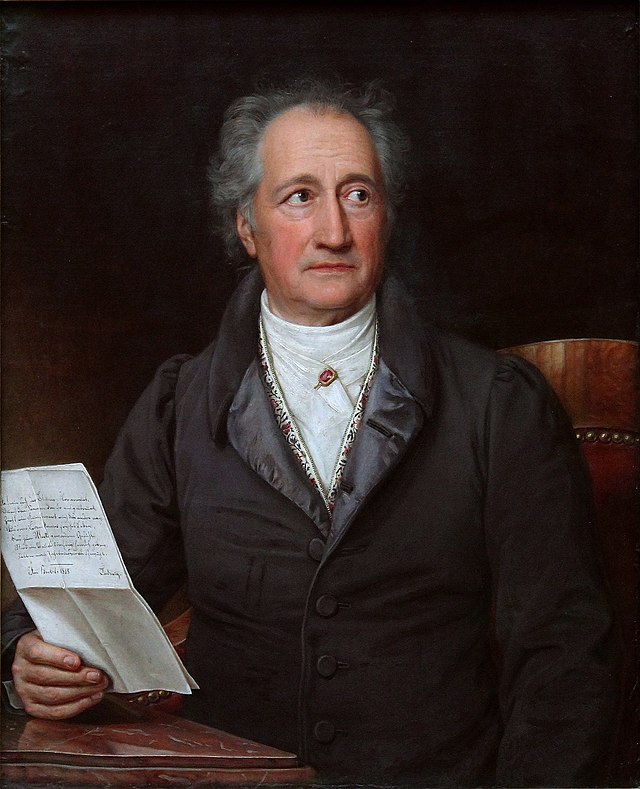
Johann Wolfgang von Goethe, born on August 28, 1749, in Frankfurt am Main, Germany, is one of the most influential literary figures in Western culture. Goethe’s contributions to literature, philosophy, and science have left an indelible mark on the world, and his works continue to be studied, admired, and celebrated. As a poet, playwright, novelist, and scientist, Goethe’s genius spanned a wide array of disciplines, making him a true Renaissance man of his time. This article delves into the life, fame, and key highlights of Johann Wolfgang von Goethe, exploring his profound influence on literature and culture.
Early Life and Education
Johann Wolfgang von Goethe was born into a well-to-do bourgeois family. His father, Johann Caspar Goethe, was an imperial counselor, and his mother, Katharina Elisabeth Textor, was the daughter of a prominent Frankfurt official. Goethe was a precocious child, showing an early interest in literature and the arts. Encouraged by his mother, who was known for her intelligence and creativity, Goethe began writing at a young age. He was particularly captivated by the puppet theater, where he first encountered the legend of Dr. Faustus, a story that would later inspire one of his greatest works.
At the age of 16, Goethe left Frankfurt to study law at the University of Leipzig, following his father’s wishes. However, his true passion lay in literature and the arts. During his time in Leipzig, Goethe immersed himself in the city’s vibrant intellectual and cultural life, studying not only law but also medicine, drawing, and poetry. His early literary work, characterized by an Anacreontic tone—a light, playful, and often libertine style—reflected the influence of the Enlightenment.
The Sturm und Drang Movement and Early Works
Goethe’s early experiences in Leipzig, coupled with a series of personal and emotional upheavals, including a failed romance with Kathchen Schönkopf, led to a period of intense creativity and self-reflection. After returning to Frankfurt in 1768, Goethe suffered a severe illness, which marked a turning point in his life. During his convalescence, he became deeply interested in alchemy, mysticism, and religious pietism, which influenced his later works.
In 1770, Goethe moved to Strasbourg to complete his law studies. It was here that he became acquainted with Johann Gottfried Herder, a philosopher and literary critic who introduced Goethe to the works of Shakespeare, Ossian, and the concept of the Volksgeist (national spirit). Herder’s ideas had a profound impact on Goethe, leading him to embrace the Sturm und Drang (Storm and Stress) movement, a literary and cultural movement that emphasized individualism, emotion, and the rejection of Enlightenment rationalism.
One of Goethe’s earliest and most influential works from this period is the drama Götz von Berlichingen (1773), a historical play that exemplifies the Sturm und Drang ethos. The play’s protagonist, Götz, is a rebellious knight who defies authority, embodying the movement’s ideals of personal freedom and resistance to tyranny. Götz von Berlichingen was a resounding success and established Goethe as a leading voice in German literature.
The Sorrows of Young Werther: Fame and Controversy
In 1771, Goethe began a legal internship in Wetzlar, where he met and fell in love with Charlotte Buff, the fiancée of one of his colleagues. This unrequited love inspired Goethe’s most famous work, The Sorrows of Young Werther (Die Leiden des jungen Werthers), published in 1774. The novel, written in the form of letters, tells the story of a young man, Werther, who falls hopelessly in love with a woman who is engaged to another man. Unable to cope with his despair, Werther eventually takes his own life.
The Sorrows of Young Werther was an immediate sensation across Europe. The novel’s exploration of intense emotion, individualism, and the conflict between personal desire and societal norms resonated deeply with readers. Werther became a cultural phenomenon, and young men across Europe emulated his style of dress and mannerisms. However, the novel also sparked controversy, with some critics accusing Goethe of glorifying suicide. Despite the controversy, The Sorrows of Young Werther solidified Goethe’s reputation as a literary genius and a leading figure of the Sturm und Drang movement.
Weimar and the Classical Period
In 1775, Goethe was invited to Weimar by Duke Karl August, who offered him a position as his advisor. Goethe accepted and moved to Weimar, where he would remain for the rest of his life. Weimar, under Goethe’s influence, became a cultural and intellectual hub, attracting artists, writers, and thinkers from across Europe.
During his early years in Weimar, Goethe’s work began to shift away from the emotional intensity of the Sturm und Drang movement towards a more classical style. This period, often referred to as Goethe’s Classical Period, was marked by a renewed interest in classical antiquity, harmony, and balance. Goethe’s friendship with Friedrich Schiller, another towering figure in German literature, was instrumental in this transition. Together, they sought to create a new form of literature that combined the emotional depth of the Sturm und Drang with the clarity and order of classical art.
One of the most significant works from this period is Goethe’s Iphigenia in Tauris (Iphigenie auf Tauris), a play that exemplifies his classical ideals. The play, based on Greek mythology, explores themes of justice, reconciliation, and the power of reason. Iphigenia in Tauris was well-received and further cemented Goethe’s status as one of the leading writers of his time.
Scientific Pursuits and the Italian Journey
In addition to his literary achievements, Goethe was also deeply interested in science. He conducted research in various fields, including botany, anatomy, and optics. Goethe’s scientific work is perhaps best known for his theory of colors, which he presented in his book Zur Farbenlehre (Theory of Colors) in 1810. In this work, Goethe challenged Isaac Newton’s theories on color, proposing that color is perceived through the interaction of light and darkness rather than being an inherent property of light. Although Goethe’s color theory was not widely accepted by the scientific community, it remains an important part of his intellectual legacy.
Goethe’s quest for artistic and intellectual fulfillment led him to undertake a journey to Italy in 1786. This journey, often referred to as his Italian Journey, was a transformative experience for Goethe. In Italy, he immersed himself in the art, culture, and landscape of the country, finding inspiration in the classical ruins and the works of the Renaissance masters. The Italian Journey had a profound impact on Goethe’s worldview, reinforcing his belief in the importance of classical ideals and the unity of nature and art.
The journey also reignited Goethe’s passion for poetry and led to the creation of some of his most beautiful and enduring works. His experiences in Italy are documented in his travelogue Italian Journey (Italienische Reise), which provides valuable insights into his artistic development and his thoughts on the relationship between art and nature.
The Collaboration with Schiller and Later Works
Upon his return to Weimar, Goethe entered into a deep and productive collaboration with Friedrich Schiller. The two writers, despite their differing temperaments and approaches to literature, shared a common goal of elevating German literature to new heights. Their collaboration resulted in some of the most significant works of the German classical period.
One of the most notable outcomes of their partnership was the publication of the Xenien, a collection of satirical epigrams that the two writers used to criticize the literary establishment and express their views on art and culture. The Xenien sparked controversy but also solidified the bond between Goethe and Schiller.
During this period, Goethe continued to work on his magnum opus, Faust, a play that would occupy him for most of his life. The first part of Faust was published in 1808, and the second part was completed shortly before Goethe’s death in 1832. Faust is considered one of the greatest works of world literature, exploring themes of ambition, desire, knowledge, and the human condition. The play’s central character, Faust, is a scholar who makes a pact with the devil, Mephistopheles, in his quest for ultimate knowledge and experience. The work is a profound meditation on the nature of good and evil, the limits of human understanding, and the pursuit of meaning in a complex and often contradictory world.
In addition to Faust, Goethe’s later works include Wilhelm Meister’s Apprenticeship (Wilhelm Meisters Lehrjahre), a novel that explores the development of the protagonist from a naive young man to a mature and enlightened individual. The novel is considered a precursor to the Bildungsroman genre, which focuses on the psychological and moral growth of the protagonist.
Final Years and Legacy
Goethe’s final years were marked by both personal and professional achievements. In 1809, he published Elective Affinities (Die Wahlverwandtschaften), a novel that explores the complexities of human relationships and the conflict between passion and societal expectations. The novel was controversial at the time but has since been recognized as one of Goethe’s most mature and psychologically insightful works.
Goethe also began writing his autobiography, Poetry and Truth (Dichtung und Wahrheit), which offers a detailed account of his life, his intellectual development, and his thoughts on art, literature, and society. The autobiography provides valuable insights into Goethe’s personality and his views on the role of the artist in society.
Goethe’s influence extended beyond literature and science. He was a statesman, serving as a member of the Duke of Weimar’s cabinet, where he was involved in various administrative and cultural initiatives. His contributions to the cultural life of Weimar helped transform the city into a center of European intellectual life.
Johann Wolfgang von Goethe passed away on March 22, 1832, in Weimar. His death marked the end of an era, but his legacy continues to resonate across the world. Goethe’s works have been translated into numerous languages and have inspired generations of writers, thinkers, and artists. His exploration of the human condition, his quest for knowledge, and his commitment to the unity of art and nature remain relevant and continue to speak to the complexities of modern life.
Conclusion
Johann Wolfgang von Goethe was more than just a writer; he was a towering intellectual figure whose influence transcends disciplines and eras. His works, from The Sorrows of Young Werther to Faust, have left an indelible mark on world literature, and his contributions to science, philosophy, and the arts have enriched human understanding in countless ways. Goethe’s life was a testament to the power of creativity, curiosity, and the relentless pursuit of truth.
As we reflect on the life and works of Goethe, it is clear that his legacy is not just a historical one. His ideas continue to challenge, inspire, and provoke, making him a timeless figure in the annals of human achievement. Johann Wolfgang von Goethe may have passed away nearly two centuries ago, but his spirit lives on in the enduring power of his words and the depth of his thought.


