
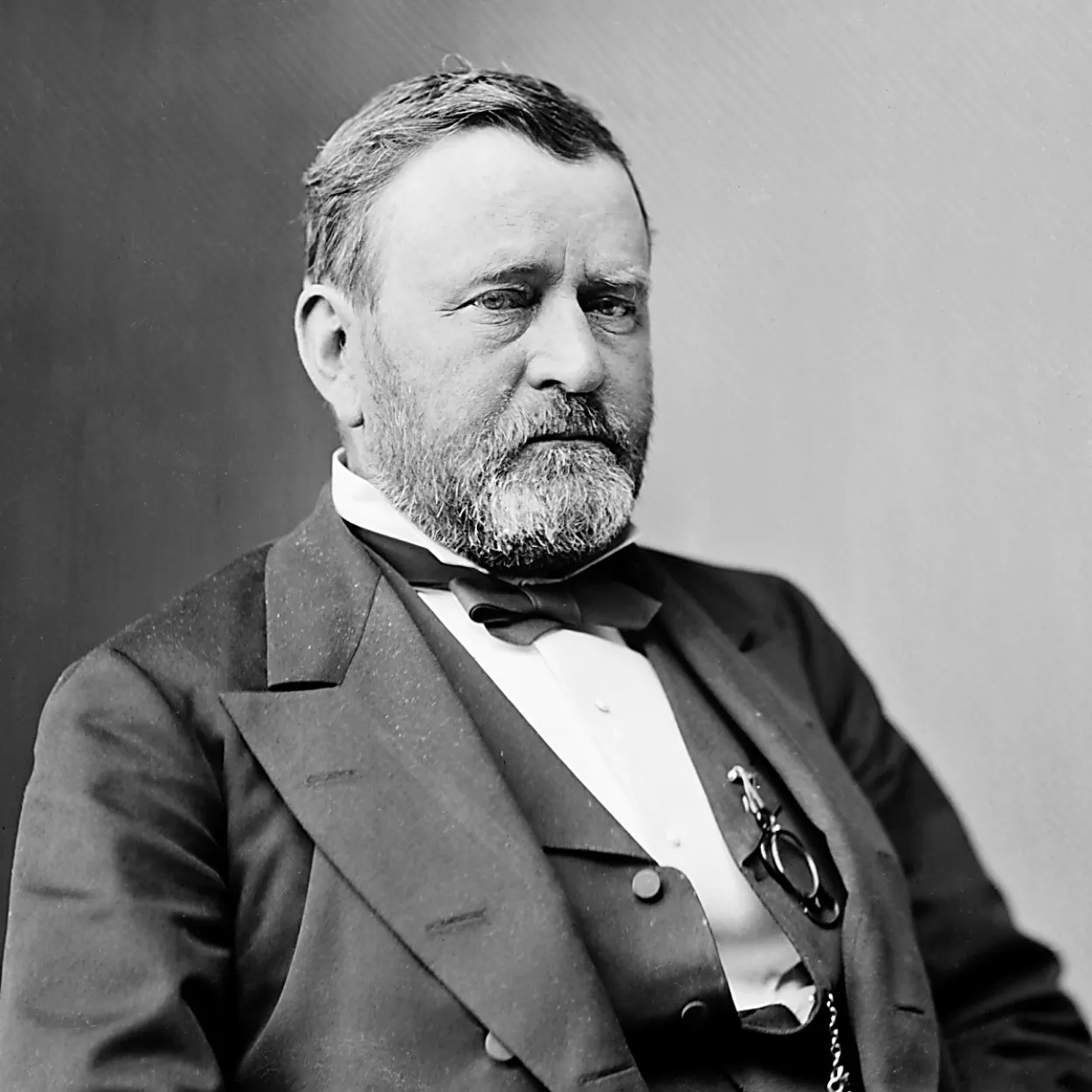
Ulysses S. Grant, born Hiram Ulysses Grant on April 27, 1822, in Point Pleasant, Ohio, is one of the most significant figures in American history. As a military leader during the Civil War and the 18th President of the United States, Grant’s life was marked by triumphs, challenges, and a steadfast commitment to the preservation of the Union. His journey from a modest upbringing to becoming a national hero and a president is a compelling narrative of resilience, leadership, and the complexities of power in a nation undergoing profound transformation.
Early Life and Military Beginnings
Ulysses S. Grant was born to Jesse Root Grant, a tanner, and Hannah Simpson Grant. Growing up in Georgetown, Ohio, young Grant led a life typical of rural America in the early 19th century. His father owned a tannery, and Grant was expected to work there, but he disliked the work and instead showed an early interest in horses, a passion that would stay with him throughout his life.
At the age of 17, through the support of a local congressman, Grant was appointed to the United States Military Academy at West Point. However, due to a clerical error, his name was recorded as Ulysses Simpson Grant, a name he would adopt for the rest of his life. Grant graduated from West Point in 1843, ranking in the middle of his class. Although he was not particularly distinguished academically, he was noted for his exceptional horsemanship—a skill that would later serve him well in battle.
Grant’s early military career began with service in the Mexican-American War (1846-1848), where he served under General Zachary Taylor. His experience in Mexico was formative, providing him with valuable combat experience and a deep understanding of military logistics and strategy. Grant’s actions during the war, including his bravery at the Battle of Monterrey and his role in the siege of Mexico City, earned him recognition and respect among his peers.
Marriage and Struggles After the War
After returning from the Mexican-American War, Grant married Julia Boggs Dent on August 22, 1848. Julia was the sister of one of Grant’s West Point classmates, and their marriage was a strong and enduring partnership, producing four children: Frederick, Ulysses Jr., Ellen, and Jesse. However, despite his growing family, Grant’s post-war life was marked by a series of personal and professional struggles.
Grant was stationed in various remote locations, including California and Oregon, far from his family, which exacerbated his loneliness. During this period, he struggled with alcohol, a problem that would shadow him throughout his life. Feeling isolated and dissatisfied with his military career, Grant resigned from the Army in 1854, returning to civilian life.
The years that followed were difficult. Grant tried his hand at several occupations, including farming, real estate, and working in his father’s leather goods store, but with limited success. By the time the Civil War broke out in 1861, Grant was struggling financially and was, by his own account, at a low point in his life. Yet, the war would provide Grant with the opportunity to redeem himself and ultimately reshape the course of American history.
Civil War Leadership and Rise to Prominence
The outbreak of the Civil War in 1861 marked a turning point in Grant’s life. He rejoined the Army, initially serving as a colonel of a volunteer regiment. His leadership abilities quickly became apparent, and he was soon promoted to brigadier general. Grant’s first major victory came at Fort Donelson in Tennessee in February 1862. When the Confederate commander requested terms of surrender, Grant famously replied, “No terms except unconditional and immediate surrender can be accepted.” This victory earned him national fame and the nickname “Unconditional Surrender” Grant.
Grant’s military career continued to ascend with a series of significant victories, including the Battle of Shiloh, the capture of Vicksburg, and the Battle of Chattanooga. His strategic acumen, determination, and ability to inspire his troops made him a vital asset to the Union cause. In 1864, President Abraham Lincoln appointed Grant as the commanding general of all Union armies, entrusting him with the task of defeating Confederate General Robert E. Lee.
Grant’s Overland Campaign in 1864, a series of brutal battles aimed at wearing down Lee’s forces, demonstrated his resolve and understanding of the war’s larger strategic goals. Despite heavy casualties, Grant pressed on, eventually cornering Lee’s army at Appomattox Court House, where Lee surrendered on April 9, 1865. This surrender effectively ended the Civil War, preserving the Union and ensuring Grant’s place as one of America’s greatest military leaders.
The Presidency: Challenges and Achievements
In 1868, Ulysses S. Grant was elected as the 18th President of the United States, succeeding Andrew Johnson. Grant’s presidency, which lasted from 1869 to 1877, was a period of significant change and challenge, as the nation grappled with the aftermath of the Civil War and the complex process of Reconstruction.
One of the most pressing issues during Grant’s presidency was the Reconstruction of the Southern states and the protection of the rights of newly freed African Americans. Grant was committed to ensuring that the Union’s victory translated into real progress for former slaves. He supported the passage of the 15th Amendment, which granted African American men the right to vote, and he used federal troops to enforce civil rights laws in the South, particularly against the violent actions of the Ku Klux Klan.
Grant’s administration also saw significant advancements in civil service reform and efforts to stabilize the national economy. The establishment of the Department of Justice and the creation of the first Civil Rights Act of 1875, which aimed to eliminate racial discrimination in public places, were notable achievements of his presidency. However, these accomplishments were often overshadowed by the widespread corruption that plagued his administration.
The scandals that emerged during Grant’s presidency, including the infamous Whiskey Ring and the Crédit Mobilier scandal, damaged his reputation. While Grant himself was not personally implicated, his loyalty to friends and political allies who were involved in corruption cases led to widespread criticism. This period of his presidency is often cited as one of the most challenging aspects of his legacy.
Post-Presidency: Travels, Writing, and Financial Hardships
After leaving the White House in 1877, Grant embarked on a two-year world tour with his family, during which he visited Europe, Asia, and Africa. The tour was an opportunity for Grant to reflect on his legacy and for the world to honor his contributions to American history. He was received with great respect and admiration wherever he went, reaffirming his status as a global figure.
Upon returning to the United States, Grant’s post-presidential years were marked by financial difficulties. In 1884, he was swindled out of his savings by a business partner, leaving him nearly destitute. Facing financial ruin, Grant turned to writing to provide for his family. Encouraged by his friend Mark Twain, Grant began working on his memoirs.
Despite suffering from terminal throat cancer, Grant dedicated himself to completing his memoirs, “Personal Memoirs of Ulysses S. Grant.” The two-volume work, published posthumously in 1885, is widely regarded as one of the greatest military memoirs ever written. Grant’s writing was praised for its clarity, honesty, and insights into the Civil War and his own experiences. The memoirs were a financial success, providing much-needed support for his family after his death.
Legacy and Historical Significance
Ulysses S. Grant died on July 23, 1885, in Wilton, New York, at the age of 63. His death was widely mourned across the nation, and he was honored as a national hero. Grant’s tomb, located in New York City’s Riverside Park, remains a testament to his enduring legacy.
Grant’s life and legacy are complex and multifaceted. As a military leader, he is celebrated for his tenacity, strategic brilliance, and commitment to the Union cause. His leadership during the Civil War was instrumental in the defeat of the Confederacy and the preservation of the United States.
As a president, Grant’s record is more controversial. While he made significant strides in civil rights and national unity during Reconstruction, his administration was marred by corruption and scandal. However, in recent years, historians have begun to reassess Grant’s presidency, recognizing his achievements in civil rights and his efforts to rebuild the nation after the Civil War.
Grant’s personal qualities—his humility, perseverance, and dedication to his country—have also been subjects of admiration. Despite his flaws and the challenges he faced, both personally and politically, Grant’s contributions to American history are undeniable. He remains a symbol of the resilience and determination that characterized the United States during one of its most turbulent periods.
Historical Context and the Evolution of American Leadership
To fully understand Ulysses S. Grant’s impact, it is essential to place him within the broader context of 19th-century American history. The period following the Civil War, known as the Reconstruction Era, was a time of significant upheaval and transformation. The United States faced the daunting task of reunifying a nation torn apart by war and addressing the profound social and economic disparities that the conflict had exposed.
Grant’s leadership during this time was crucial. His commitment to civil rights and his efforts to suppress the Ku Klux Klan were pivotal in the struggle to protect the freedoms of newly emancipated African Americans. However, the challenges of Reconstruction were immense, and the backlash against these efforts in the South led to a long and painful struggle for racial equality that would continue well into the 20th century.
Moreover, Grant’s presidency occurred during a time of rapid industrialization and economic change in the United States. The Gilded Age, as this period is often called, was marked by both incredible economic growth and stark social inequalities. Grant’s administration grappled with these issues, though his efforts were often overshadowed by the corruption that permeated American politics during this era.
Conclusion
Ulysses S. Grant’s life is a story of resilience, leadership, and the enduring struggle to define and protect American ideals. From his humble beginnings in Ohio to his rise as a military hero and his complex legacy as president, Grant’s journey reflects the challenges and contradictions of a nation in transition. His contributions to the Union’s victory in the Civil War and his efforts to promote civil rights during Reconstruction are lasting legacies that continue to shape the United States.
Grant’s personal qualities—his perseverance in the face of adversity, his humility despite great power, and his unwavering commitment to his country—make him a figure of enduring significance in American history. As historians continue to reevaluate his presidency and his impact on the nation, Grant’s story serves as a reminder of the complexities of leadership and the ongoing quest to fulfill the promise of American democracy.


