
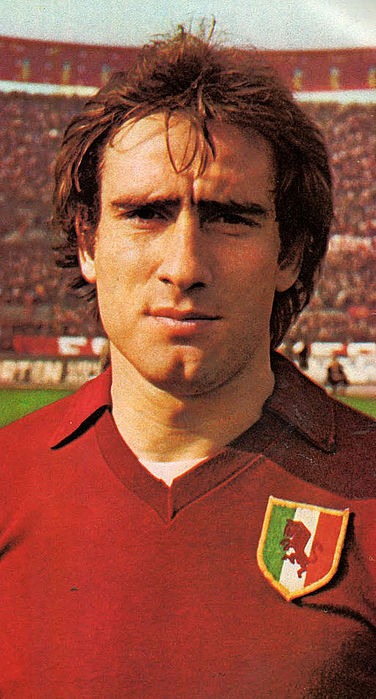
Francesco “Ciccio” Graziani is a name that resonates deeply within the annals of Italian football history. Born on December 16, 1952, in Subiaco, near Rome, Graziani’s journey from a small-town boy to one of Italy’s most celebrated footballers is a tale of talent, determination, and sheer passion for the game. As a prolific striker and a key figure in Italy’s national team during the 1970s and 1980s, Graziani’s career is marked by numerous achievements, both at the club and international levels.
Early Life and Beginnings in Football
Francesco Graziani’s love for football began at a young age. Growing up in Subiaco, he was exposed to the sport through local clubs and quickly demonstrated a natural aptitude for the game. His early career saw him playing for Arezzo, where his potential as a striker began to shine. His performances at Arezzo caught the attention of larger clubs, and in 1973, he made a significant move to Torino, one of Italy’s top football clubs.
This transfer marked the beginning of Graziani’s rise to fame. At Torino, Graziani quickly established himself as a key player, known for his powerful strikes, aerial ability, and relentless work rate. Over eight seasons with the club, Graziani made 289 appearances, scoring numerous goals and earning a reputation as one of Italy’s most reliable forwards.
The Glory Years at Torino
Graziani’s time at Torino is often regarded as the pinnacle of his club career. It was here that he formed one of the most iconic strike partnerships in Italian football history with Paolo Pulici. Together, they were dubbed “Gemelli del Gol” (The Goal Twins) by the Italian media, a testament to their prolific scoring abilities and telepathic understanding on the pitch.
The 1975-1976 season was particularly memorable for Graziani and Torino. The club secured the Serie A title, breaking a 27-year drought and re-establishing themselves as a dominant force in Italian football. Graziani played a crucial role in this success, with his goals and leadership on the field driving Torino to glory. The following season, he continued his exceptional form, finishing as the top scorer in Serie A with 21 goals. This achievement solidified his status as one of the best strikers in Europe at the time.
National Team Success and World Cup Glory
While Graziani was achieving great success at the club level, his performances also earned him a regular spot in the Italian national team. He made his international debut in 1975 and quickly became a mainstay in the squad. Graziani’s physical presence, goal-scoring ability, and versatility made him a valuable asset for the national team, and he was selected to represent Italy in the 1978 FIFA World Cup in Argentina.
Although Italy did not win the tournament, Graziani’s performances were commendable, and he played a key role in helping the team reach the semi-finals. However, it was in the 1982 FIFA World Cup in Spain that Graziani achieved his greatest international success. As part of the squad led by coach Enzo Bearzot, Graziani was instrumental in Italy’s journey to their third World Cup title.
The 1982 World Cup is often remembered for Italy’s remarkable turnaround after a slow start in the tournament. Graziani, along with teammates such as Paolo Rossi and Dino Zoff, played a vital role in Italy’s resurgence, culminating in a 3-1 victory over West Germany in the final. Graziani’s contributions throughout the tournament were significant, and he remains celebrated as one of the heroes of Italy’s 1982 World Cup-winning team.
Later Club Career and Move to Fiorentina and Roma
After his successful spell at Torino, Graziani moved to Fiorentina in 1981. His time at Fiorentina, although shorter than his tenure at Torino, was marked by solid performances and a continuation of his goal-scoring prowess. Graziani’s experience and leadership were invaluable to the team, and he continued to be a key figure in Italian football.
In 1983, Graziani made another significant move, this time to AS Roma. At Roma, Graziani added more silverware to his collection, winning the Coppa Italia twice (in 1983-1984 and 1985-1986). Perhaps one of the most dramatic moments of his career came in 1984 when Roma reached the final of the European Cup (now UEFA Champions League). In a match against Liverpool that went to penalties, Graziani was one of the players who missed his spot-kick, resulting in Roma’s heartbreaking loss. Despite this setback, Graziani’s contributions to Roma during his time there were significant, and he remained a beloved figure among the fans.
Transition to Coaching and Life After Football
After retiring from professional football, Graziani transitioned into coaching and football management. His post-playing career was marked by various roles, including a stint as the president of Arezzo, where he successfully guided the club out of financial difficulties and back into Serie C. Graziani also took on coaching roles, most notably leading Fiorentina to the final of the UEFA Cup in the 1989-1990 season, although they were ultimately defeated by Juventus.
Graziani’s coaching career also saw him managing several other clubs, including Reggina, Avellino, and Catania. His time at Catania was particularly notable, as he, along with Maurizio Pellegrino, led the team to promotion to Serie B in the 2001-2002 season. Graziani’s managerial career, however, was characterized by mixed results, and he eventually moved away from coaching to pursue other interests.
Media Presence and Reality TV
In the mid-2000s, Francesco Graziani became a familiar face on Italian television, participating in various reality shows and football-related programs. One of his most notable ventures was his involvement in the reality show “Campioni,” which aired on Italia 1. In this show, Graziani served as the head coach of the amateur football team Cervia, guiding them to promotion from the Eccellenza Romagna league to Serie D. The show was a hit with viewers and further cemented Graziani’s status as a popular and respected figure in Italian football.
Graziani also appeared on the reality show “Circus” in 2006 and became a regular guest on the sports program “Controcampo.” His affable personality and deep knowledge of the game made him a favorite among audiences, and he continues to be a sought-after commentator and pundit for various sports media outlets in Italy.
Legacy and Influence on Italian Football
Francesco Graziani’s impact on Italian football is undeniable. As a player, he was known for his physicality, goal-scoring ability, and leadership on the field. His partnership with Paolo Pulici at Torino remains one of the most iconic in Serie A history, and their combined efforts during the 1975-1976 season are still fondly remembered by Torino fans.
Graziani’s contributions to the Italian national team, particularly his role in the 1982 World Cup victory, have earned him a place among the legends of Italian football. His name is often mentioned alongside other greats of the game, and his achievements continue to inspire future generations of footballers.
Off the field, Graziani’s foray into coaching and his work in football management demonstrate his deep commitment to the sport. Although his coaching career had its ups and downs, Graziani’s passion for football remained evident throughout his various roles. His involvement in media and reality television further showcased his versatility and ability to connect with fans beyond the pitch.
Historical Context and the Evolution of Italian Football
To fully appreciate Francesco Graziani’s career, it’s essential to consider the broader context of Italian football during his playing years. The 1970s and 1980s were transformative decades for Italian football, characterized by a growing emphasis on tactical discipline, physical fitness, and defensive solidity. Graziani’s style of play, which combined technical skill with physical strength, was well-suited to the demands of this era.
During these years, Italian football clubs began to gain prominence on the European stage, with teams like AC Milan, Juventus, and AS Roma achieving success in international competitions. The 1982 World Cup victory was a defining moment for Italian football, symbolizing the nation’s return to the pinnacle of world football after years of underachievement. Graziani’s role in this triumph highlights his importance in the broader narrative of Italian football history.
Furthermore, Graziani’s career coincided with a period of significant changes in football, including the increasing commercialization of the sport, the rise of player power, and the evolution of football tactics. As a player and later as a coach, Graziani navigated these changes with adaptability and resilience, maintaining his relevance in a rapidly evolving football landscape.
Conclusion
Francesco Graziani’s journey from a small town in Italy to the heights of international football is a story of perseverance, talent, and passion. His achievements on the field, including his key role in Italy’s 1982 World Cup victory and his successful stints with Torino, Fiorentina, and Roma, have earned him a lasting legacy in the sport. Beyond his playing career, Graziani’s contributions as a coach, football manager, and media personality have further solidified his place as one of Italy’s most beloved football figures.
In reflecting on Graziani’s life and career, it’s clear that he embodies the spirit of Italian football—passionate, determined, and always striving for excellence. His story serves as an inspiration to aspiring footballers and a reminder of the impact that one individual can have on the beautiful game.


