
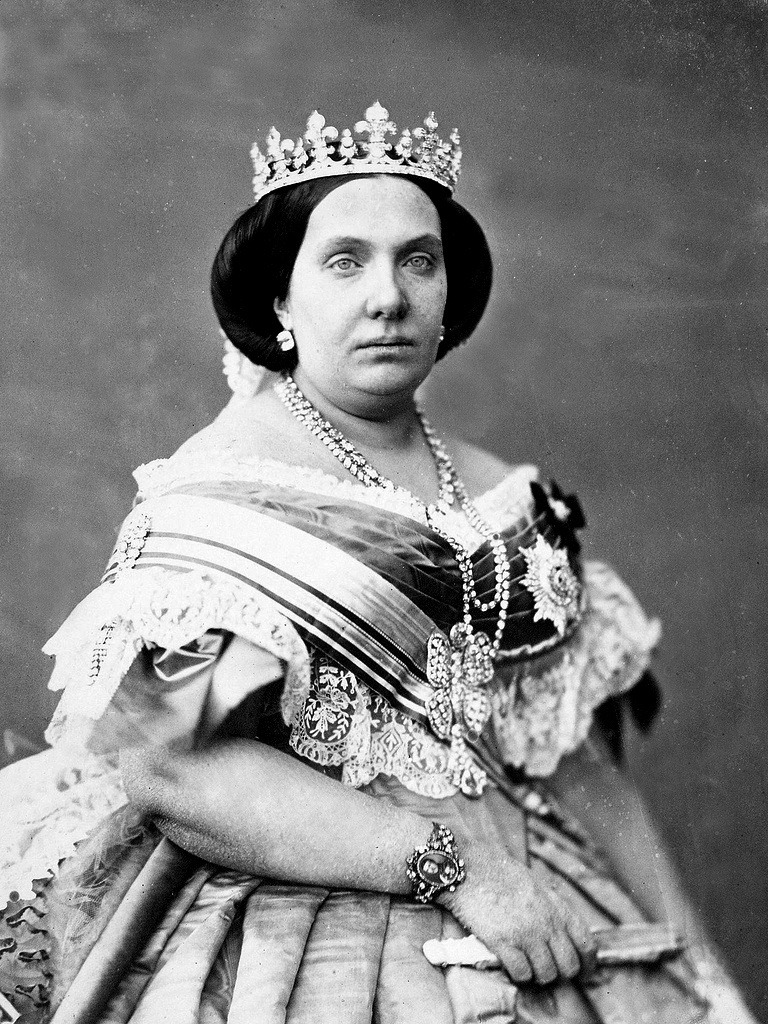
Isabella II of Spain, born on October 10, 1830, in Madrid, was the first and only queen regnant of Spain to hold the throne in her own right. Her reign, which began in 1833 and lasted until 1868, was marked by political instability, internal strife, and significant changes in the Spanish monarchy. As one of the most significant female rulers in Spanish history, Isabella’s life was shaped by power struggles, personal challenges, and the shifting tides of European politics.
Early Life and Ascension to the Throne
Isabella was born into the House of Bourbon, a dynasty that had been ruling Spain since the early 18th century. Her father, King Ferdinand VII, had married four times in his quest to produce a male heir, but it was his fourth wife, Maria Cristina of the Two Sicilies, who gave birth to Isabella. Despite being a female, Isabella’s path to the throne was secured by the Pragmatic Sanction of 1830, which her father issued to ensure his daughters could inherit the throne by overturning the Salic law, which barred women from succession.
When Ferdinand VII died in 1833, the three-year-old Isabella was proclaimed queen. However, due to her young age, her mother, Maria Cristina, acted as regent. The regency of Maria Cristina was immediately contested by Ferdinand’s brother, Don Carlos, who saw himself as the rightful heir under the traditional Salic law. This dispute led to the First Carlist War, a brutal civil conflict that pitted the supporters of Isabella (known as the “Isabelinos”) against the Carlists, who were loyal to Don Carlos.
The First Carlist War and Early Challenges
The First Carlist War (1833-1839) was one of the early significant challenges to Isabella’s reign. It was a conflict rooted in the broader ideological struggle between liberalism and conservatism that was sweeping across Europe during this period. The Carlists, who were conservative and traditionalist, supported the old order of absolute monarchy and the Catholic Church’s dominance. In contrast, the Isabelinos were generally more liberal, advocating for constitutional monarchy and reforms that would modernize Spain.
The war was brutal and divided the country deeply. It ended in 1839 with the victory of the Isabelinos, but the conflict left lasting scars on Spanish society and set the stage for further unrest during Isabella’s reign.
The Regency and Power Struggles
Following the end of the First Carlist War, Isabella’s mother continued to act as regent. However, her regency was marked by political turmoil, with various factions vying for control of the government. Maria Cristina’s inability to stabilize the situation led to her eventual downfall. In 1840, the liberal General Baldomero Espartero, who had gained significant influence due to his role in the Carlist War, forced Maria Cristina to abdicate the regency and go into exile.
Espartero then assumed the role of regent, but his tenure was also short-lived. His authoritarian rule and his failure to address Spain’s economic problems led to widespread discontent. In 1843, at the age of just 13, Isabella was declared of age by the Spanish Cortes, effectively ending Espartero’s regency and allowing Isabella to take the throne as queen in her own right.
The Reign of Isabella II: A Turbulent Monarchy
Isabella II’s reign was marked by political instability, with a series of short-lived governments and frequent changes in leadership. The period from 1843 to 1868 saw numerous uprisings, military coups, and power struggles between different factions within the Spanish government. Isabella, though intelligent and well-meaning, struggled to navigate the complex political landscape of Spain.
One of the key challenges of her reign was the ongoing tension between liberals and conservatives. Isabella often found herself caught between these two factions, with her government oscillating between liberal reforms and conservative reaction. This instability was exacerbated by the continued influence of military leaders, who frequently intervened in politics through coups and rebellions.
The Marriage and Personal Struggles
In 1846, in an effort to secure her position and produce an heir, Isabella was married to her cousin, Francisco de Asís de Borbón. The marriage, however, was unhappy and reportedly unconsummated. Francisco was widely rumored to be homosexual, and the couple’s relationship was strained from the outset. Despite these difficulties, Isabella and Francisco had several children, though their relationship remained distant.
The arranged marriage was not just a personal matter but a political one as well. It was designed to strengthen the Bourbon dynasty and secure the throne. However, the lack of genuine affection between Isabella and Francisco led to rumors and scandals that further undermined her reign.
Political Instability and the Liberal Revolt
Isabella’s reign continued to be plagued by political instability. In 1854, a military coup led by General Leopoldo O’Donnell forced her to accept a more liberal government. This period, known as the “Bienio Progresista,” was marked by significant reforms, including the disestablishment of certain church properties and the expansion of the electoral franchise.
However, the liberal government’s reforms did not go far enough for some and went too far for others, leading to continued unrest. The economic crisis of the 1860s further exacerbated these tensions. The government struggled to manage the country’s finances, leading to inflation, unemployment, and widespread poverty. These conditions fueled discontent among the population and eroded support for the monarchy.
The Glorious Revolution and Exile
The political and economic turmoil of the 1860s culminated in the Glorious Revolution of 1868. A coalition of liberals, republicans, and disgruntled military officers, led by General Juan Prim and Admiral Juan Bautista Topete, rose against Isabella II. The revolution was swift and decisive; Isabella was forced to flee to France, where she lived in exile.
In France, Isabella formally abdicated the throne in 1870 in favor of her son, Alfonso XII. However, Spain itself did not immediately settle into a stable monarchy. After Isabella’s abdication, the country went through a brief period of experimentation with a democratic monarchy under King Amadeo I and then a republic, before the restoration of the Bourbon monarchy in 1874 under Alfonso XII.
Later Life and Legacy
Isabella spent the rest of her life in France, separated from her husband and largely removed from Spanish politics. Her later years were marked by reflection and a quieter existence, far from the tumultuous events that had defined her reign. She maintained contact with her son, Alfonso XII, who eventually restored the Bourbon monarchy in Spain, but she played no direct role in Spanish affairs after her abdication.
Isabella II died on April 9, 1904, in Paris at the age of 73. Her death marked the end of an era in Spanish history, one that had been fraught with conflict, change, and the challenges of navigating a monarchy in a time of rapid social and political evolution.
Historical Context and Nuances of Isabella II’s Reign
Isabella II’s reign must be understood within the broader context of 19th-century European history, a period marked by the rise of nationalism, the struggle between liberalism and conservatism, and the decline of absolute monarchies. Spain, like many other European nations, was grappling with these issues, and Isabella’s reign was deeply affected by the ideological battles of the time.
The First Carlist War was not just a dynastic struggle but a clash of visions for Spain’s future. The Carlists represented the old order—absolute monarchy, the dominance of the Catholic Church, and traditional social hierarchies. The Isabelinos, on the other hand, were more inclined toward constitutionalism, reform, and modernization. The war and its aftermath left deep divisions in Spanish society, divisions that would resurface throughout Isabella’s reign and beyond.
Isabella herself was a product of her time, a queen who inherited a throne in a period of profound change and instability. Her attempts to balance the competing demands of liberal and conservative factions, as well as her struggles with personal and dynastic challenges, reflect the broader difficulties faced by monarchs in 19th-century Europe.
Conclusion: The Legacy of Isabella II di Spagna
Isabella II of Spain remains a controversial figure in Spanish history. Her reign was marked by turbulence, and she was ultimately unable to maintain the stability of her throne. Yet, her legacy is complex. She was the first woman to rule Spain in her own right, and her reign witnessed significant social and political changes, even if those changes were often forced upon her rather than initiated by her.
Isabella’s abdication and the subsequent restoration of the Bourbon monarchy under her son, Alfonso XII, helped to pave the way for a more stable and modern Spain, although the country would continue to face significant challenges well into the 20th century. Her life and reign offer valuable insights into the struggles of monarchy during a time of profound change, and her story remains a key chapter in the history of Spain.


