
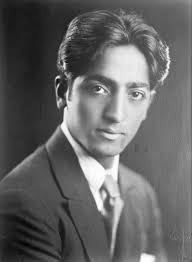
Jiddu Krishnamurti, born on May 11, 1895, in Madanapalle, India, was one of the most influential spiritual thinkers and philosophers of the 20th century. His teachings, which emphasized the importance of individual transformation and the rejection of organized religion and authority, have inspired millions of people around the world. Krishnamurti’s life journey from a young boy in India to an internationally recognized speaker and author is a testament to his profound impact on spiritual and philosophical thought.
Early Life and Theosophical Beginnings
Jiddu Krishnamurti was born into a Brahmin family in the small town of Madanapalle, located in what is now the state of Andhra Pradesh, India. His father, Narianiah, was a clerk in the British colonial administration, and his mother, Sanjeevamma, passed away when he was just ten years old. This loss deeply affected Krishnamurti and his siblings, as they were left in a precarious financial situation.
In 1909, Krishnamurti’s life took a dramatic turn when he was discovered by Charles Webster Leadbeater, a prominent member of the Theosophical Society. Leadbeater believed that Krishnamurti was the chosen vehicle for the coming “World Teacher,” a messianic figure who would bring spiritual enlightenment to the world. This belief was supported by Annie Besant, the president of the Theosophical Society, who became Krishnamurti’s legal guardian.
Under the care of the Theosophical Society, Krishnamurti was groomed for his future role as the World Teacher. He was educated in England and traveled extensively, meeting influential figures and delivering speeches to large audiences. The Society established the Order of the Star in the East in 1911, with Krishnamurti as its head, to prepare the world for his teachings.
A Personal and Philosophical Awakening
Despite the grand expectations placed upon him, Krishnamurti began to question the role that had been assigned to him. In 1922, he experienced a profound spiritual awakening in Ojai, California, which led to a deep personal transformation. This experience, which he later described as a “process” of inner clarity, marked a turning point in his life. He realized that truth could not be organized or institutionalized, and that the pursuit of spiritual enlightenment was a deeply personal journey.
In 1929, at the age of 34, Krishnamurti made a bold and unprecedented decision to dissolve the Order of the Star in the East. In a landmark speech, he declared that he had no allegiance to any religion, sect, or political party, and that his only concern was the liberation of the human mind. This act of renunciation shocked the Theosophical Society and the broader spiritual community, but it also marked the beginning of Krishnamurti’s independent teachings.
Krishnamurti’s teachings emphasized the importance of self-inquiry, meditation, and the rejection of all forms of authority, including his own. He believed that true spiritual freedom could only be attained through direct personal experience and that the adherence to any organized belief system was inherently limiting.
Global Influence and Intellectual Legacy
Following his break from the Theosophical Society, Krishnamurti embarked on a lifelong journey of teaching and lecturing around the world. For over six decades, he traveled extensively, speaking to audiences in Europe, Asia, and the Americas. His talks covered a wide range of topics, including the nature of the self, the pitfalls of organized religion, the role of education, and the importance of psychological freedom.
One of Krishnamurti’s key teachings was the idea that true understanding comes from observing oneself without judgment or preconceived notions. He encouraged his listeners to engage in deep self-reflection and to question their own beliefs, fears, and desires. This process of self-observation, he believed, was the foundation of inner transformation and the key to living a life free from conflict and suffering.
Krishnamurti also emphasized the interconnectedness of all human beings and the need for compassion and understanding in addressing the world’s problems. He argued that societal change could only come about through individual change and that each person had a responsibility to cultivate inner peace and awareness.
Throughout his life, Krishnamurti engaged with some of the most prominent intellectuals and thinkers of his time. In 1938, he met Aldous Huxley, the renowned author of Brave New World, who became a close friend and admirer of Krishnamurti’s work. Huxley once described Krishnamurti as “one of the greatest minds of the age,” and the two engaged in numerous discussions on topics ranging from consciousness to the future of humanity.
In the 1960s, Krishnamurti also met with the Dalai Lama, the spiritual leader of Tibetan Buddhism, and B.K.S. Iyengar, a pioneer of modern yoga. These encounters further solidified Krishnamurti’s reputation as a bridge between Eastern and Western philosophies. His dialogues with David Bohm, a prominent physicist and friend of Albert Einstein, were particularly significant. Bohm found parallels between Krishnamurti’s teachings and his own work in quantum physics, leading to a series of discussions that explored the relationship between science and spirituality.
Rejection of Authority and the Role of Education
A central theme in Krishnamurti’s teachings was the rejection of all forms of authority, whether religious, political, or psychological. He believed that the reliance on external authorities prevented individuals from discovering truth for themselves. This perspective extended to his views on education, which he saw as a crucial area for fostering independent thought and self-awareness.
Krishnamurti was deeply critical of conventional education systems, which he believed focused too much on rote learning and conformity. He advocated for an educational approach that emphasized the development of the whole person—intellectually, emotionally, and spiritually. In his view, true education should encourage students to question, explore, and understand the world around them, rather than merely absorbing information.
To put his ideas into practice, Krishnamurti established several schools around the world, including the Brockwood Park School in England, the Rishi Valley School in India, and the Oak Grove School in California. These schools were founded on the principles of holistic education, where the focus was on nurturing curiosity, creativity, and self-discovery in students. Krishnamurti remained actively involved in these institutions throughout his life, often visiting and engaging in dialogues with students and teachers.
Later Years and Continued Impact
Krishnamurti continued his work well into his later years, delivering lectures and writing books that have since become spiritual classics. His books, such as The First and Last Freedom, Freedom from the Known, and The Awakening of Intelligence, have been translated into numerous languages and continue to be widely read and studied.
In 1984, just two years before his death, Krishnamurti gave a series of talks at the Los Alamos National Laboratory in New Mexico, where he engaged with scientists on the nature of the mind and the role of consciousness in understanding reality. These discussions highlighted Krishnamurti’s enduring curiosity and his willingness to explore the intersections between spirituality and science.
Krishnamurti passed away on February 17, 1986, in Ojai, California, at the age of 90. His death marked the end of an era, but his teachings continue to resonate with people around the world. The schools he founded remain active, and his books, lectures, and recorded talks are still widely studied by those seeking to understand the complexities of the human mind and the nature of existence.
Legacy and Enduring Relevance
Jiddu Krishnamurti’s legacy is one of profound spiritual inquiry and an unwavering commitment to the pursuit of truth. His teachings challenge individuals to look beyond the surface of their beliefs and to question the very foundations of their thinking. In a world often divided by dogma and ideology, Krishnamurti’s emphasis on self-awareness and personal responsibility remains as relevant today as it was during his lifetime.
Krishnamurti’s rejection of organized religion and authority set him apart from many other spiritual leaders of his time. He was not interested in creating followers or establishing a new belief system; instead, he encouraged people to think for themselves and to discover truth through their own experiences. This approach has made his teachings accessible to people from all walks of life, regardless of their religious or philosophical backgrounds.
Today, Krishnamurti’s influence can be seen in various fields, from education and psychology to science and spirituality. His ideas continue to inspire educators, psychologists, philosophers, and seekers of truth around the world. The annual gatherings at Saanen, Switzerland, where Krishnamurti once gave talks, continue to draw people interested in exploring his teachings and their implications for modern life.
In the end, Jiddu Krishnamurti’s life was a testament to the power of individual inquiry and the importance of living a life of integrity and authenticity. His teachings invite us to embark on a journey of self-discovery, free from the constraints of authority and dogma, and to explore the limitless potential of the human mind.


