
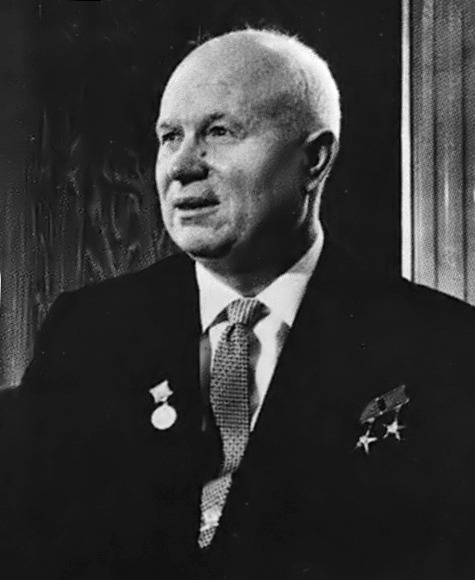
Nikita Sergeevich Khrushchev, born on April 15, 1894, in Kalinovka, Russia, stands as a monumental figure in 20th-century politics. His life, marked by dramatic shifts in the Soviet Union’s political landscape, offers profound insights into the complexities of Soviet governance and international diplomacy. This exploration delves into Khrushchev’s rise to power, his notable achievements, and the eventual decline that led to his retirement.
Early Life and Rise to Power
Nikita Khrushchev was born into a peasant family in the Kursk region of Imperial Russia. His early years were marked by hardship, and he received only a minimal formal education before starting work in various factories and mines. His involvement in labor unions during this period was crucial, as it laid the groundwork for his future political career.
In 1908, Khrushchev’s family moved to Yuzovka (now Donetsk), where he began working as a pipe fitter. His early work experiences, combined with his involvement in labor movements, positioned him as a significant figure in the burgeoning Soviet political landscape. Following the Russian Revolution of 1917, Khrushchev joined the Red Army and soon became a political commissar, a role that marked the beginning of his rise within the Communist Party.
Political Career and Stalin Era
Khrushchev’s political ascent began with administrative roles in the Donbass region and Kiev, culminating in his appointment as the head of the Moscow City Committee (Gorkom) in 1934. His strategic political maneuvering, supported by allies such as Lazar Kaganovich, helped him secure influential positions within the Communist Party. By the late 1930s, Khrushchev had become the first secretary of the Ukrainian Communist Party, positioning him as a central figure in Soviet politics.
During World War II, Khrushchev played a pivotal role as a political officer in the Soviet military. His tenure was marked by significant disagreements with Stalin, particularly regarding military strategies during the German invasion. These conflicts highlighted his growing divergence from Stalin’s policies.
After Stalin’s death in 1953, Khrushchev emerged as a key figure in the power struggle that followed. Initially overshadowed by figures like Lavrentiy Beria, Khrushchev eventually secured his position as the leader of the Communist Party with the support of Nikolai Bulganin and other key figures. His famous “Secret Speech” in 1956, delivered at the 20th Congress of the Communist Party, denounced Stalin’s crimes and the cult of personality surrounding him, marking a significant shift in Soviet policy.
Khrushchev’s Leadership and Major Policies
In 1958, Khrushchev became the Chairman of the Council of Ministers, effectively consolidating his power. His leadership style and policies had a profound impact on both domestic and international affairs. One of his most notable achievements was the 1959 “kitchen debate” with U.S. Vice President Richard Nixon, which symbolized the ideological clash between the Soviet Union’s planned economy and American capitalism. This debate, held in the context of the American National Exhibition in Moscow, highlighted Khrushchev’s confrontational and assertive foreign policy stance.
Domestically, Khrushchev initiated several significant reforms, including the Virgin Lands Campaign aimed at increasing agricultural production. However, his policies were met with mixed results, and his tenure saw both progress and setbacks. His decision to back the construction of the Berlin Wall in 1961, while intended to stem the tide of emigration from East to West Germany, was viewed as a contradiction to his previously promoted policies of openness and engagement with the West.
The Decline and Fall
Khrushchev’s tenure faced increasing challenges, particularly during the Cuban Missile Crisis of 1962. His handling of the crisis, marked by intense negotiations with U.S. President John F. Kennedy, was controversial and contributed to his declining popularity within the Communist Party. His foreign policy, particularly the handling of the Cuban Missile Crisis, was heavily criticized, leading to his eventual downfall.
In October 1964, Khrushchev was removed from power in a coup orchestrated by key figures within the Communist Party, including Leonid Brezhnev and the KGB chief Vladimir Semichastny. The reasons for his ousting included dissatisfaction with his economic policies and his increasingly erratic behavior. Following his removal, Khrushchev retired to a modest life in Moscow, where he lived until his death on September 11, 1971, from a heart attack. He was buried in the Novodevichy Cemetery, rather than the Kremlin, reflecting the fall from grace he experienced in his final years.
Legacy and Historical Context
Nikita Khrushchev’s legacy is complex and multifaceted. His tenure is often remembered for its dramatic shifts in Soviet policy and his role in the Cold War’s intense confrontations. His efforts to denounce Stalinist practices and initiate reforms in the Soviet Union’s governance marked a significant, though contentious, period in Soviet history.
Khrushchev’s approach to international diplomacy, including his interactions with Western leaders and his role in critical Cold War events, had lasting implications for global geopolitics. His policies and leadership style reflected a transitional phase in Soviet history, characterized by a mix of reformist zeal and rigid ideological commitment.
In summary, Nikita Khrushchev’s life and career offer a window into a transformative era of Soviet history. From his early struggles to his rise as a key Soviet leader, Khrushchev’s legacy is a testament to the tumultuous and often contradictory nature of Soviet politics during the mid-20th century. His impact on both domestic policies and international relations continues to be a subject of study and debate, illustrating the enduring significance of his role in shaping the course of Soviet and global history.


