
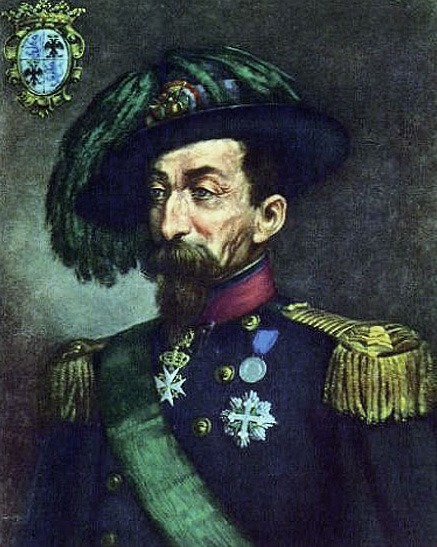
Alessandro La Marmora is a name that resonates with heroism, innovation, and military prowess in Italian history. Born on March 27, 1799, in Turin, Italy, La Marmora emerged as a significant military figure whose legacy is eternally linked with the creation of the Bersaglieri, a highly mobile and elite light infantry unit of the Italian Army. His contributions to military strategy and his life, marked by service and sacrifice, have left an indelible mark on the history of Italy.
Early Life and Military Beginnings
Alessandro La Marmora was born into a prominent aristocratic family in Turin, the capital of the Kingdom of Sardinia. His father, Celestino Ferrero della Marmora, was a marquis and a captain, and his mother, Raffaella Argentero di Rasezio, also hailed from nobility. Alessandro was the eighth of sixteen children, although three of his siblings died in infancy. His upbringing in a military family naturally led him towards a career in the armed forces, following in the footsteps of his father and his brothers, all of whom would distinguish themselves in various military roles.
From a young age, Alessandro demonstrated a keen interest in both the sciences and military arts. His education and training prepared him well for a career that would demand both intellectual rigor and physical endurance. He was particularly influenced by his observations of the French, Austrian, and Prussian armies, which he studied closely. These early experiences exposed him to the strengths and weaknesses of European military tactics, and he became acutely aware of the need for reform within the Italian military.
Founding the Bersaglieri: A Military Revolution
One of La Marmora’s most significant contributions to military history is the creation of the Bersaglieri, a corps that would become synonymous with agility, precision, and elite status within the Italian Army. Before the establishment of the Bersaglieri, La Marmora was disillusioned with the state of the infantry in the Kingdom of Sardinia. He observed that soldiers were poorly trained, lacked marksmanship skills, and were more concerned with the appearance of their uniforms than with combat readiness. His dissatisfaction with the status quo spurred him to propose a radical overhaul of the infantry.
La Marmora envisioned a unit that would be different from the traditional, rigid infantry formations. He believed that the mountainous and varied terrain of Italy required soldiers who were not only excellent marksmen but also physically fit and capable of rapid movement. This led him to conceptualize a new type of soldier — one who could move quickly, strike with precision, and adapt to the challenging environments of the battlefield.
In 1835, La Marmora submitted a detailed proposal to King Carlo Alberto of Sardinia, outlining his vision for a light infantry corps. His proposal was met with skepticism from many military officials who were accustomed to the traditional methods of warfare. However, King Carlo Alberto recognized the potential of La Marmora’s ideas and gave his approval. On June 18, 1836, the Bersaglieri were officially established, with Alessandro La Marmora appointed as their commander.
The Bersaglieri were trained rigorously in marksmanship, physical endurance, and tactical movement. They were equipped with lighter, more maneuverable firearms designed by La Marmora himself, which allowed for greater accuracy and ease of use in the field. This new corps quickly proved its effectiveness, demonstrating its value in various military engagements.
The Bersaglieri’s Baptism of Fire: The Battle of Goito
The Bersaglieri’s first major test came during the First Italian War of Independence against the Austrian Empire. On April 8, 1848, at the Battle of Goito, the Bersaglieri were deployed in combat for the first time. Their performance in this battle was nothing short of extraordinary. The Bersaglieri’s speed, agility, and innovative tactics caught the Austrians off guard, leading to a decisive victory for the Kingdom of Sardinia.
During the battle, Alessandro La Marmora was severely wounded in the jaw, but his determination and leadership never wavered. He refused medical treatment until the fighting was over, a testament to his dedication and courage. The victory at Goito cemented the Bersaglieri’s reputation as an elite fighting force, and they quickly became a symbol of Italian resilience and bravery.
The Battle of Goito was a turning point in Italian military history, showcasing the effectiveness of La Marmora’s reforms and the potential of the Bersaglieri as a new model of infantry. Their success not only boosted the morale of the Sardinian forces but also inspired other military leaders to rethink their strategies and adopt similar reforms.
Military Career and Strategic Innovations
Following the success at Goito, Alessandro La Marmora continued to rise through the military ranks. In 1849, he was appointed Chief of Staff of the Sardinian Army, a position that allowed him to further influence the development of military strategy in Italy. La Marmora’s approach to warfare was characterized by a focus on mobility, adaptability, and the importance of individual soldier skills — principles that would later become fundamental in modern military doctrine.
La Marmora’s leadership was not limited to the battlefield. He was also a forward-thinking strategist who understood the importance of logistics, training, and morale in maintaining an effective military force. He introduced several innovations, including improved training programs for officers and enlisted men, the development of new weapons and equipment, and the establishment of better supply chains to support the troops in the field.
His contributions to military strategy extended beyond the Kingdom of Sardinia. La Marmora was well-respected among his European peers, and his ideas influenced military reforms in other nations. His emphasis on rapid movement and flexible tactics anticipated the modern concept of mobile warfare, which would become a key element in military strategy during the 20th century.
The Crimean War: Service and Sacrifice
In 1854, La Marmora’s career took another significant turn when he was called to serve in the Crimean War. The Kingdom of Sardinia, under the leadership of Prime Minister Camillo Benso di Cavour, had allied with Britain and France against the Russian Empire. This alliance was part of a broader strategy to gain international support for Italian unification.
Alessandro La Marmora, now a general, was tasked with leading the Sardinian contingent, which included 18,000 men and five battalions of Bersaglieri. The deployment to Crimea was a challenging and dangerous mission, as the troops had to contend not only with the enemy but also with harsh weather conditions, inadequate supplies, and the constant threat of disease.
The Sardinian forces played a crucial role in the Siege of Sevastopol, one of the most important battles of the Crimean War. However, the campaign was marred by the outbreak of cholera, a deadly disease that claimed more lives than the fighting itself. Tragically, Alessandro La Marmora was among the victims. He contracted cholera and died on the night of June 6-7, 1855, in Kadikoy, near Balaklava, at the age of 56.
La Marmora’s death was a profound loss for the Italian military and for the cause of Italian unification. His leadership, vision, and innovations had a lasting impact on the Sardinian Army and set the stage for the eventual unification of Italy. The Bersaglieri, the corps he created, continued to serve with distinction in subsequent conflicts, including the wars of Italian unification.
Legacy and Historical Significance
Alessandro La Marmora’s legacy is one of courage, innovation, and dedication to his country. The Bersaglieri, the corps he founded, remains one of the most iconic units of the Italian Army, known for their distinctive plumed hats and their tradition of running, rather than marching, during parades — a symbol of their agility and readiness for battle.
La Marmora’s contributions to military strategy and his emphasis on the importance of training, mobility, and adaptability have influenced generations of military leaders. His ideas foreshadowed many aspects of modern military doctrine, particularly the focus on rapid deployment and the use of elite, highly trained units in warfare.
In addition to his military achievements, La Marmora is remembered as a patriot who dedicated his life to the service of his country. His role in the Crimean War, though cut short by his untimely death, demonstrated his commitment to the broader goals of Italian unification and his willingness to make the ultimate sacrifice for the cause.
Conclusion: The Enduring Legacy of Alessandro La Marmora
Alessandro La Marmora’s life and career are a testament to the power of innovation, leadership, and dedication in shaping the course of history. His creation of the Bersaglieri revolutionized military tactics in Italy and set a new standard for light infantry units around the world. His strategic insights and reforms laid the groundwork for modern military doctrine, and his legacy continues to inspire military leaders today.
La Marmora’s story is also one of personal courage and sacrifice. His willingness to challenge the status quo, his commitment to improving the effectiveness of the military, and his ultimate sacrifice in the service of his country make him a hero not only in Italy but in the annals of military history.
As Italy celebrates its rich history and the contributions of its many heroes, Alessandro La Marmora stands out as a figure of enduring significance. His legacy lives on in the Bersaglieri, in the principles of military strategy he championed, and in the ongoing quest for innovation and excellence in the armed forces.


