
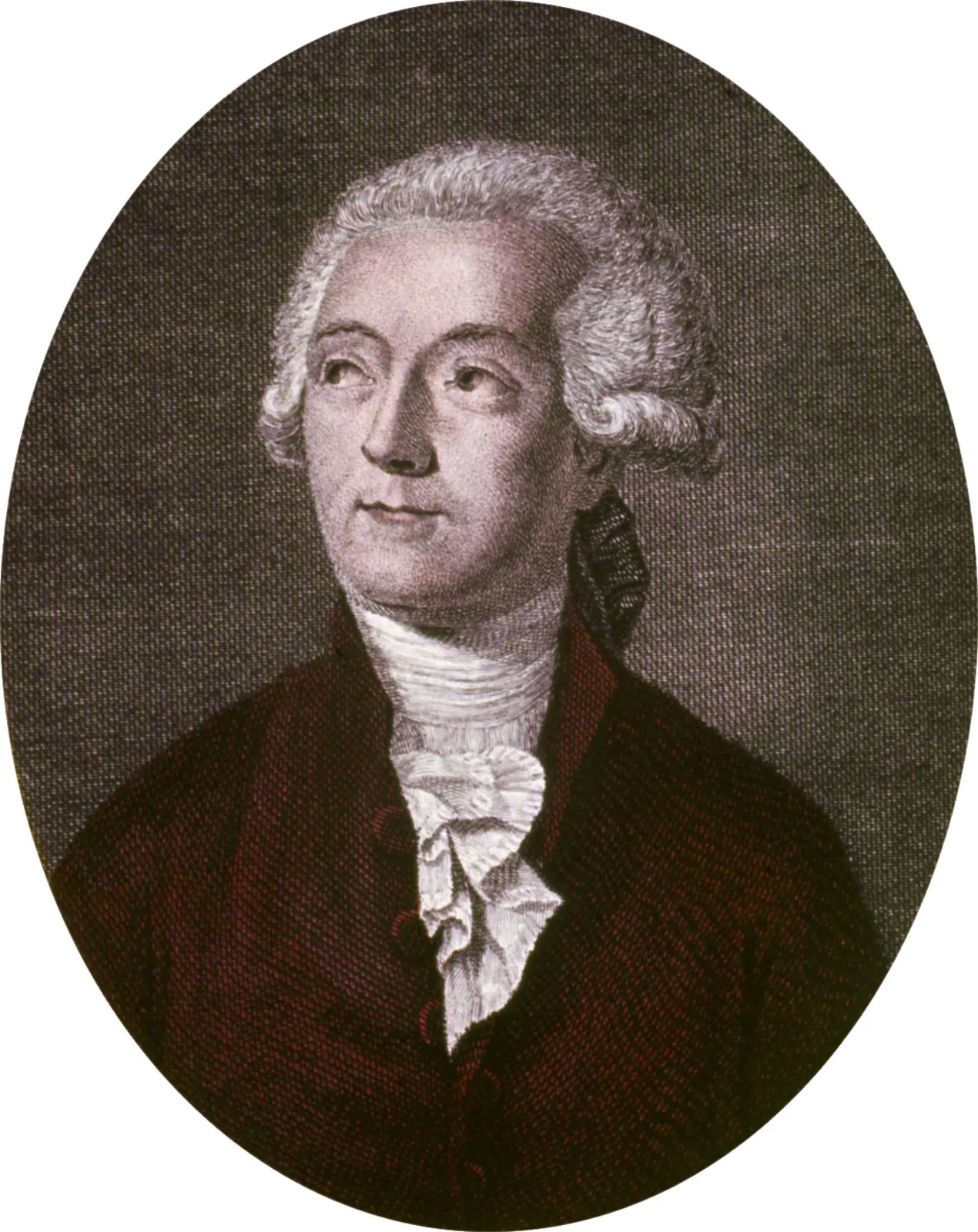
Antoine-Laurent de Lavoisier, born on August 26, 1743, in Paris, France, is widely regarded as the “Father of Modern Chemistry.” His groundbreaking contributions to the field of chemistry laid the foundation for many scientific principles that are still in use today. Lavoisier’s work in understanding the nature of combustion, the role of oxygen in respiration, and the conservation of mass has made him a towering figure in the history of science. His life, marked by intellectual brilliance and tragic demise during the French Revolution, offers a compelling narrative of scientific discovery and political turmoil.
Early Life and Education
Antoine Lavoisier was born into an affluent family, which afforded him the opportunity to pursue an excellent education. After his mother’s death, Lavoisier inherited significant wealth, which allowed him to attend the prestigious Collège Mazarin in Paris from 1754 to 1761. There, he studied a broad range of subjects, including chemistry, botany, astronomy, and mathematics. Lavoisier’s education was deeply influenced by the Enlightenment, a period that emphasized reason, scientific inquiry, and the rejection of traditional dogma. His studies were further enriched by his association with Étienne Bonnot de Condillac, a prominent philosopher of the time, with whom he shared many intellectual pursuits.
Early Scientific Work and Career
Lavoisier’s early scientific endeavors were marked by a strong desire to apply theoretical knowledge to practical problems. In 1767, he was appointed to supervise a geological survey in Alsace-Lorraine, a task that provided him with valuable hands-on experience in the natural sciences. This practical engagement with science was a hallmark of Lavoisier’s approach, as he believed in the importance of empirical evidence and experimentation.
By 1768, Lavoisier’s reputation had grown sufficiently to earn him a place in the French Academy of Sciences, one of the most prestigious scientific institutions in Europe. His admission to the Academy was partly due to his work on street lighting, but it was his later contributions to chemistry that would cement his legacy.
Marriage and Collaborative Work
In 1771, Lavoisier married Marie-Anne Pierrette Paulze, who was just 13 years old at the time. Despite the age difference, their marriage proved to be a true partnership. Marie-Anne, who had received an education that was rare for women of her time, became not only Lavoisier’s wife but also his collaborator. She played a crucial role in his scientific work by translating English scientific texts, illustrating his experiments, and promoting his ideas within the scientific community. Her support was instrumental in the dissemination of Lavoisier’s theories and in securing his place in the annals of science.
The Discovery of Oxygen and the Overthrow of Phlogiston Theory
One of Lavoisier’s most significant contributions to chemistry was his role in the discovery of oxygen and the subsequent debunking of the phlogiston theory. The phlogiston theory, which had dominated scientific thought for nearly a century, posited that a fire-like element called phlogiston was released during combustion. Lavoisier, through meticulous experimentation, demonstrated that combustion was not the release of phlogiston but rather the combination of a substance with oxygen, a gas that he identified and named.
In collaboration with Pierre-Simon Laplace, Lavoisier conducted experiments that showed oxygen’s role in combustion and respiration, fundamentally altering the understanding of these processes. He also demonstrated that water was not a simple element, as previously thought, but a compound of hydrogen and oxygen. These discoveries were pivotal in the development of modern chemistry, leading to the abandonment of the phlogiston theory and the establishment of the oxygen theory of combustion.
The Conservation of Mass and Chemical Nomenclature
Another cornerstone of Lavoisier’s legacy is his formulation of the Law of Conservation of Mass, which states that mass is neither created nor destroyed in a chemical reaction. This principle was revolutionary, providing a quantitative framework for chemical reactions and laying the groundwork for the development of stoichiometry. Lavoisier’s insistence on precise measurement and careful experimentation helped transform chemistry from a qualitative to a quantitative science.
Lavoisier also made significant contributions to chemical nomenclature, working alongside chemists like Claude Louis Berthollet, Antoine François Fourcroy, and Guyton de Morveau. Together, they developed a systematic method for naming chemical substances based on their composition and properties. This new nomenclature was published in the seminal work Méthode de nomenclature chimique (Method of Chemical Nomenclature) in 1787, and it provided a standardized language for chemistry that is still in use today. This system not only facilitated communication among scientists but also helped clarify the relationships between different chemical substances.
The Publication of “Traité Élémentaire de Chimie”
In 1789, Lavoisier published Traité Élémentaire de Chimie (Elementary Treatise on Chemistry), a comprehensive work that is often regarded as the first modern chemistry textbook. In this treatise, Lavoisier outlined the principles of chemical reactions, introduced the concept of elements as the fundamental building blocks of matter, and explained the role of oxygen in combustion, respiration, and acid formation. The Traité also included a detailed description of Lavoisier’s experiments and the apparatus he used, emphasizing the importance of experimental evidence in scientific inquiry.
The Traité Élémentaire de Chimie was groundbreaking not only for its content but also for its clarity and accessibility. It quickly became the standard reference for chemists across Europe and played a crucial role in the education of future generations of scientists. The treatise also helped establish chemistry as a distinct scientific discipline, separate from alchemy and natural philosophy.
Lavoisier’s Involvement in Politics and the French Revolution
While Lavoisier is best known for his contributions to science, he was also deeply involved in the politics of his time. In addition to his scientific work, Lavoisier served as a tax collector for the French government, a role that made him a target during the French Revolution. As a member of the Ferme Générale, a private agency responsible for collecting taxes on behalf of the king, Lavoisier became associated with the ancien régime and its unpopular fiscal policies.
Lavoisier’s political activities extended beyond tax collection. He was a member of several government committees, where he applied his scientific expertise to issues such as public health, agriculture, and the improvement of gunpowder. Despite his contributions to the nation, Lavoisier’s association with the Ferme Générale and his perceived loyalty to the monarchy ultimately led to his downfall.
The Tragic End: Execution and Legacy
The French Revolution, which began in 1789, brought about profound social and political changes in France. As the revolution became more radical, those associated with the old regime, including Lavoisier, were increasingly viewed with suspicion. In 1793, the Ferme Générale was dissolved, and its members were arrested. Lavoisier was tried by the Revolutionary Tribunal, and despite his immense contributions to science and the nation, he was found guilty of treason.
On May 8, 1794, Antoine Lavoisier was executed by guillotine in Paris. His death was a significant loss to the scientific community, and many of his contemporaries mourned his passing. The mathematician Joseph-Louis Lagrange famously remarked, “It took them only an instant to cut off that head, but France may not produce another like it in a century.”
Lavoisier’s execution marked a tragic end to a brilliant career, but his scientific achievements have endured. His work laid the foundation for the modern understanding of chemistry, and his contributions to the scientific method continue to influence research and education today.
The Enduring Impact of Antoine Lavoisier
Antoine Lavoisier’s legacy is not confined to his discoveries in chemistry; it also extends to his approach to scientific inquiry. Lavoisier was a strong advocate for the importance of empirical evidence and precise measurement, principles that remain central to the scientific method. His work helped to transform chemistry from a speculative art into a rigorous science, setting the stage for the advancements that would follow in the 19th and 20th centuries.
In addition to his scientific achievements, Lavoisier’s life story serves as a reminder of the complex relationship between science and society. His involvement in politics and his ultimate fate during the French Revolution illustrate the challenges that scientists can face when their work intersects with broader social and political forces.
Today, Antoine Lavoisier is remembered as one of the greatest scientists of all time. His contributions to chemistry are celebrated in textbooks, and his name is honored through various awards and institutions. The International Union of Pure and Applied Chemistry (IUPAC) recognizes Lavoisier’s contributions to chemical nomenclature, and his name is enshrined in the periodic table of elements.
In conclusion, Antoine Lavoisier’s life and work exemplify the power of scientific inquiry to transform our understanding of the natural world. His discoveries have had a lasting impact on the field of chemistry and have paved the way for countless innovations. As we reflect on Lavoisier’s legacy, we are reminded of the enduring importance of curiosity, experimentation, and the pursuit of knowledge in the face of adversity.


