
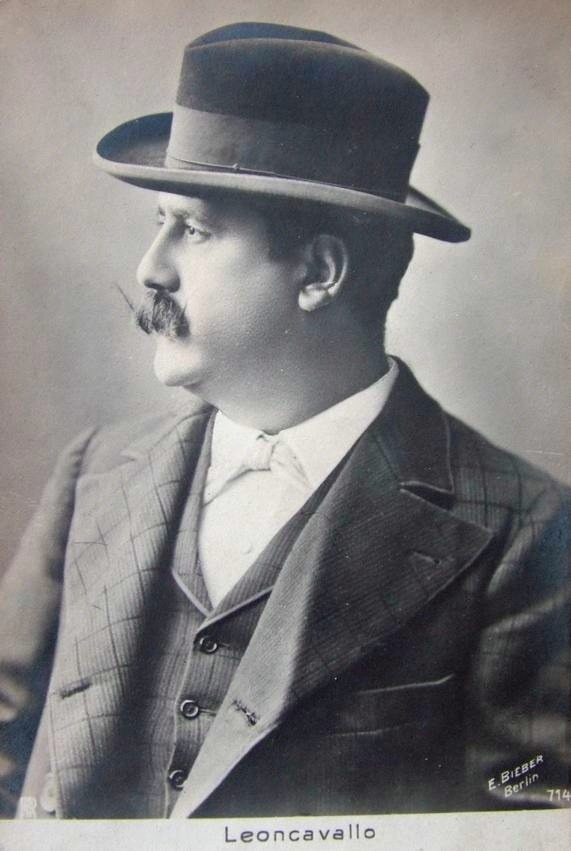
Ruggero Leoncavallo, born on April 23, 1857, in Naples, Italy, is one of the most distinguished composers of the verismo opera movement, most famous for his work Pagliacci. His life, marked by both extraordinary success and considerable challenges, provides a compelling narrative of talent, ambition, and the changing tides of musical taste. This article will delve into the life and achievements of Ruggero Leoncavallo, exploring his early influences, rise to fame, significant works, and legacy.
Early Life and Education
Leoncavallo was born into a well-to-do family in the Chiaia neighborhood of Naples. His father, Vincenzo, was a magistrate, and the family frequently moved due to his father’s professional obligations. One of these relocations, to the region of Calabria, would have a profound impact on young Ruggero. It was here that he witnessed a dramatic and violent love affair that ended in murder—a real-life event that would later inspire his most famous opera, Pagliacci.
Ruggero’s early exposure to music came from his family; he began learning the piano as a child. His love for music deepened during his teenage years when he studied at the Naples Conservatory, one of Italy’s most prestigious music schools. Despite his family’s wishes for him to follow a more traditional career path, Ruggero was determined to pursue a life in music. He completed his formal musical education at the Conservatory, likely around 1876, although he often claimed to have graduated earlier.
The Influence of Richard Wagner and Giosuè Carducci
After completing his studies, Leoncavallo was deeply influenced by the music of Richard Wagner, whose works he encountered at the Bayreuth Festival in 1876. Wagner’s use of leitmotifs and his ambition to create a “total work of art” would leave a lasting impression on Leoncavallo. He dreamed of composing operas that could capture the same grandeur and emotional depth as Wagner’s.
Leoncavallo also attended lectures by the poet and scholar Giosuè Carducci at the University of Bologna, further shaping his literary and artistic sensibilities. Although Leoncavallo never completed a university degree, Carducci’s teachings on the power of narrative and the importance of national identity resonated with him, influencing the thematic elements of his later works.
Early Career Struggles and Life in Egypt
Despite his ambitions, Leoncavallo’s early career was fraught with difficulties. After a brief stint back in Potenza to avoid military conscription, Leoncavallo moved to Egypt in 1879, where his uncle Giuseppe had settled after fleeing Italy for political reasons. In Egypt, Ruggero worked as a pianist and music teacher within the Italian expatriate community, but the political climate became increasingly hostile to Westerners, forcing him to leave in 1882.
Leoncavallo then moved to Paris, where he continued to struggle financially but remained connected to the musical world. During his time in Paris, he met and married Berhte Rambaud, one of his piano students. His time in the French capital also brought him into contact with prominent composers like Charles Gounod and Jules Massenet, and the famous baritone Victor Maurel, who had worked closely with Giuseppe Verdi. These connections would later prove valuable when Leoncavallo returned to Italy.
Return to Italy and the Creation of Pagliacci
In 1888, Leoncavallo returned to Italy, settling in Milan, where he began working on a new operatic project, I Medici, a grand opera that he hoped would emulate the successes of Wagner’s works. However, I Medici failed to gain the attention Leoncavallo had anticipated, despite the support of the publisher Giulio Ricordi and the influence of Victor Maurel.
Leoncavallo’s fortunes changed dramatically after the success of Pietro Mascagni’s Cavalleria Rusticana in 1890, which had popularized the verismo style—a form of opera that focused on the everyday lives and emotions of ordinary people, often in rural settings. Inspired by this success, Leoncavallo decided to write an opera based on the real-life murder he had witnessed as a child in Calabria. Within five months, he completed Pagliacci.
Pagliacci premiered at the Teatro Dal Verme in Milan on May 21, 1892, under the direction of the great conductor Arturo Toscanini. The opera was an immediate success, praised for its raw emotion and compelling narrative. The character of Canio, the tragic clown, became an iconic figure in opera, and his aria “Vesti la giubba” is still one of the most famous and frequently performed pieces in the operatic repertoire.
International Success and the Struggles of a Composer
Following the success of Pagliacci, Leoncavallo became a celebrated figure in the international music scene. The opera was performed extensively across Europe and the Americas, including major cities like London, Paris, New York, Buenos Aires, and Moscow. The number of performances of Pagliacci surpassed even the most popular works of his contemporaries, including Giacomo Puccini.
However, despite the overwhelming success of Pagliacci, Leoncavallo struggled to replicate this achievement with his subsequent works. I Medici, which was revived in the wake of Pagliacci’s success, failed to capture the public’s imagination. Similarly, his opera La Bohème, which premiered just 15 months after Puccini’s more famous work of the same name, was overshadowed and ultimately unsuccessful. Leoncavallo’s La Bohème had a more grounded, realist approach compared to Puccini’s romanticized version, but it never gained the same level of popularity.
Leoncavallo did achieve moderate success with the opera Zazà in 1900, which captured the vibrant atmosphere of the café-concerts of Paris, a scene he knew well from his time in the city. Despite this, the opera did not reach the heights of Pagliacci, and Leoncavallo’s later years were marked by financial difficulties. His lavish lifestyle, which had grown unsustainable in the wake of his early success, forced him to sell his villa in Switzerland and seek new opportunities.
Later Years and Shift to Operettas
As his operatic career waned, Leoncavallo turned to composing operettas, a genre that was gaining popularity at the time. His operettas, such as Malbruk (1910) and La reginetta delle rose (1912), enjoyed a certain level of success, providing him with much-needed financial stability. These works showcased Leoncavallo’s melodic talents and his ability to write engaging, lighter music, but they never matched the critical acclaim of his earlier operas.
In 1909, the German Emperor Wilhelm II, impressed by Leoncavallo’s success in Berlin, commissioned him to write an opera celebrating the Hohenzollern dynasty. The resulting work, Der Roland von Berlin, had a respectable debut but did not secure a lasting place in the operatic canon.
Health Decline and Final Years
The later years of Leoncavallo’s life were plagued by health issues, particularly diabetes, which took a toll on his physical and creative energies. During World War I, he lived in Tuscany, where he composed the patriotic opera Mameli in 1916, which paid tribute to the Italian national hero Goffredo Mameli. Despite his declining health, Leoncavallo continued to compose, although none of his later works achieved the impact of his earlier successes.
Ruggero Leoncavallo died on August 9, 1919, in Montecatini, Tuscany, at the age of 62. His death marked the end of an era in Italian opera, as the verismo style began to give way to new musical movements in the early 20th century.
Legacy and Impact on Music
Ruggero Leoncavallo’s legacy is indelibly tied to Pagliacci, which remains one of the most frequently performed operas in the world. The opera’s exploration of human emotion, particularly jealousy and rage, continues to resonate with audiences, and its influence can be seen in the works of later composers and in popular culture.
While Leoncavallo’s other works may not have achieved the same enduring fame, his contributions to the verismo movement helped shape the direction of Italian opera in the late 19th and early 20th centuries. His ability to capture the raw emotions of everyday life in his music has ensured that Pagliacci remains a staple of the operatic repertoire, admired by audiences and musicians alike.
Leoncavallo’s story is one of both triumph and tragedy, reflecting the volatile nature of the music industry and the challenges faced by artists in maintaining their success. His work continues to be celebrated, and his influence on the world of opera remains significant more than a century after his death.


