
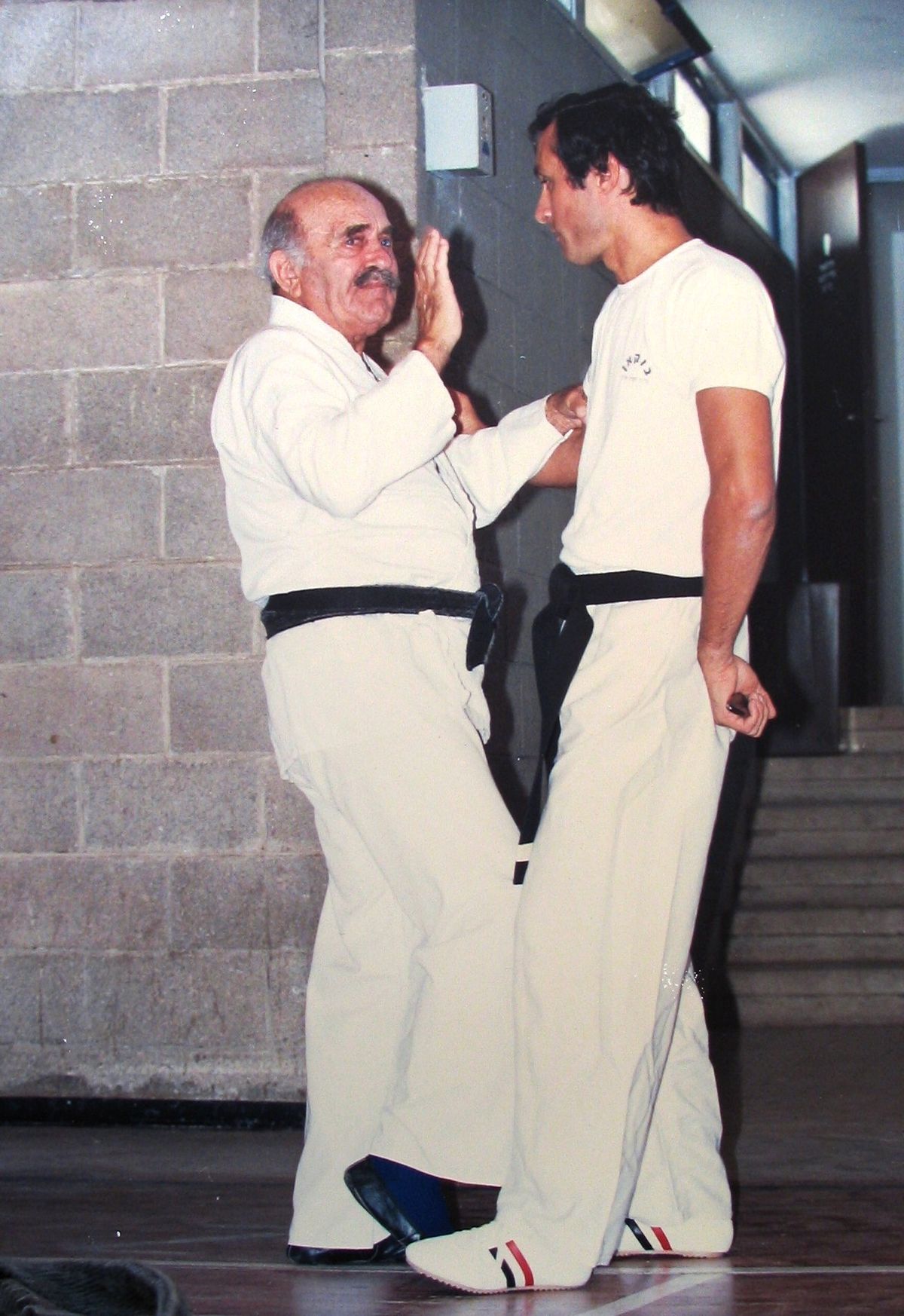
Imi Lichtenfeld, born Imre Emerich Lichtenfeld on May 26, 1910, in Budapest, Hungary, and later known as Imi Sde-Or, is renowned for his significant contributions to martial arts as the founder of Krav Maga. His innovative approach to self-defense and combat has left an enduring legacy in both the military and civilian spheres. This comprehensive overview delves into his life, career, and the profound impact he made on martial arts and self-defense.
Early Life and Influences
Imi Lichtenfeld was born into a Jewish family with a rich tradition in physical performance and discipline. His father, Samuel Lichtenfeld, was a circus performer skilled in wrestling and boxing, and later served as an inspector in the police force. Samuel’s diverse expertise in physical training and law enforcement had a significant influence on young Imi.
Growing up in Bratislava (then Pozsony), Slovakia, Imi was immersed in a culture that valued physical prowess and discipline. By the age of 13, he had joined a traveling circus, further developing his skills in acrobatics and physical performance. His early involvement in sports was marked by considerable achievements: in 1928, he won the Czech youth wrestling championship, and by 1929, he was the national wrestling champion and an international boxing champion.
Development of Combat Skills
Imi’s formative years were characterized by a broad range of physical activities. He excelled in wrestling, boxing, and judo, and he also participated in gymnastics and dramatic arts. His multifaceted training provided him with a solid foundation in various combat and physical disciplines, which would later influence the development of Krav Maga.
During the 1930s, the rise of anti-Semitic violence in Bratislava exposed Imi to real-world combat situations. He, along with other Jewish fighters, defended against aggressors, which highlighted the gap between traditional sports and street-fighting scenarios. This experience was crucial in shaping his approach to self-defense.
The Birth of Krav Maga
The Nazi occupation of Czechoslovakia in World War II prompted Imi to flee to Palestine in 1940 to escape the Holocaust. His journey was fraught with danger, including a near-death experience while rescuing people from a capsized boat. Upon arriving in Palestine, which was under British mandate at the time, Imi began his involvement with the Jewish paramilitary organizations, Haganah and Palmach.
In 1944, Imi joined the newly established Israeli Defense Forces (IDF). His combat experience and expertise were instrumental in training elite units within the IDF. It was during this period that Imi began to formalize his self-defense techniques, integrating his extensive knowledge of various combat systems into a cohesive method. This led to the development of Krav Maga, a practical and efficient system designed for real-life self-defense.
Krav Maga, meaning “contact combat” in Hebrew, focuses on neutralizing threats quickly and effectively. Unlike traditional martial arts, which often emphasize competition and sport, Krav Maga is rooted in practical applications for self-defense and military combat. Imi’s approach was designed to be intuitive and easy to learn, catering to people of all ages and physical abilities.
Professionalization and Global Impact
After the establishment of the State of Israel in 1948, Imi continued to refine Krav Maga, making it a core component of the IDF’s training programs. His methods were adopted by various military and law enforcement agencies, solidifying Krav Maga’s reputation as a highly effective self-defense system.
In 1964, Imi retired from the military but remained dedicated to spreading Krav Maga. He established training schools in Tel Aviv and Netanya, where he adapted the system for civilian use. His efforts in civilian training included integrating Krav Maga into police training programs and making it accessible to people of all ages and backgrounds.
Imi’s commitment to Krav Maga’s global proliferation led to the establishment of the Israeli Krav Maga Association (IKMA) in 1978. This organization was crucial in promoting and standardizing the practice of Krav Maga within Israel. In 1995, he founded the International Krav Maga Federation (IKMF), which aimed to professionalize and spread Krav Maga worldwide. Through these organizations, Krav Maga gained international recognition and established a network of certified instructors and practitioners.
Legacy and Influence
Imi Lichtenfeld’s impact on martial arts and self-defense extends far beyond his lifetime. His innovative approach to combat training has influenced various military and law enforcement agencies worldwide. Krav Maga’s effectiveness in real-world scenarios has made it a preferred choice for self-defense and tactical training.
Imi’s contributions have been recognized through numerous awards and honors. His legacy is preserved through the continued practice and evolution of Krav Maga, as well as through the work of organizations like the IKMF and IKMA. His methods have been adapted for different contexts, including civilian self-defense, law enforcement, and military training.
Imi’s death on January 9, 1998, in Netanya, Israel, marked the end of an era, but his legacy lives on. His approach to self-defense remains a testament to his vision and dedication. The principles of Krav Maga continue to be taught and practiced by millions around the world, reflecting the enduring relevance of Imi Lichtenfeld’s contributions.
Conclusion
Imi Lichtenfeld’s life and work embody the essence of innovation and practical application in martial arts. From his early achievements in combat sports to his groundbreaking development of Krav Maga, Imi’s journey is a remarkable story of dedication and impact. His contributions have left an indelible mark on both military and civilian self-defense, highlighting the importance of practical and effective training methods.
As we reflect on his life, it is clear that Imi Lichtenfeld’s influence extends beyond his immediate field. His approach to self-defense has shaped modern training techniques and continues to inspire individuals and professionals worldwide. His legacy is a testament to his vision of creating a practical, accessible, and effective method of combat that addresses real-world challenges.
Imi Lichtenfeld’s story serves as a powerful reminder of how passion, innovation, and dedication can create lasting change. His contributions to martial arts and self-defense have not only transformed the way we approach combat training but also provided a valuable resource for individuals seeking to protect themselves and others.


