
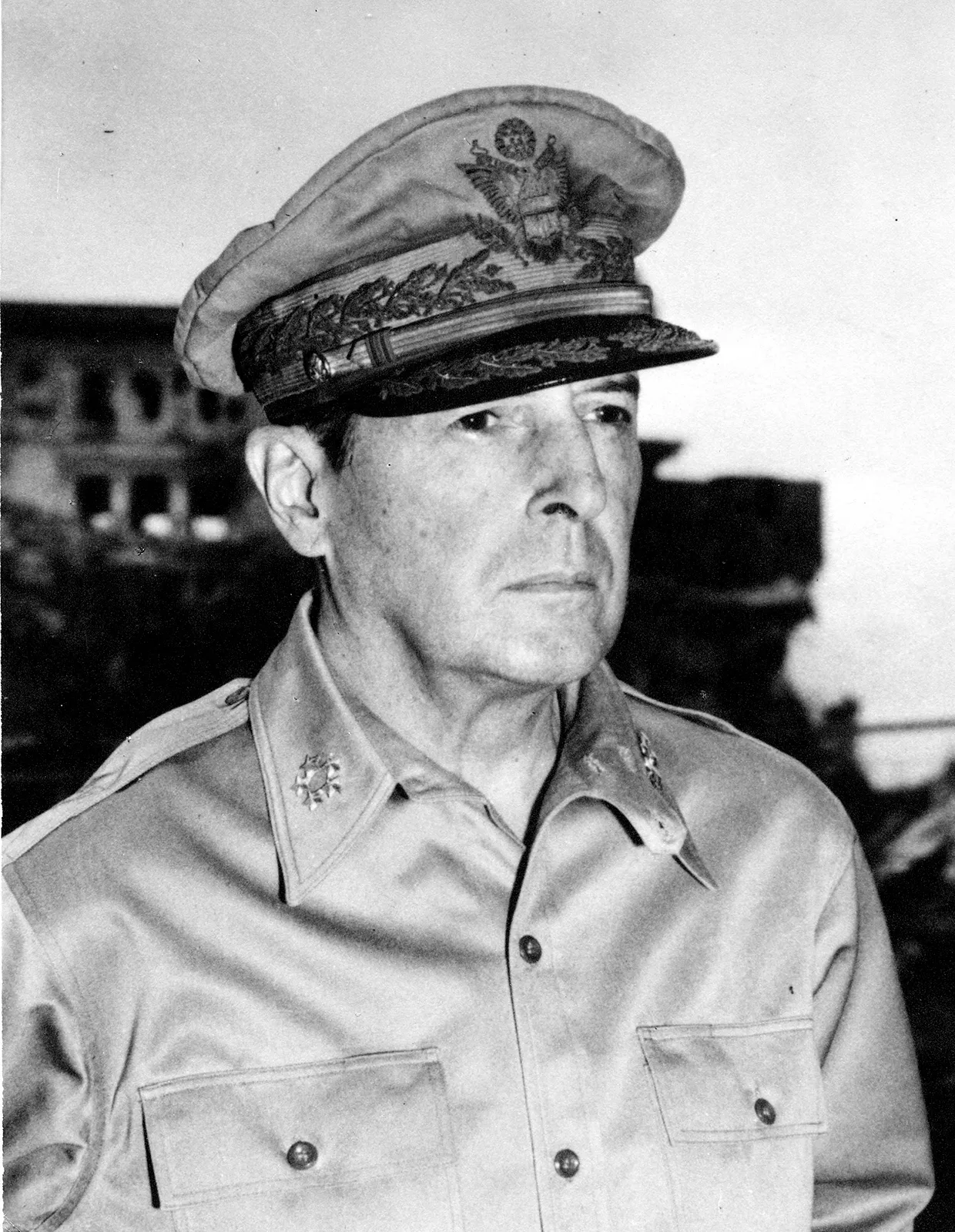
Douglas MacArthur, a towering figure in American military history, is best known for his command of Allied forces in the Pacific during World War II and his leadership in the Korean War. Born on January 26, 1880, in Little Rock, Arkansas, MacArthur’s life is a story of military brilliance, strategic innovation, and complex personal and political dynamics. His legacy, though sometimes controversial, remains influential in both military strategy and international relations.
Early Life and Military Beginnings
Douglas MacArthur was born into a military family, with his father, Arthur MacArthur Jr., being a decorated Union officer in the American Civil War. This legacy undoubtedly influenced young Douglas, who would go on to attend the United States Military Academy at West Point. MacArthur entered West Point at a young age and graduated in 1903 as a second lieutenant in the Corps of Engineers. His time at the academy was marked by academic excellence and leadership, foreshadowing the remarkable career that lay ahead.
MacArthur’s early military career saw him serving in various capacities, including assignments in the Philippines, Japan, and Mexico. His rise through the ranks was rapid, and by the time World War I erupted, MacArthur was already demonstrating the qualities that would define his later career: boldness, innovation, and a deep understanding of military strategy.
World War I and Rise to Prominence
During World War I, MacArthur served with distinction in France, where his leadership of the 42nd “Rainbow” Division earned him widespread acclaim. Known for his fearless approach to combat and his ability to inspire his troops, MacArthur’s actions in the trenches of Europe solidified his reputation as a brilliant and courageous officer. He was wounded in action and decorated for bravery, receiving numerous medals, including the Distinguished Service Cross and the Silver Star.
After the war, MacArthur continued to climb the military hierarchy. His post-war years were spent in various command and staff positions, where he honed his strategic thinking and leadership skills. By the 1930s, he had become a key figure in the U.S. military establishment, serving as Chief of Staff of the United States Army from 1930 to 1935. During his tenure as Chief of Staff, MacArthur was instrumental in shaping the army’s response to the economic challenges of the Great Depression and the rising threats from abroad.
World War II: The Pacific Theater
When World War II broke out, MacArthur was in the Philippines, serving as a military advisor to the Philippine government. The Japanese attack on Pearl Harbor in December 1941 brought the United States into the war, and MacArthur found himself at the center of the conflict in the Pacific. Initially, the situation was dire for MacArthur and his forces. The Japanese invasion of the Philippines forced MacArthur to make a dramatic escape to Australia, where he famously vowed, “I shall return.”
True to his word, MacArthur orchestrated a brilliant series of military campaigns that gradually pushed back the Japanese forces. His strategy of “island hopping,” which involved bypassing heavily fortified Japanese positions in favor of targeting weaker, strategically important islands, proved highly effective. This approach not only conserved resources but also hastened the Allied advance across the Pacific.
One of MacArthur’s most significant achievements during the war was the liberation of the Philippines in 1944-1945. This campaign was not only a military success but also a deeply personal victory for MacArthur, who had never wavered in his determination to free the islands from Japanese occupation. His leadership during this period earned him the rank of General of the Army, and he was widely celebrated as a national hero in the United States.
The Japanese Surrender and Post-War Japan
As the war drew to a close, MacArthur played a central role in the surrender of Japan. On September 2, 1945, aboard the USS Missouri in Tokyo Bay, MacArthur accepted Japan’s formal surrender, marking the end of World War II. This momentous event symbolized not only the end of one of the most destructive conflicts in human history but also the beginning of a new era in Japan’s history.
Following the surrender, MacArthur was appointed Supreme Commander for the Allied Powers (SCAP) and tasked with overseeing the occupation and reconstruction of Japan. His approach to this enormous task was marked by a blend of firmness and foresight. MacArthur understood that Japan’s future stability depended on significant political, economic, and social reforms. Under his leadership, Japan underwent a profound transformation, moving from a militaristic empire to a democratic and peaceful nation.
MacArthur’s role in drafting the new Japanese Constitution was particularly significant. The constitution introduced democratic principles, including the renunciation of war as a sovereign right, the establishment of a parliamentary system, and the protection of civil liberties. MacArthur’s influence on post-war Japan was so profound that some historians argue his policies laid the foundation for Japan’s emergence as a modern economic power.
The Korean War and Controversy
Despite his successes, MacArthur’s career was far from over. In 1950, North Korea’s invasion of South Korea prompted the United States to intervene in the Korean Peninsula under the auspices of the United Nations. MacArthur was appointed commander of the UN forces, and his leadership was instrumental in turning the tide of the war. His bold landing at Inchon in September 1950 is often cited as one of the most brilliant military maneuvers of the 20th century. The successful landing allowed UN forces to recapture Seoul and push the North Korean army back across the 38th parallel.
However, the Korean War also marked the beginning of the end of MacArthur’s military career. As the conflict escalated, MacArthur began to advocate for a more aggressive strategy, including the possibility of extending the war into China. His public disagreements with President Harry S. Truman over the conduct of the war led to a dramatic clash between military and civilian authority. In April 1951, Truman made the controversial decision to relieve MacArthur of his command, citing the need to maintain civilian control over the military.
MacArthur’s dismissal was a watershed moment in American history, sparking intense debate over the limits of military authority and the role of the military in shaping foreign policy. Upon his return to the United States, MacArthur delivered a farewell address to Congress, in which he famously declared, “Old soldiers never die; they just fade away.” This speech, steeped in pathos and dignity, further solidified his status as an American icon, even as it marked the end of his active military service.
Legacy and Final Years
Following his dismissal, MacArthur retired from public life, though he remained a prominent figure in American society. He spent his final years writing his memoirs and reflecting on his long and storied career. His memoirs, published in 1964, offer valuable insights into his views on leadership, strategy, and the complex nature of warfare.
Douglas MacArthur passed away on April 5, 1964, at the age of 84. His death was widely mourned, and he was honored with a state funeral, befitting a man of his stature. MacArthur’s legacy is a complex one, encompassing both his military brilliance and the controversies that surrounded his later years. He is remembered as one of the most influential military leaders in American history, whose impact on the conduct of war and the reconstruction of post-war Japan continues to be felt today.
The Enduring Influence of Douglas MacArthur
Douglas MacArthur’s influence extends beyond his military achievements. He was a man of vision, deeply committed to the principles of duty, honor, and country. His strategic innovations, particularly his emphasis on flexibility and the element of surprise, have left a lasting mark on military doctrine. MacArthur’s belief in the importance of psychological warfare and his understanding of the political dimensions of military conflict were ahead of their time and continue to be studied by military strategists today.
In the broader context of American history, MacArthur represents a unique blend of warrior and statesman. His role in the democratization of Japan and his efforts to rebuild a nation shattered by war demonstrate his capacity for leadership not just on the battlefield, but in the complex realm of international relations. MacArthur’s ability to navigate the challenges of occupation and reconstruction with both firmness and compassion set a precedent for future military and political leaders.
At the same time, MacArthur’s career serves as a cautionary tale about the limits of military power in a democratic society. His conflict with President Truman underscored the fundamental principle of civilian control over the military—a principle that remains a cornerstone of American governance. MacArthur’s story is a reminder that even the most powerful military leaders must operate within the constraints of constitutional authority.
Conclusion: A Legacy of Leadership
Douglas MacArthur’s life and career offer a rich tapestry of military innovation, strategic brilliance, and complex personal dynamics. From his early days as a cadet at West Point to his role in shaping the outcome of World War II and the Korean War, MacArthur’s contributions to American military history are immense. His legacy is one of both triumph and controversy, reflecting the challenges and complexities of leadership in times of war and peace.
In the end, MacArthur’s enduring influence lies not just in the battles he won, but in the way he approached the art of war itself. His belief in the power of surprise, his understanding of the psychological aspects of warfare, and his commitment to the principles of democracy and human rights have left an indelible mark on the world. As we look back on his life, we see a man who, despite his flaws, remained steadfast in his dedication to his country and his duty. MacArthur’s legacy, like the man himself, is both larger than life and deeply human—a testament to the enduring power of leadership and the complexities of military command.


