
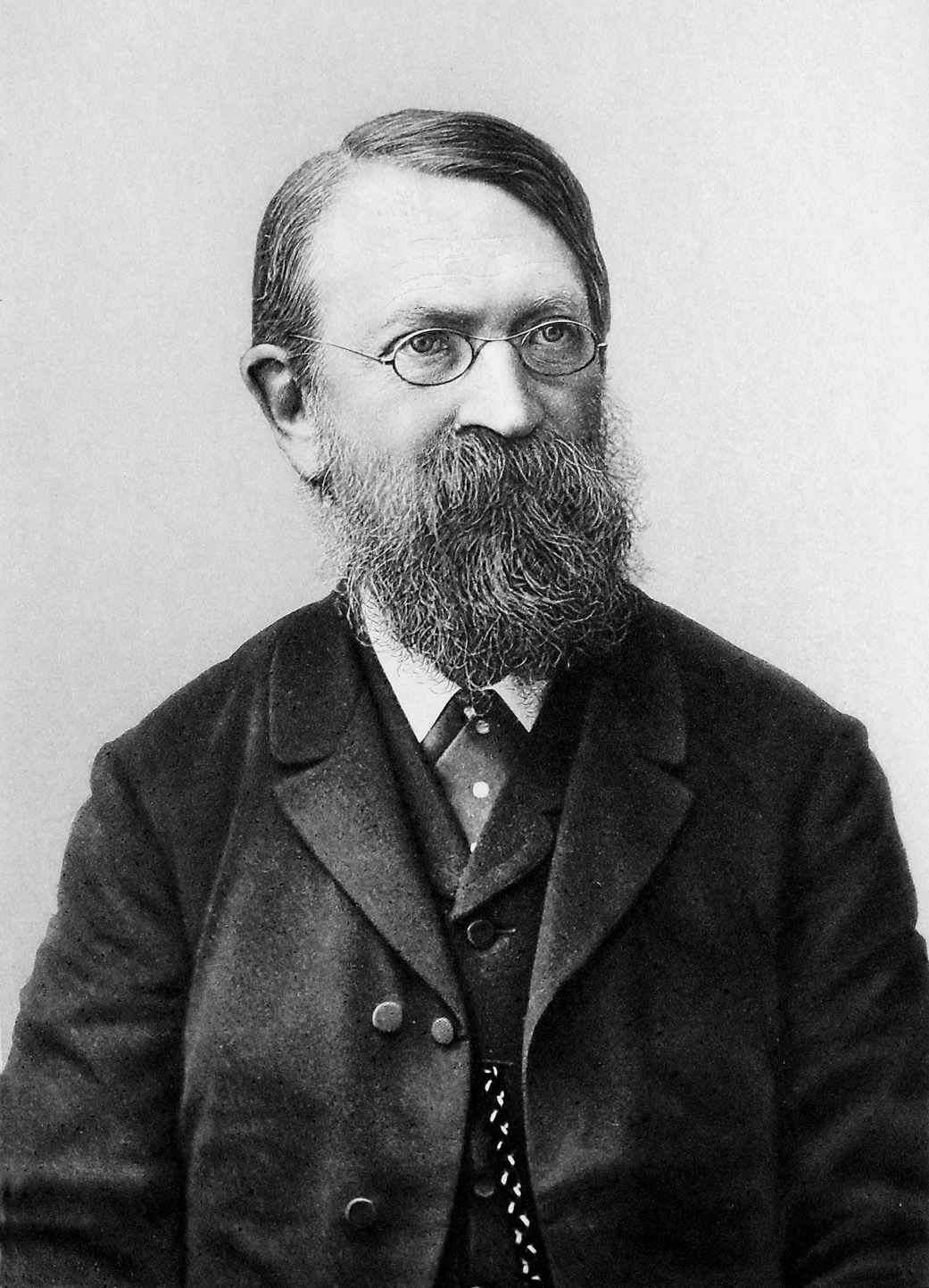
Ernst Mach is a name that resonates deeply within the realms of physics, philosophy, and science. Born on February 18, 1838, in Chirlitz-Turas, Moravia—an area that was then part of the Austrian Empire and is now within the borders of the Czech Republic—Mach’s life and work have left an indelible mark on multiple disciplines. His journey from a young boy educated at home to a renowned physicist and philosopher is a testament to his intellectual curiosity and tireless pursuit of knowledge.
Early Life and Education
Ernst Mach’s early years were spent in the quietude of a private education, guided by his family until the age of fourteen. In 1853, he transitioned to formal education at a gymnasium, a type of secondary school, where he quickly distinguished himself as a brilliant student. By 1856, at the young age of seventeen, Mach had enrolled at the University of Vienna. His academic journey at Vienna was nothing short of remarkable, culminating in the completion of his doctorate in 1860.
Mach’s early academic career was marked by his appointment as a lecturer in mechanics and physics at the University of Vienna. His tenure at the university from 1860 to 1864 laid the groundwork for his future contributions to science. By 1864, he had secured a professorship in mathematics at the University of Graz, signaling the beginning of a distinguished academic career.
Contributions to Physics and the Concept of Mach Bands
While Mach’s early inclinations leaned towards philosophy, his work as a physicist soon began to attract attention. One of his earliest and most notable contributions to the field of physics came with the discovery of the phenomenon now known as “Mach Bands.” This optical illusion, where the human eye perceives bright or dark bands near the edges of differing brightness, has had significant implications in the understanding of sensory perception and the functioning of the human visual system. The Mach Bands effect continues to be a relevant concept in the study of visual perception, illustrating how the human brain interprets visual information.
Academic Career and Major Discoveries
In 1867, Mach accepted a position as a professor of experimental physics at Charles University in Prague. This period, spanning nearly three decades, was perhaps the most productive of his career. During his time in Prague, Mach conducted extensive research on the sensation of motion and acceleration, which he referred to as “kinesthetic sensation.” His studies in this area were groundbreaking, as they explored the ways in which humans perceive and react to changes in motion and acceleration—a concept that would later influence the field of aviation and human factors engineering.
Mach’s work during the 1870s and 1880s laid the foundation for several key advancements in the understanding of wave propagation and the behavior of fluids. His experiments in wave dynamics and his pioneering use of photographic techniques to measure wave lengths and propagation speeds were particularly noteworthy. However, it was in 1887 that Mach made one of his most enduring contributions to science—the development of the principles of supersonics and the formulation of the Mach number.
The Mach Number and Its Impact
The Mach number, a dimensionless quantity in fluid dynamics, represents the ratio of the speed of an object to the speed of sound in the surrounding medium. This concept has become a cornerstone in the study of aerodynamics, particularly in the analysis of high-speed flight. When the Mach number is less than one, the flow is termed subsonic; when it is greater than one, the flow is supersonic. Mach’s work in this area has had profound implications, not only in theoretical physics but also in practical applications such as aircraft design and the exploration of supersonic and hypersonic flight.
The classification of fluids based on the Mach number—whether they are compressible or incompressible—remains a fundamental concept in fluid dynamics. For instance, gases flowing with a Mach number below 0.3 are typically considered incompressible. This distinction is critical in many engineering applications, from the design of efficient aircraft to the development of advanced propulsion systems.
Mach’s Philosophical Contributions and the Principle of Inertia
While Ernst Mach is primarily celebrated for his contributions to physics, his influence extends far beyond the confines of traditional science. His philosophical ideas, particularly those related to the concept of inertia, have sparked significant debate and have been instrumental in shaping modern scientific thought. Mach’s principle of inertia posits that the inertia of an object is the result of its interaction with the rest of the universe’s matter. This principle suggests that inertia is not an inherent property of an object but rather a consequence of its relationship with the surrounding environment.
Mach’s ideas on inertia were revolutionary, challenging the Newtonian conception of absolute space and motion. These concepts later influenced Albert Einstein’s development of the theory of relativity, underscoring the profound impact of Mach’s work on the evolution of modern physics. Mach’s emphasis on the relativity of motion and his rejection of absolute space were key components in the philosophical underpinnings of Einstein’s groundbreaking theories.
Later Life and Legacy
In 1895, Mach returned to the University of Vienna, this time as a professor of inductive philosophy. His career, however, was soon interrupted by a severe heart attack in 1897, which left him with lasting health issues. Despite these challenges, Mach continued to contribute to the academic world, albeit in a more limited capacity. In 1901, he officially retired from active research, though he remained intellectually engaged, continuing to write and teach.
One of Mach’s significant later works was “Erkenntnis und Irrtum” (“Knowledge and Error”), published in 1905. This book explored the nature of human understanding and the limitations of knowledge, reflecting Mach’s deep engagement with philosophical questions throughout his life. In 1910, he published an autobiography that offered insights into his personal and professional journey.
Ernst Mach’s life came to an abrupt end on February 19, 1916, in Haar, near Munich, Germany. However, his legacy endures, both in the scientific principles that bear his name and in the philosophical debates he ignited. His contributions continue to influence a wide range of fields, from physics and engineering to philosophy and the history of science.
The Enduring Influence of Ernst Mach
Today, Ernst Mach is remembered not only for his scientific achievements but also for his profound influence on the development of modern thought. His interdisciplinary approach, blending physics with philosophy, has inspired generations of scientists and thinkers. The Mach number remains a fundamental concept in fluid dynamics and aerodynamics, essential for understanding high-speed flight and the behavior of fluids under varying conditions.
Moreover, Mach’s philosophical inquiries into the nature of perception, motion, and knowledge have left a lasting impact on the philosophy of science. His ideas challenged the prevailing notions of his time, paving the way for new ways of thinking about the relationship between observation, measurement, and reality.
In the broader context of scientific history, Ernst Mach stands as a figure who bridged the gap between empirical research and philosophical reflection. His work exemplifies the power of interdisciplinary thinking and the importance of questioning established assumptions. As we continue to explore the frontiers of science and technology, Mach’s legacy serves as a reminder of the enduring value of curiosity, skepticism, and the relentless pursuit of understanding.
In conclusion, Ernst Mach’s life and work offer a rich tapestry of scientific discovery and philosophical inquiry. From his early contributions to the understanding of visual perception to his pioneering work in fluid dynamics and his philosophical explorations of inertia and knowledge, Mach’s influence is felt across multiple disciplines. His legacy is one of intellectual rigor, innovative thinking, and a deep commitment to the pursuit of knowledge—a legacy that continues to inspire and inform the scientific and philosophical endeavors of today.


