
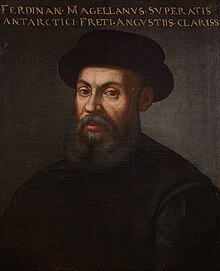
Ferdinando Magellano, known more widely as Ferdinand Magellan, is a figure of enduring fascination in the annals of world exploration. Born on October 17, 1480, in Sobrosa, Portugal, Magellano’s life was one of adventure, hardship, and groundbreaking discoveries. He is best known for leading the first expedition to circumnavigate the globe, an achievement that not only altered the course of history but also solidified his place among the most renowned explorers of all time.
Early Life and Aristocratic Roots
Ferdinando Magellano was born into an aristocratic yet economically weakened family. His father, the mayor of Sobrosa, and his mother, who managed the household, had three children: Magellano, his brother Diego, and sister Isabel. Despite the noble lineage, the family faced financial difficulties, a common plight among the lesser nobility of the time. At the tender age of ten, Magellano was orphaned, a tragic event that set the stage for his future. He and his brother were sent to the court of King John II in Lisbon, where Magellano served as a page. This position, though menial, provided him with a unique education and exposure to the world of exploration that would shape his destiny.
The Call of the Sea
Magellano’s early years at court were formative, but his true passion was the sea. In 1505, King John II sent him to India to serve under Viceroy Francisco de Almeida. Magellano’s abilities quickly became apparent, and he was recognized for his courage and leadership, notably for quelling a mutiny aboard one of the royal ships. This event marked the beginning of his illustrious maritime career.
In 1506, Magellano joined an expedition to the Spice Islands, known then as the Moluccas. These islands were famous for their wealth of spices, a highly coveted commodity in Europe. The journey was a critical moment in Magellano’s career, as it offered him firsthand experience in navigation and exploration. However, his adventurous spirit often led him into trouble. During the expedition, he strayed from the established route to explore uncharted territories, an act of insubordination that resulted in his demotion.
A Career in Jeopardy
Despite the setbacks, Magellano continued his maritime career. In 1510, he served under the command of Alfonso de Albuquerque during the conquest of Malacca, a crucial port in Southeast Asia. The victory in Malacca was a significant achievement, but it was not enough to secure Magellano’s position. In 1513, he participated in the battle of Azamor in Morocco, where he faced accusations of engaging in unauthorized trade with Muslims. This controversy led to his dishonorable discharge from the Portuguese navy in 1514, a blow that could have ended his career.
Undeterred, Magellano began to envision a new expedition, one that would bypass the established routes to the East by sailing westward. He possessed a map that suggested a possible passage to the Pacific Ocean south of the Rio de la Plata in South America. This daring plan aimed to reach the Spice Islands by a new route, reducing the distance and circumventing the need to sail around Africa.
A Bold Proposal to the Spanish Crown
Magellano’s vision was audacious, and he knew that to achieve it, he would need the support of a powerful patron. He turned to Spain, presenting his proposal to King Charles I (later Emperor Charles V). The young monarch was intrigued by the potential of the expedition, not only for its promise of wealth but also for the geopolitical implications. If Magellano’s route proved successful, it would affirm Spain’s claim over the Spice Islands, a point of contention with Portugal. Moreover, the possibility of discovering new territories to colonize was an enticing prospect.
King Charles V agreed to sponsor the expedition, providing ships, men, and supplies. On September 20, 1519, Magellano set sail from Sanlúcar de Barrameda with a fleet of five ships and 265 men. The flagship, Trinidad, was under his direct command. The expedition marked the beginning of one of the most significant voyages in history.
The Voyage of Discovery
The journey across the Atlantic was fraught with challenges, but the fleet eventually reached the coast of South America. Magellano directed the ships southward, searching for the passage to the Pacific. After months of navigating along the coast, battling harsh conditions, and enduring the grueling winter, the expedition finally found the strait that would bear Magellano’s name. The Strait of Magellan was a narrow, treacherous waterway that connected the Atlantic and Pacific Oceans. On October 25, 1520, the fleet emerged from the strait into the vast and uncharted Pacific Ocean.
The Pacific crossing was arduous, with the crew suffering from scurvy, starvation, and despair. Magellano’s leadership was tested as his men, worn down by the journey, pleaded to return home. However, Magellano was resolute, determined to push forward to the Spice Islands. The ocean’s calm waters led Magellano to name it “Pacific,” meaning peaceful, though the voyage was anything but serene.
The Tragic End in the Philippines
After months at sea, the expedition reached the Philippine archipelago in March 1521. The arrival in the Philippines marked the beginning of the end for Magellano. In an attempt to convert the local ruler of Cebu to Christianity, Magellano became embroiled in a conflict with the inhabitants of Mactan, a nearby island. On April 27, 1521, Magellano was killed in battle by the warriors of Mactan, led by the chieftain Lapu-Lapu.
Magellano’s death was a tragic end to a life marked by exploration and ambition. He did not live to see the completion of his great journey, but his legacy was secured. The remnants of his fleet, under the command of Juan Sebastián Elcano, continued the voyage, returning to Spain in 1522, thus completing the first circumnavigation of the globe.
Legacy and Historical Impact
Ferdinando Magellano’s expedition changed the world in profound ways. It provided concrete evidence that the Earth was round, disproving lingering doubts from the ancient world. The voyage also opened new trade routes and led to the establishment of Spanish influence in the Pacific, a legacy that would endure for centuries. Magellano’s name became synonymous with exploration and adventure, and his life story has inspired countless generations of explorers.
Magellano’s journey was not just a physical expedition; it was a triumph of human determination and curiosity. His willingness to venture into the unknown, to defy the odds, and to challenge the limits of the world as it was known, make him a figure of enduring significance in history.
Conclusion
Ferdinando Magellano’s life was a testament to the spirit of exploration that defined the Age of Discovery. His achievements were monumental, and his legacy continues to influence our understanding of the world. As we reflect on his life and the impact of his journey, we recognize that Magellano was not just a man of his time but a pioneer whose vision extended far beyond the horizon. His story is a reminder of the power of ambition, the importance of resilience, and the enduring quest for knowledge.


