
René François Ghislain Magritte, a towering figure in the world of art, was born on November 21, 1898, in Lessines, Belgium. His life and work have left an indelible mark on the art world, particularly through his association with the Surrealist movement. This article delves into the life of René Magritte, exploring his age, rise to fame, significant life events, and his profound influence on modern art.
Early Life and Tragic Beginnings
René Magritte’s early life was marked by a significant tragedy that would shape much of his artistic expression. Born to Léopard Magritte, a merchant, and his wife, the family frequently moved due to his father’s business. However, it was in 1910, when the family was living in Châtelet, that a life-altering event occurred. At the tender age of thirteen, Magritte witnessed the retrieval of his mother’s lifeless body from the Sambre River. She had committed suicide, and the image of her nightdress covering her face left a lasting impression on him. This tragic moment is often cited as a pivotal influence on his later works, such as “L’histoire centrale” and “Les amants,” which depict themes of concealment and identity.
Following this tragedy, Magritte, along with his father and two brothers, relocated to Charleroi in an attempt to escape the haunting memories. Despite these early challenges, Magritte pursued classical studies and eventually turned his attention to painting. In 1916, he enrolled at the Académie Royale des Beaux-Arts in Brussels, where his family had moved two years earlier.
The Birth of a Surrealist Icon
Magritte’s early work was heavily influenced by the avant-garde movements of the early 20th century, including Cubism and Futurism. However, a significant turning point in his career came with his discovery of the works of Giorgio de Chirico, particularly “The Song of Love,” which deeply resonated with him. This painting, featuring a giant Greek statue’s head and a large rubber glove, struck Magritte with its surreal juxtaposition of ordinary objects in an unfamiliar context. This encounter with de Chirico’s work marked the beginning of Magritte’s exploration of Surrealism, a movement that sought to unlock the creative potential of the unconscious mind.
In 1925, Magritte officially entered his Surrealist period, joining the Surrealist group in Brussels, which included figures like Camille Goemans, Marcel Lecomte, and Paul Nougé. His first Surrealist painting, “The Lost Jockey,” was created during this time, and he continued to work as a graphic designer, primarily designing wallpaper to support himself financially.
Rise to Fame and Surrealist Masterpieces
Magritte’s unique approach to Surrealism quickly gained him recognition. In 1927, he held his first solo exhibition at the Galerie Le Centaure in Brussels, where he showcased 61 of his works. This exhibition marked the beginning of Magritte’s rise to fame within the art world. The following year, he moved to Perreux-sur-Marne, near Paris, with his wife, Georgette Berger, whom he had married in 1922 after meeting her when he was just fifteen years old.
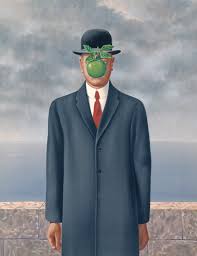
During his time in France, Magritte connected with André Breton, the leader of the Surrealist movement. Breton’s influence further solidified Magritte’s position within the Surrealist circle. Magritte’s work from this period is characterized by his use of ordinary objects placed in extraordinary contexts, creating a sense of mystery and questioning the nature of reality. Paintings like “The Treachery of Images” (famous for its inscription “Ceci n’est pas une pipe”) and “The Son of Man,” with its iconic image of a man with an apple obscuring his face, exemplify Magritte’s ability to challenge perceptions and provoke thought.
Artistic Evolution and Later Years
Magritte’s work continued to evolve over the years, reflecting the changing social and political climate. During the 1940s, fearing the German occupation during World War II, Magritte and his wife moved to the south of France, settling in Carcassonne. This period saw Magritte experimenting with a new painting style, which he referred to as the “Renoir” or “solar” period. This style was characterized by a more vibrant, luminous palette, inspired by the works of Auguste Renoir. However, Magritte later abandoned this style, feeling it did not resonate with his true artistic vision.
In the mid-1940s, Magritte entered his “vache” period, a brief but notable phase where he parodied the Fauvist movement. This period was marked by a deliberate crudeness and garish colors, serving as a satirical commentary on the art establishment. Although short-lived, this phase demonstrated Magritte’s willingness to challenge conventions and explore new artistic directions.
Despite these explorations, Magritte remained committed to the core principles of Surrealism throughout his life. His works continued to provoke questions about the nature of reality, perception, and the role of art in society. Magritte’s ability to present the familiar in an unfamiliar way made his work both accessible and intellectually challenging, appealing to a wide audience.
Legacy and Impact on Modern Art
René Magritte passed away on August 15, 1967, in Brussels, after a brief illness. His death marked the end of an era, but his legacy continues to thrive. Magritte is often referred to as “le saboteur tranquille” (the quiet saboteur) for his ability to subtly undermine reality through his art. He did not seek to interpret or replicate reality; instead, he sought to reveal its inherent mysteries and contradictions.
Magritte’s influence on modern art cannot be overstated. His work has inspired countless artists, filmmakers, and writers, and his imagery has permeated popular culture. The enigmatic nature of his paintings, combined with their meticulous execution, has ensured that Magritte remains one of the most celebrated artists of the 20th century.
In particular, Magritte’s exploration of the relationship between language and image has had a profound impact on conceptual art. His famous declaration that “This is not a pipe” in “The Treachery of Images” challenges the viewer to question the connection between words and the objects they represent. This exploration of semiotics has resonated with artists and theorists alike, making Magritte a central figure in discussions about the nature of representation.
Conclusion: The Enduring Appeal of Magritte’s Work
René Magritte’s life and work offer a fascinating glimpse into the mind of an artist who was constantly questioning the world around him. His ability to blend the ordinary with the extraordinary, to make the familiar strange, has ensured that his work remains relevant and thought-provoking to this day. Magritte’s paintings continue to captivate audiences, inviting them to look beyond the surface and explore the deeper mysteries of existence.
As we reflect on Magritte’s life, it becomes clear that his age and the era in which he lived were instrumental in shaping his artistic vision. The tragedies he experienced, the cultural movements he encountered, and the personal relationships he forged all played a role in the development of his unique style. Today, Magritte’s work stands as a testament to the power of art to challenge perceptions and to remind us that reality is never as straightforward as it seems.


