
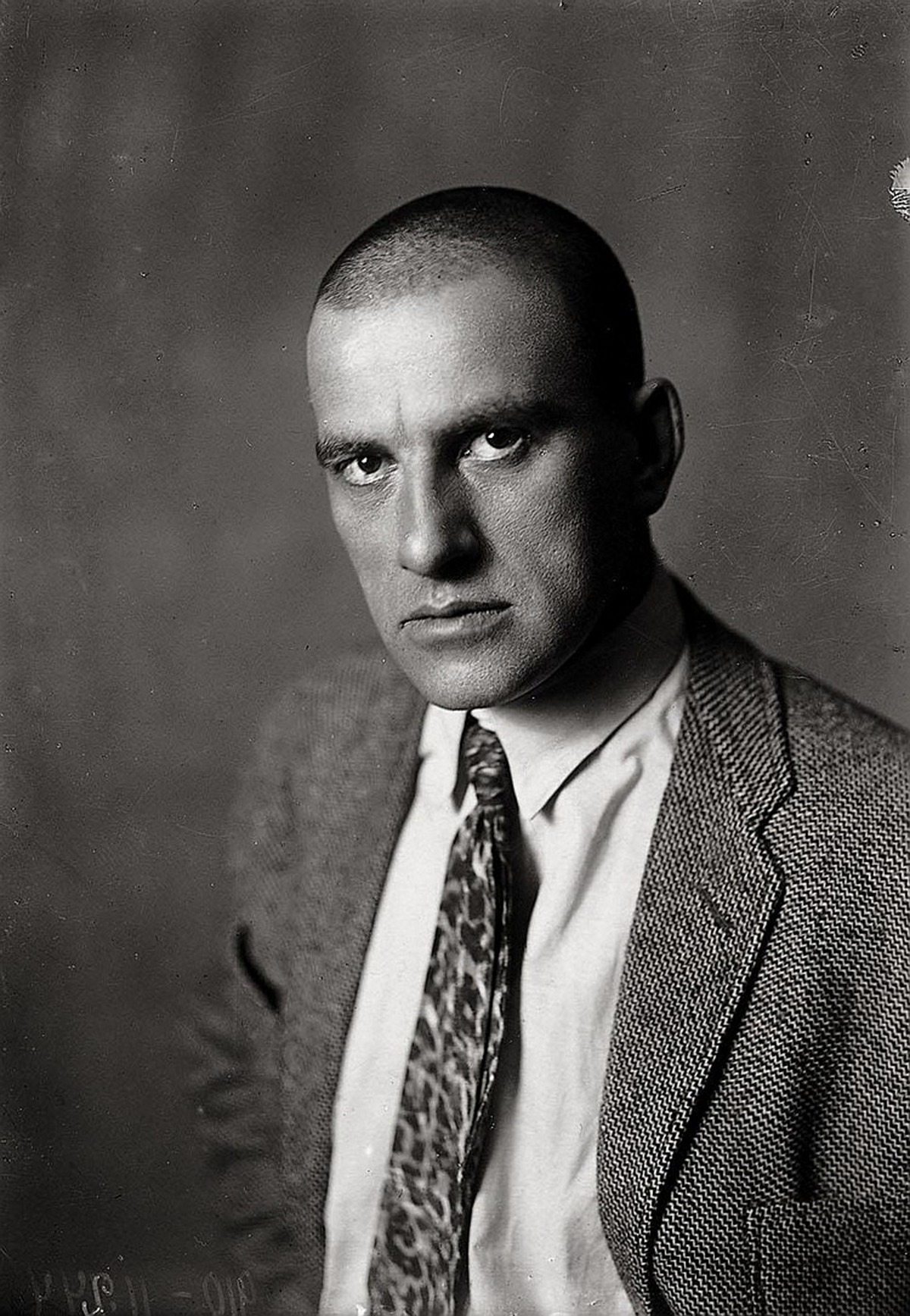
Vladimir Vladimirovich Majakovskij, born on July 7, 1893, in Bagdati, Georgia, was a Russian poet, playwright, and artist who became one of the most prominent figures of the Russian Futurist movement. His work, characterized by its boldness, innovation, and revolutionary spirit, captured the tumultuous era of early 20th-century Russia. Although his life was tragically cut short at the age of 36, Majakovskij’s influence on literature, art, and Soviet culture endures.
Early Life and Education
Majakovskij was born into a family that, while not wealthy, held a respected position in society. His father, a forest ranger of Russian descent, died when Vladimir was only seven years old, a traumatic event that profoundly affected him. The young Majakovskij, alongside his mother and two sisters, moved to Moscow in 1906, where he would spend his formative years.
In Moscow, Majakovskij was introduced to revolutionary ideas, which soon became a central focus of his life. By the age of 13, he had already immersed himself in revolutionary activities, joining the Russian Social Democratic Labour Party (RSDLP) in 1908. His involvement in the party’s activities led to multiple arrests, during which he spent time in various prisons. These early experiences with the harsh realities of political activism shaped his worldview and informed much of his later work.
Despite his political engagements, Majakovskij pursued education at the Moscow School of Painting, Sculpture, and Architecture in 1911. It was here that he met David Burliuk, a key figure in Russian Futurism, who recognized Majakovskij’s poetic talent and encouraged him to write. Burliuk’s mentorship was instrumental in Majakovskij’s development as a poet, providing him with the financial and intellectual support he needed to pursue his artistic ambitions.
Early Literary Career: The Birth of a Revolutionary Poet
Majakovskij’s early literary efforts were closely tied to the Futurist movement, which sought to break away from traditional artistic forms and embrace a new, modern aesthetic. In 1912, he co-signed the Futurist manifesto A Slap in the Face of Public Taste, a provocative document that declared war on the established literary norms and called for a radical transformation of art and society.
In 1913, Majakovskij published his first poetry collection, I!, a bold statement of individualism and artistic freedom. This was followed by his dramatic debut in the same year, a theatrical performance titled Vladimir Majakovskij: A Tragedy, which he also wrote and starred in. The play was a groundbreaking work that combined elements of traditional theater with the avant-garde techniques of Futurism, earning Majakovskij both acclaim and controversy.
The Russian Revolution and the Poet of the People
The Russian Revolution of 1917 was a turning point not only in Russian history but also in Majakovskij’s life. He wholeheartedly embraced the Bolshevik cause, seeing the revolution as the realization of the Futurist ideals he had long championed. Majakovskij believed that poetry and art should serve the people and the revolution, and he dedicated his work to supporting the new Soviet state.
His poetry from this period, including The Backbone Flute (1915) and The Cloud in Trousers (1915), reflects both his revolutionary fervor and his innovative use of language. Majakovskij’s style was characterized by its emotional intensity, use of colloquial language, and bold visual imagery, all of which broke with the traditions of Russian poetry.
During the revolution and the subsequent Civil War, Majakovskij became a prominent voice of the Soviet avant-garde. He contributed to the state’s propaganda efforts, writing slogans, posters, and poems that celebrated the revolution and called for the construction of a new socialist society. His work with the Russian Telegraph Agency (ROSTA) involved creating visually striking posters that combined text and image to convey political messages to the masses.
Contributions to the Russian Avant-Garde
Majakovskij’s contributions to the Russian avant-garde extended beyond poetry. He was also a key figure in the visual arts, collaborating with artists like Kazimir Malevich and El Lissitzky. Together, they pushed the boundaries of artistic expression, exploring new forms and techniques that reflected the revolutionary spirit of the time.
In 1919, Majakovskij co-founded the Left Front of the Arts (LEF), an organization that sought to unite artists, writers, and filmmakers in the service of the revolution. LEF published a magazine of the same name, which became a platform for the most radical and experimental ideas in Soviet art. Through LEF, Majakovskij championed the idea that art should be practical and serve the needs of the new socialist society.
One of Majakovskij’s most significant contributions to Soviet literature was his development of agitprop (agitation propaganda), a form of political communication that aimed to inspire action through emotional appeal. His poems, posters, and plays from this period were designed to mobilize the masses, urging them to participate in the building of the new Soviet state.
Travels and the American Experience
In 1925, Majakovskij embarked on a journey to the United States, a trip that would have a profound impact on his worldview. He traveled through several cities, including New York, Chicago, and Detroit, observing the stark contrasts between American capitalism and the socialist ideals he championed.
Majakovskij’s experiences in the United States were mixed. On one hand, he was fascinated by the technological advancements and the dynamism of American society. On the other hand, he was deeply troubled by the inequality and exploitation he witnessed, particularly in the working conditions of industrial laborers. These observations formed the basis of his American Cycle of poems, which he published upon his return to the Soviet Union. These works expressed both admiration and criticism of American society, reflecting his complex and ambivalent feelings.
The journey also inspired his prose work, My Discovery of America (1926), where Majakovskij detailed his observations and experiences in a candid and often critical tone. The book provides a unique perspective on the United States during the 1920s, seen through the eyes of a committed Soviet revolutionary.
The Playwright and Satirist
While Majakovskij is best known for his poetry, he was also an accomplished playwright and satirist. His plays, such as Mystery-Bouffe (1918) and The Bedbug (1929), combined satire, absurdity, and social critique, often targeting the bourgeoisie and other enemies of the revolution. These works were innovative in their use of language and structure, blending traditional theatrical forms with the experimental techniques of the avant-garde.
The Bathhouse (1929) is another notable work, a satire of Soviet bureaucracy that was both humorous and biting in its critique. Although it was not well-received by Soviet officials, the play remains an important example of Majakovskij’s ability to use humor as a tool for social and political commentary.
In his plays, Majakovskij sought to expose the contradictions and hypocrisies of society, using humor and exaggeration to make serious points about the challenges facing the Soviet Union. His work in the theater was an extension of his poetic mission, to engage the public and provoke thought through art.
The Final Years: Disillusionment and Tragic End
By the late 1920s, Majakovskij’s relationship with the Soviet state had become increasingly strained. The initial euphoria of the revolution had faded, and the harsh realities of life under Stalinist rule began to take their toll on the poet. Majakovskij became disillusioned with the direction the Soviet Union was taking, particularly with the increasing censorship and repression of artistic expression.
Despite his deep commitment to the ideals of the revolution, Majakovskij found himself at odds with the Soviet literary establishment. His work was increasingly criticized by party officials, who saw his avant-garde style as out of step with the emerging Socialist Realist doctrine. This growing isolation, combined with personal and romantic difficulties, led Majakovskij into a deep depression.
In 1930, at the age of 36, Vladimir Majakovskij took his own life. He left behind a brief but poignant suicide note, in which he asked for forgiveness and urged his friends and comrades not to blame anyone for his death. The exact reasons for his suicide remain a subject of debate, but it is clear that a combination of personal, political, and creative frustrations played a role.
Legacy and Influence
Majakovskij’s death was a significant loss to Soviet culture, but his legacy has endured. Despite the initial attempts by the Soviet state to downplay his contributions, Majakovskij eventually came to be recognized as one of the most important figures in Russian literature and a symbol of the revolutionary spirit.
His work has influenced generations of poets, artists, and writers, both in Russia and abroad. Majakovskij’s innovative use of language, his fusion of poetry and politics, and his commitment to using art as a tool for social change continue to resonate with audiences today.
In the decades following his death, Majakovskij’s reputation has undergone several transformations. During the Soviet era, he was celebrated as a martyr of the revolution, his image co-opted by the state to serve its propaganda needs. However, his work has also been re-evaluated in the post-Soviet period, with scholars and critics exploring the complexities of his life and the contradictions within his work.
Today, Vladimir Majakovskij is remembered not just as a poet of the revolution, but as a visionary artist who sought to redefine the role of art in society. His contributions to literature and the avant-garde have secured his place in the pantheon of great modernist poets, and his work remains a vital part of the cultural history of the 20th century.
Conclusion: The Enigmatic Genius of Majakovskij
Vladimir Majakovskij was a man of contradictions—a revolutionary poet who both embraced and critiqued the system he helped to create, an avant-garde artist who sought to make his work accessible to the masses, and a passionate individual whose intense emotions both fueled his creativity and led to his tragic end.
His life and work are a testament to the power of art to challenge, provoke, and inspire. Majakovskij’s legacy is not just in the poems and plays he left behind, but in the enduring influence he has had on the world of literature and beyond. He remains a symbol of the revolutionary potential of art, a reminder of the ways in which creativity can be both a tool for social change and a deeply personal expression of the human experience.


