
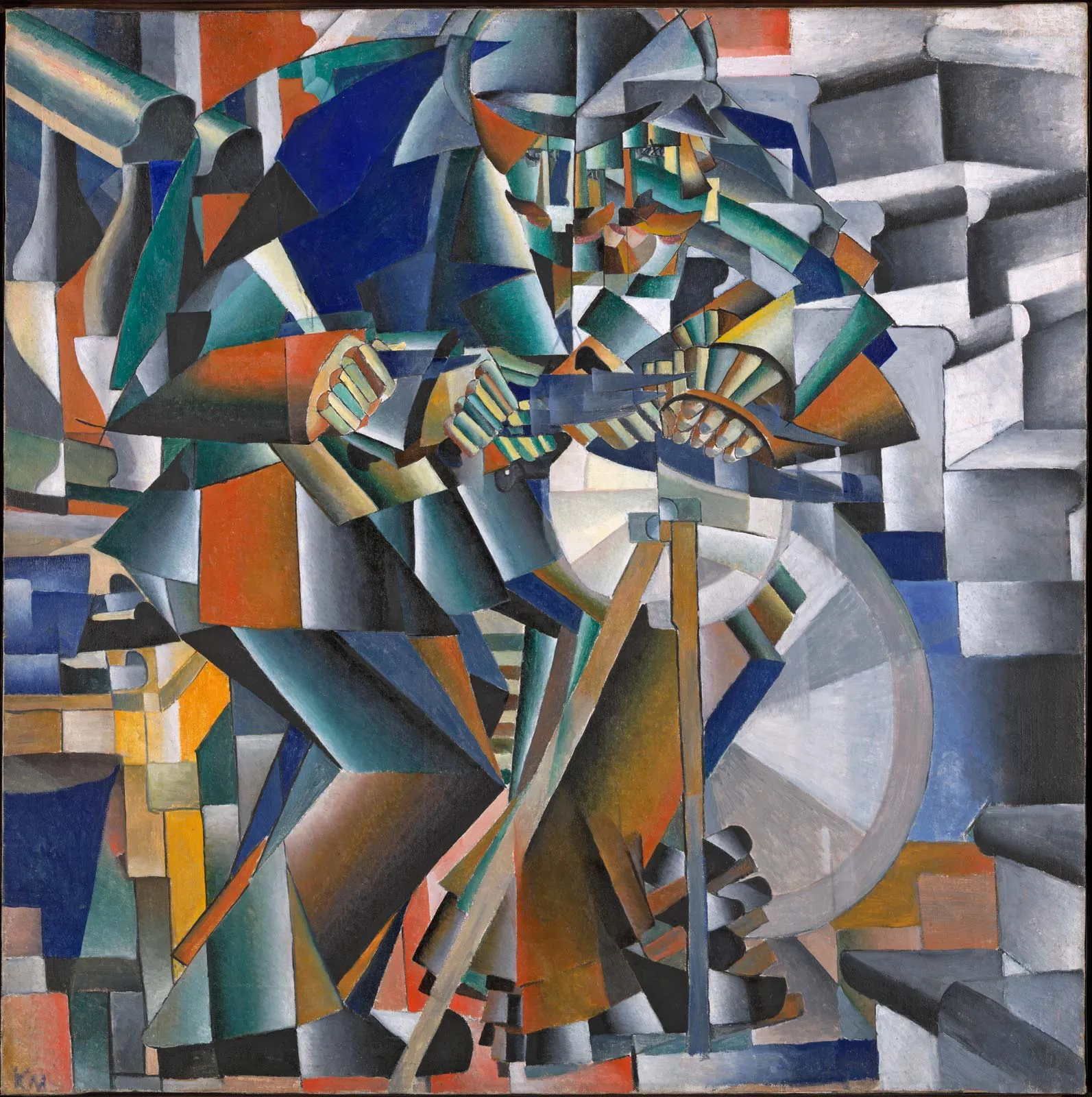
Kazimir Severinovich Malevich, born on February 23, 1878, in Kyiv, Ukraine, stands as one of the most pivotal figures in the world of art. His journey, marked by innovation and profound influence, led to the development of Suprematism, an art movement that revolutionized the concept of abstract art. This article delves into the life, fame, and significant achievements of Kazimir Malevich, exploring the nuances and historical contexts that shaped his work.
Early Life and Artistic Beginnings
Kazimir Malevich was born into a Polish family in Kyiv, Ukraine, then part of the Russian Empire. From an early age, Malevich showed an interest in the arts, which was nurtured by his environment. In 1903, he moved to Moscow to study at the Institute of Painting, Sculpture, and Architecture. Here, Malevich was exposed to various artistic styles, initially experimenting with naturalism, but it wasn’t long before he began exploring more avant-garde approaches.
During the early stages of his career, Malevich participated in major exhibitions of Russian avant-garde art, including those organized by the Association of Moscow Artists in 1909, which featured other luminaries such as Wassily Kandinsky and Mikhail Larionov. His involvement in these exhibitions marked the beginning of his ascent in the Russian art world, where he would later become a key figure.
Suprematism: A Revolutionary Art Movement
Malevich’s most significant contribution to the art world came in 1915 with the introduction of Suprematism. This movement, characterized by abstract geometric shapes and a focus on pure artistic feeling rather than the depiction of objects, marked a radical departure from traditional forms of representation.
The seeds of Suprematism were sown in 1913 when Malevich began to experiment with cubist and futurist ideas, blending them into something entirely new. His work on the opera “Victory Over the Sun” that year, where he designed sets and costumes, was a pivotal moment in his artistic evolution. The abstract, non-representational forms he used in the opera laid the groundwork for what would become Suprematism.
In 1915, Malevich formally presented Suprematism at the “Last Futurist Exhibition” in Petrograd (now St. Petersburg), showcasing his iconic painting Black Square. This piece, a simple black square on a white background, became a symbol of the movement and represented the “zero point of painting,” where art was stripped to its most fundamental elements.
Malevich and the Russian Avant-Garde
The rise of Suprematism coincided with a period of great upheaval in Russia, as the country experienced the Bolshevik Revolution of 1917. The new Soviet government, initially supportive of avant-garde artists, provided Malevich and his contemporaries with opportunities to hold prominent positions in the arts. Malevich became a professor at the Vitebsk Art School in 1919 and later the director, where he influenced a new generation of artists.
During this time, Malevich also engaged in theoretical work, publishing “From Cubism and Futurism to Suprematism” in 1919. This text outlined the principles of Suprematism and positioned it as the pinnacle of abstract art, transcending the limitations of earlier movements. Malevich argued that art should be free from the constraints of reality, allowing the artist to express pure emotion and spiritual experience.
The Impact of Suprematism on Architecture and Design
While Suprematism is primarily associated with painting, Malevich extended its principles to architecture and design. In the early 1920s, he began experimenting with three-dimensional forms, creating architectural models known as “architectons.” These models, composed of simple geometric shapes, embodied the Suprematist ideals of purity and abstraction.
Malevich’s architectural work, although never realized on a large scale, influenced later developments in modernist architecture, particularly the Bauhaus movement. His ideas about the integration of art and architecture would resonate with architects such as Walter Gropius and Le Corbusier, who sought to create a new, modern environment that reflected the technological and social changes of the 20th century.
Later Years and the Decline of Avant-Garde Art in Soviet Russia
As the Soviet Union consolidated power, the cultural environment began to shift. By the late 1920s, the Soviet government started to suppress avant-garde art, favoring Socialist Realism, which emphasized realistic depictions of workers and peasants in service of the state’s propaganda. Malevich, whose abstract work was increasingly seen as incompatible with the regime’s ideals, faced growing challenges.
In 1927, Malevich traveled to Germany to exhibit his work in Warsaw and Berlin, where he met influential figures such as Jean Arp, Kurt Schwitters, and Naum Gabo. He also visited the Bauhaus, a hub of modernist architecture and design, where his ideas were highly regarded. However, upon returning to the Soviet Union, Malevich was arrested in 1930 due to his associations with Western artists and the changing political climate.
After his release, Malevich’s work took a noticeable turn. Under pressure from the Soviet authorities, he began producing more figurative paintings, a stark contrast to his earlier abstract works. Some of his naturalistic paintings from the early 1910s, previously unknown, were suddenly attributed to him, suggesting a possible reworking of his legacy to align with the regime’s expectations.
Legacy and Influence of Kazimir Malevich
Kazimir Malevich’s death on May 15, 1935, in Leningrad (now St. Petersburg) marked the end of an era in Russian art. Despite the challenges he faced in his later years, Malevich’s impact on the art world was profound and enduring. His development of Suprematism laid the groundwork for much of modern abstract art, influencing movements such as Constructivism, Minimalism, and Abstract Expressionism.
Malevich’s Black Square remains one of the most iconic works of the 20th century, symbolizing the radical shift in art that occurred during his lifetime. His ideas about the role of the artist and the purpose of art continue to inspire artists and theorists today, as they grapple with the tension between representation and abstraction, tradition and innovation.
Conclusion
Kazimir Malevich was more than just a painter; he was a visionary who challenged the very foundations of art. Through his development of Suprematism, he pushed the boundaries of what art could be, stripping it down to its most essential elements and, in the process, creating something entirely new. His work not only reflects the tumultuous period in which he lived but also continues to resonate in the contemporary art world, reminding us of the power of innovation and the enduring legacy of the avant-garde.
Malevich’s life and work offer a compelling narrative of creativity, struggle, and resilience, highlighting the ways in which art can both reflect and influence the world around us. As we look back on his contributions, we can appreciate the boldness of his vision and the depth of his impact, which continues to shape our understanding of modern art.


