
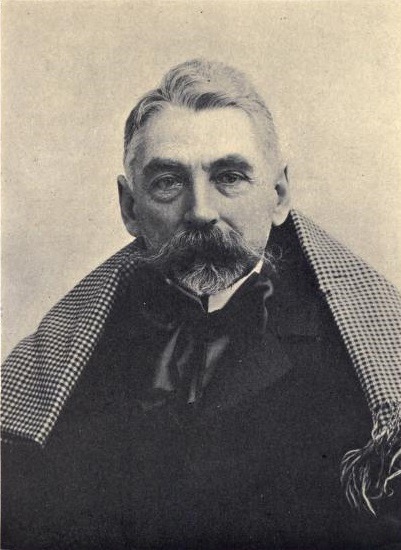
Stéphane Mallarmé, a central figure in 19th-century French literature, is often celebrated for his pioneering contributions to the Symbolist movement. Born on March 18, 1842, in Paris, Mallarmé’s life was marked by both personal tragedy and extraordinary literary innovation. As a poet, essayist, and critic, Mallarmé sought to transcend the conventional boundaries of language, crafting works that aimed to capture the ineffable and the mystical. His influence extends far beyond his lifetime, leaving an indelible mark on modern poetry and literary theory.
Early Life and Education
Mallarmé was born into a family of civil servants. His early life was marred by tragedy; at the tender age of five, he lost his mother, a loss that would profoundly shape his sensibilities. He was subsequently raised in the care of his father and other relatives, receiving his education at the Collège d’Auteuil. In 1857, the death of his younger sister Marie deepened his melancholic disposition, a mood that would later permeate his poetry.
The young Mallarmé initially pursued a career as a civil servant, much like his father, but found little satisfaction in this path. His dissatisfaction with his work led him to seek new horizons. In 1862, he traveled to England, a journey that proved to be pivotal in his development as a writer. It was during this time that he immersed himself in the study of English literature, particularly the works of John Keats, Edgar Allan Poe, and the philosophical writings of George Berkeley and G. W. F. Hegel.
Literary Career and Symbolism
Upon his return to France, Mallarmé began to publish his early poems in various literary magazines. His initial works, including the unfinished poem “Hérodiade,” reflect his association with the Parnassian movement, a group of poets who emphasized formal precision and clarity. However, Mallarmé’s poetic vision soon began to diverge from the Parnassians as he sought to explore more abstract and symbolically rich themes.
In 1867, Mallarmé started writing “Igitur, ou la folie d’Elbehnon,” a prose poem that delves into themes of destiny, identity, and existential despair. This work marked a significant departure from the descriptive style of the Parnassians, signaling Mallarmé’s shift towards Symbolism. Symbolism, a literary movement that emerged in France in the late 19th century, sought to express the underlying truths of the world through symbols and metaphor rather than direct representation.
Mallarmé’s most famous work, “L’Après-midi d’un faune” (The Afternoon of a Faun), was published in 1876. This poem, which explores the sensual experiences of a faun—a mythical half-man, half-goat creature—became a hallmark of Symbolist poetry. The poem was later adapted into a musical composition by Claude Debussy, further cementing its place in the canon of French literature.
The Parisian Intellectual Scene
By the 1870s, Mallarmé had become an influential figure in Paris’s intellectual and artistic circles. He was known for hosting “Mardis” (Tuesday gatherings) at his home, where he engaged in deep philosophical discussions with other prominent writers and artists of the time. These gatherings attracted literary luminaries such as Paul Verlaine, André Gide, Paul Valéry, and even the Irish playwright Oscar Wilde.
Mallarmé’s influence extended beyond his own writing. His theoretical writings, particularly his essays on literature and language, were instrumental in shaping the Symbolist movement. He argued that poetry should aim not to describe reality directly but to evoke the emotions and ideas that lie beneath the surface of the material world. This approach to poetry had a profound impact on subsequent generations of writers, including Guillaume Apollinaire, Rainer Maria Rilke, and the Italian poets Giuseppe Ungaretti and Eugenio Montale.
Later Life and Legacy
In 1887, Mallarmé published a collection of his poems titled “Poésies,” which showcased his mature style, characterized by its hermetic and enigmatic language. The Symbolist movement, with Mallarmé as one of its leading figures, reached its zenith in the late 19th century. However, despite his growing fame, Mallarmé continued to lead a relatively modest life. In 1893, at the age of 51, he was able to retire from his teaching position, thanks to a pension, which allowed him to devote himself entirely to his writing.
One of Mallarmé’s most ambitious projects was his attempt to create what he called the “Livre” or “Book,” a work that would encapsulate all human knowledge and experience. This project, which he referred to as the “absolute book,” was never completed, and it remains one of the great unrealized dreams of literary history. The idea of the “Livre” reflects Mallarmé’s belief in the power of language to transcend the physical world and reach into the realm of the ideal.
In 1897, Mallarmé published “Un Coup de Dés Jamais N’Abolira le Hasard” (A Throw of the Dice Will Never Abolish Chance), a poem that is often considered his masterpiece. This work, with its fragmented structure and unconventional use of typography, broke new ground in literary form and content. It embodies Mallarmé’s belief that the meaning of a poem lies not in the words themselves but in the spaces between them—the silences and pauses that give the poem its rhythm and depth.
Mallarmé’s health began to decline in the late 1890s, and he spent his final years in relative seclusion at his home in Valvins, near Fontainebleau. He passed away on September 9, 1898, at the age of 56, from a sudden throat condition.
The Impact of Mallarmé’s Work
Stéphane Mallarmé’s work had a lasting influence on the development of modern poetry. His innovative use of language, his exploration of the symbolic potential of words, and his commitment to the idea of the “absolute book” have inspired countless poets and writers. His work paved the way for the modernist movement of the early 20th century, influencing figures such as T.S. Eliot, Ezra Pound, and Wallace Stevens.
Mallarmé’s legacy also extends to the visual arts. His emphasis on the interplay between words and space influenced artists like Marcel Duchamp and the Dadaists, who sought to challenge conventional notions of art and representation. The typographical innovations seen in “Un Coup de Dés” can be seen as a precursor to concrete poetry, a movement that emerged in the 1950s and 1960s, which treats the visual arrangement of text as an integral part of the poetic experience.
Conclusion
Stéphane Mallarmé remains a towering figure in the history of literature, a poet whose work continues to resonate with readers and scholars alike. His life was one of relentless pursuit of artistic perfection, a quest that led him to explore the furthest reaches of language and meaning. Through his poetry, essays, and personal philosophy, Mallarmé sought to elevate literature to the highest form of art, one that could capture the mysteries of existence and the beauty of the ineffable.
His influence on subsequent generations of writers and artists is a testament to the enduring power of his vision. Stéphane Mallarmé’s work challenges us to see beyond the surface of words and to embrace the deeper, symbolic meanings that lie beneath—a legacy that continues to inspire and provoke thought to this day.


