
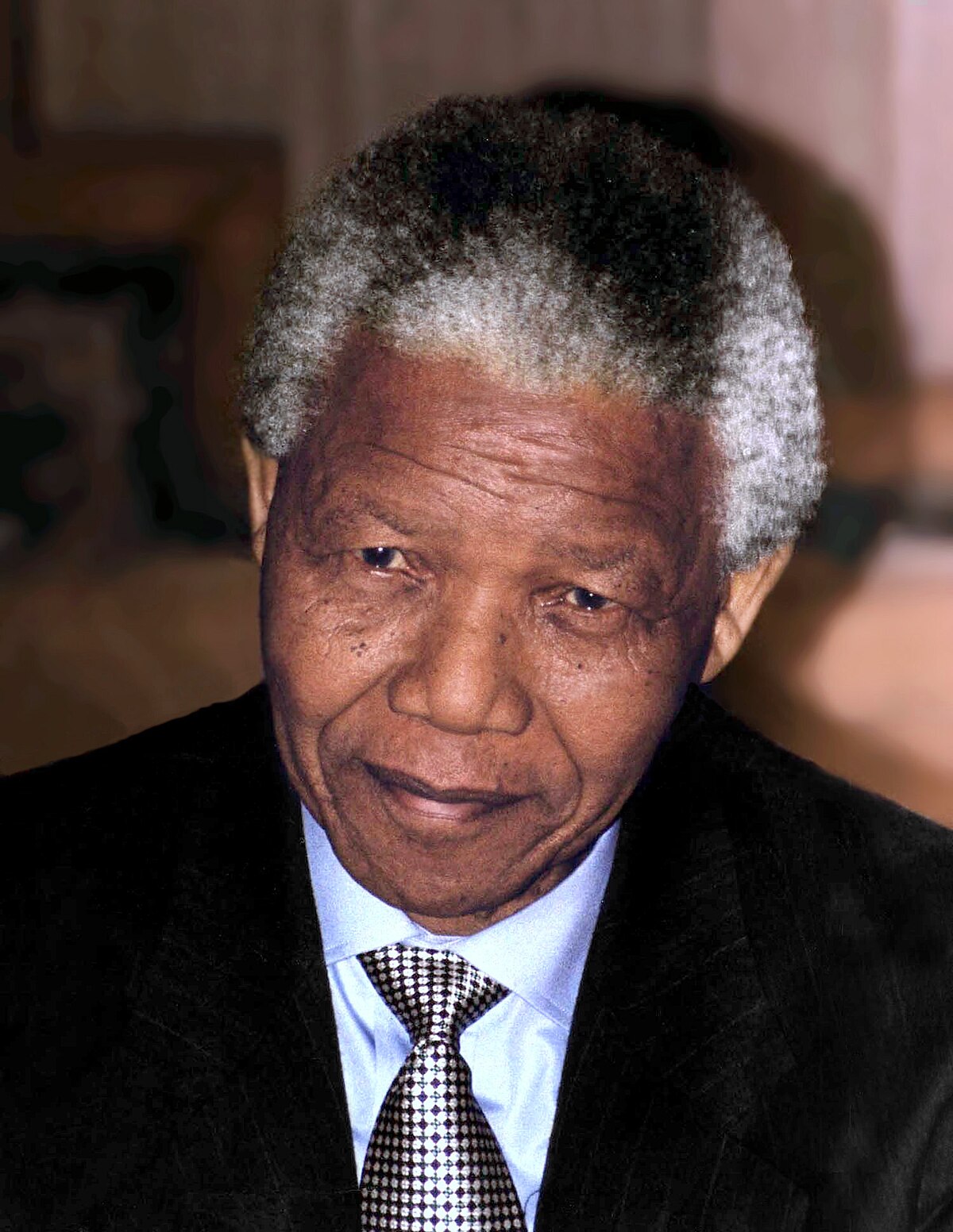
Nelson Mandela, a towering figure in the 20th century, remains a symbol of freedom, justice, and resilience. His life, marked by an unwavering commitment to fighting apartheid in South Africa, has left an indelible mark on the global consciousness. Born on July 18, 1918, in the rural village of Mvezo, in the Umtata district of South Africa’s Eastern Cape Province, Mandela’s journey from a rural upbringing to becoming the first Black president of South Africa is a story of extraordinary determination and courage.
Early Life and Education
Nelson Rolihlahla Mandela was born into the Thembu royal family, part of the Xhosa-speaking people, which gave him a traditional aristocratic lineage. His father, Gadla Henry Mphakanyiswa, was a chief and a counselor to the Thembu king. Mandela’s early life was influenced by African traditions and the stories of his ancestors, who had resisted colonial encroachment.
Mandela’s given name, Rolihlahla, roughly translates to “pulling the branch of a tree” or colloquially, “troublemaker,” a fitting name for a man who would challenge one of the most oppressive regimes in history. Mandela attended primary school in Qunu, where his teacher, Miss Mdingane, gave him the English name “Nelson,” a common practice among Africans at the time.
Mandela continued his education at the Clarkebury Boarding Institute and later Healdtown, a Wesleyan secondary school of some repute. His academic prowess and leadership qualities were evident early on, which led him to the University of Fort Hare, the only Western-style higher education institution for Black people in Southern Africa at the time. It was here that Mandela first became involved in student protests, marking the beginning of his lifelong commitment to activism.
Political Awakening and the African National Congress (ANC)
After leaving Fort Hare without a degree due to his involvement in a student protest, Mandela moved to Johannesburg, where he completed his Bachelor of Arts through the University of South Africa and began his law studies. Johannesburg was a place of political awakening for Mandela. The city exposed him to the harsh realities of apartheid, and it was here that he joined the African National Congress (ANC) in 1944.
The ANC, a political organization founded in 1912 to fight for the rights of the Black South African majority, became the platform for Mandela’s activism. Together with Oliver Tambo and Walter Sisulu, Mandela co-founded the ANC Youth League (ANCYL), advocating for a more radical approach to the struggle against apartheid. The ANCYL’s influence grew, leading to the adoption of the Programme of Action in 1949, which called for mass resistance to apartheid through strikes, boycotts, and civil disobedience.
The Sharpeville Massacre and Shift to Armed Struggle
The 1960s were a turning point in Mandela’s life and in South Africa’s history. The Sharpeville Massacre of March 21, 1960, where South African police opened fire on a crowd of peaceful protesters, killing 69 people, shocked the world and marked the start of an intense period of state repression. The government declared a state of emergency, banned the ANC, and arrested thousands of activists, including Mandela.
This brutal crackdown convinced Mandela and his colleagues that the time had come to shift from passive resistance to armed struggle. In 1961, Mandela co-founded Umkhonto we Sizwe (MK), meaning “Spear of the Nation,” the armed wing of the ANC. MK carried out sabotage campaigns against government installations, aiming to avoid civilian casualties while pressuring the government to dismantle apartheid. Mandela became known as “the Black Pimpernel” for his ability to evade capture by the authorities while leading MK’s operations.
Imprisonment and International Symbol of Resistance
Mandela’s life took a dramatic turn in 1962 when he was arrested and sentenced to five years in prison for inciting workers’ strikes and leaving the country without permission. The following year, he and other ANC leaders were charged with sabotage and attempting to violently overthrow the government during the infamous Rivonia Trial. In 1964, Mandela was sentenced to life imprisonment, narrowly escaping the death penalty.
During his 27 years in prison, primarily on Robben Island, Mandela became the face of the anti-apartheid struggle. Although cut off from the outside world, Mandela’s influence only grew. His letters, smuggled messages, and the unyielding stand of his fellow prisoners inspired the international anti-apartheid movement. The global call for his release became a rallying cry for human rights activists, with “Free Nelson Mandela” becoming a slogan of resistance.
Despite the harsh conditions of his imprisonment, Mandela continued to be a leader and a teacher, educating his fellow prisoners in what became known as the “Robben Island University.” He also engaged in secret negotiations with the apartheid government, recognizing that the end of apartheid could not be achieved through violence alone.
Release and Negotiations for a New South Africa
On February 11, 1990, after nearly three decades behind bars, Nelson Mandela was finally released from prison, a moment broadcast live to the world and celebrated across South Africa and beyond. His release marked the beginning of a new chapter in South African history.
Mandela immediately took on the role of a key negotiator in the process of dismantling apartheid. He worked tirelessly to bring about a peaceful transition to a multiracial democracy. His partnership with then-President F.W. de Klerk, although fraught with challenges, was instrumental in navigating the country through this volatile period. Their efforts culminated in the first multiracial elections in 1994, in which Mandela was elected as South Africa’s first Black president.
Presidency and Legacy
Mandela’s presidency from 1994 to 1999 was a period of profound transformation in South Africa. His leadership was characterized by a commitment to reconciliation and nation-building. One of his most significant achievements was the establishment of the Truth and Reconciliation Commission (TRC), led by Archbishop Desmond Tutu. The TRC was a groundbreaking initiative that aimed to heal the wounds of apartheid by uncovering the truth about human rights violations and fostering national unity.
Mandela’s government also focused on addressing the vast inequalities left by apartheid. His administration implemented policies aimed at economic growth, poverty reduction, and the expansion of services like healthcare and education to the previously marginalized Black population. However, Mandela’s presidency was not without challenges. South Africa continued to grapple with high levels of poverty, unemployment, and crime, and the new government faced criticism for not moving quickly enough on economic reforms.
Despite these challenges, Mandela’s presidency is widely regarded as a success, particularly in laying the foundations for a democratic South Africa. He chose not to seek re-election after his first term, a decision that further cemented his legacy as a leader who prioritized the country’s well-being over personal power.
Post-Presidency and Global Statesmanship
After stepping down as president, Mandela remained a global figure, using his influence to advocate for peace, justice, and human rights around the world. He established the Nelson Mandela Foundation in 1999, which focuses on promoting his legacy through dialogue and social justice initiatives.
Mandela also became a vocal advocate in the fight against HIV/AIDS, a major public health crisis in South Africa. His personal experience with the disease, as his son Makgatho died from AIDS-related complications in 2005, spurred him to raise awareness and combat the stigma associated with the disease.
In 2002, Mandela played a crucial role in mediating peace talks in the Democratic Republic of Congo, further solidifying his reputation as a global peacemaker. His moral authority was unparalleled, and he used it to speak out against human rights abuses and injustices wherever they occurred.
Personal Life and Family
Nelson Mandela’s personal life was as complex as his political journey. He was married three times and had six children. His first marriage was to Evelyn Ntoko Mase in 1944, which ended in divorce in 1958. His second marriage to Winnie Madikizela in 1958 became one of the most well-known relationships in the world, largely due to Winnie’s own role in the anti-apartheid struggle. However, their marriage was strained by Mandela’s long imprisonment and eventually ended in divorce in 1996.
In 1998, on his 80th birthday, Mandela married Graça Machel, the widow of Mozambican President Samora Machel. This union brought Mandela peace and companionship in his later years, and the couple remained together until his death.
Mandela’s children and grandchildren have continued his legacy in various ways, though the family has also faced its share of challenges and controversies. Mandela’s commitment to family, despite the sacrifices he made for his country, is a testament to his character and values.
Final Years and Death
In his final years, Mandela lived a quieter life, focusing on his family and the work of his foundation. He continued to make public appearances, though these became less frequent as his health declined. Mandela’s last public appearance was at the 2010 FIFA World Cup in South Africa, where he received a rapturous welcome from the crowd.
Nelson Mandela passed away on December 5, 2013, at the age of 95, at his home in Johannesburg. His death was met with an outpouring of grief and tributes from around the world. South Africa and the international community celebrated his life with a series of memorials and events, reflecting on his legacy as a champion of freedom and human dignity.
Conclusion
Nelson Mandela’s life is a testament to the power of resilience, forgiveness, and unwavering commitment to justice. From his early days as a young lawyer in Johannesburg to his rise as a global icon, Mandela’s journey was one of extraordinary courage and sacrifice. His ability to emerge from 27 years of imprisonment with a spirit of reconciliation rather than revenge is perhaps his most enduring legacy.
Mandela’s impact extends far beyond South Africa’s borders. He inspired countless individuals and movements around the world, proving that one person can indeed make a difference. His legacy continues to live on through the work of the Nelson Mandela Foundation, the countless streets and buildings named in his honor, and the global celebration of Mandela Day each year on his birthday.
In remembering Nelson Mandela, we are reminded of the importance of standing up for what is right, even when the path is difficult. His life teaches us that true leadership is about serving others, seeking justice, and promoting peace. As the world continues to face challenges of inequality, injustice, and conflict, Mandela’s example remains a guiding light for all who strive to create a better world.


