
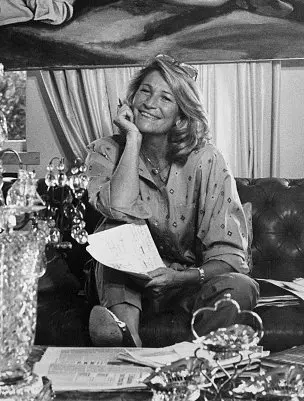
Marta Marzotto, born Marta Vacondio on February 24, 1931, in Reggio Emilia, Italy, was a celebrated Italian fashion designer, cultural icon, and socialite known for her vibrant personality, artistic influence, and high-profile relationships. Her life story is a fascinating journey from humble beginnings to becoming one of the most glamorous and influential figures in Italian society.
Early Life and Humble Beginnings
Marta Marzotto’s early life was far from the luxury and glamour that would later define her existence. She was born into a modest family; her father worked as a railway laborer, and her mother was an industrial worker who also took on jobs as a seamstress and rice field worker (mondina) to support the family. Growing up in the small town of Mortara in the Lomellina region, Marta’s childhood was marked by economic hardships and the challenges of rural life.
Despite these challenges, Marta showed an early interest in fashion and style. Her first job was as a mondina, following in her mother’s footsteps, working in the rice fields. However, her ambition and striking beauty set her on a different path. She began working as an apprentice seamstress in a small Milanese atelier owned by the Aguzzi sisters. This was the first step in what would become a remarkable career in the world of fashion.
Entry into the World of Fashion
Marta’s beauty and elegance did not go unnoticed. By the age of 15, she was already being courted by fashion houses and designers who recognized her potential as a model. Her height and poise made her a natural on the runway, and she soon began working as a mannequin, modeling the creations of various small fashion houses in Milan.
It was during this time that Marta met Count Umberto Marzotto, a member of the Marzotto family, one of Italy’s most prominent textile dynasties. Umberto, a nobleman known for his sophisticated taste and interest in fashion, was immediately captivated by Marta. Their relationship blossomed quickly, leading to a marriage that would catapult Marta into the upper echelons of Italian society.
Marriage to Count Umberto Marzotto
Marta Vacondio married Count Umberto Marzotto on December 18, 1954, in Milan. The marriage was a significant turning point in her life, bringing her into contact with the elite of Italian society and providing her with opportunities to cultivate her artistic and social interests. The couple had five children together: Paola, Annalisa, Vittorio Emanuele, Maria Diamante, and Matteo. Despite their seemingly perfect life, the marriage faced challenges, particularly in its later years.
In 1960, Marta Marzotto’s life took another dramatic turn when she met the renowned Italian painter Renato Guttuso. Their meeting at a dinner hosted by Rolly Marchi, a curator of Guttuso’s work, marked the beginning of a passionate and complex relationship that would last for decades.
The Muse of Renato Guttuso
Marta Marzotto became much more than just a lover to Renato Guttuso; she became his muse and the central female figure in many of his works. Their relationship, though extramarital, was intense and creative, with Marta inspiring some of Guttuso’s most famous pieces. Guttuso, known for his politically charged and emotionally evocative art, was deeply fascinated by Marta’s beauty and personality. He captured her essence in numerous paintings, most notably in the series of drawings known as the “Cartoline” (Postcards), which includes 37 mixed-media works.
Their relationship was conducted in secret for many years, with the two meeting in a Rome apartment provided by Guttuso’s art dealer, Romeo Toninelli. Despite Guttuso’s marriage to his wife Mimise, Marta remained a central figure in his life and work until his death in 1986.
Cultural Icon and Socialite
In the 1970s, Marta Marzotto firmly established herself as a cultural icon and socialite. She moved to Rome, where she created a legendary salon that became the meeting place for intellectuals, artists, and political figures. Her home in Piazza di Spagna was a hub of creativity and discussion, hosting some of the most prominent figures of the time. One of the most memorable moments in her salon’s history was a visit from Andy Warhol, the father of Pop Art, who was captivated by Marta’s charm and style.
Marta’s influence extended beyond the art world. She was also deeply involved in the fashion industry, both as a designer and as a tastemaker. Known for her bold style and love of luxury, Marta was often seen in the finest couture, and her opinion was highly regarded in fashion circles. Her designs, particularly her jewelry, became highly sought after, adding another dimension to her already multifaceted career.
Later Relationships and Personal Challenges
In addition to her relationship with Renato Guttuso, Marta Marzotto had a notable affair with Lucio Magri, a left-wing politician and journalist. Their relationship, which began in 1976, was marked by intellectual exchange and shared political ideals, though it was less public than her liaison with Guttuso. Despite the intensity of their relationship, it eventually ended, and Marta continued to be a prominent figure in both social and cultural circles.
After Guttuso’s death in 1986, Marta’s marriage to Umberto Marzotto officially ended in divorce. The dissolution of their marriage did not diminish Marta’s status; she retained the Marzotto name and continued to be a fixture in high society. However, her life was not without controversy. In 2006, Marta faced legal challenges when she was accused of reproducing Guttuso’s artworks without authorization. She was initially convicted and sentenced to eight months in prison, but the conviction was later overturned on appeal.
Legacy and Impact on Italian Culture
Marta Marzotto’s legacy is multifaceted. She was a woman of contrasts: born into humble beginnings, she rose to become a symbol of Italian glamour and sophistication. Her life was marked by her relationships with powerful men, her influence in the fashion industry, and her role as a muse to one of Italy’s greatest artists.
Marta was also a pioneer in many ways. She was one of the first Italian women to break into the upper echelons of society based on her own talents and charisma, rather than just her marriage. Her involvement in the arts, fashion, and culture helped shape the Italian aesthetic of the 20th century. Her work as a designer, particularly in jewelry, showcased her keen eye for beauty and her ability to translate that vision into tangible art.
Moreover, Marta’s role as a cultural mediator between the worlds of art, politics, and fashion cannot be understated. Her salons were not just social gatherings; they were places where ideas were exchanged, and where the boundaries between different creative disciplines were blurred. This cross-pollination of ideas contributed to the vibrant cultural landscape of Italy during the post-war period.
Final Years and Death
In her later years, Marta Marzotto remained active in the cultural scene, although she eventually moved back to Milan, where she spent her final years. She authored two books, “Il successo dell’eccesso” (The Success of Excess) and “Finestra su Piazza di Spagna” (Window on Piazza di Spagna), reflecting on her life experiences and the many personalities she had encountered.
Marta Marzotto passed away on July 29, 2016, at the age of 85 in Milan, after being hospitalized at La Madonnina clinic. Her death marked the end of an era in Italian culture, but her legacy lives on through the many lives she touched and the indelible mark she left on the worlds of fashion, art, and society.
Conclusion: The Enduring Influence of Marta Marzotto
Marta Marzotto’s life was a tapestry of art, fashion, love, and influence. She was a woman who defied the conventions of her time, creating a space for herself in a world that was often dominated by men. Her relationships with powerful figures like Renato Guttuso and Umberto Marzotto, her role as a cultural and fashion icon, and her contributions to Italian society all speak to her remarkable ability to navigate and shape the cultural currents of her time.
Her story is one of resilience and reinvention. From the rice fields of Lomellina to the glamorous salons of Rome, Marta Marzotto’s journey was marked by her ability to adapt, to charm, and to inspire. Her life serves as a reminder that true influence comes not just from power or wealth, but from the ability to touch the lives of others and to leave a lasting legacy.
As we look back on Marta Marzotto’s life, it is clear that she was much more than just a socialite or a fashion icon. She was a true cultural force, whose impact on Italian society will be felt for generations to come.


