
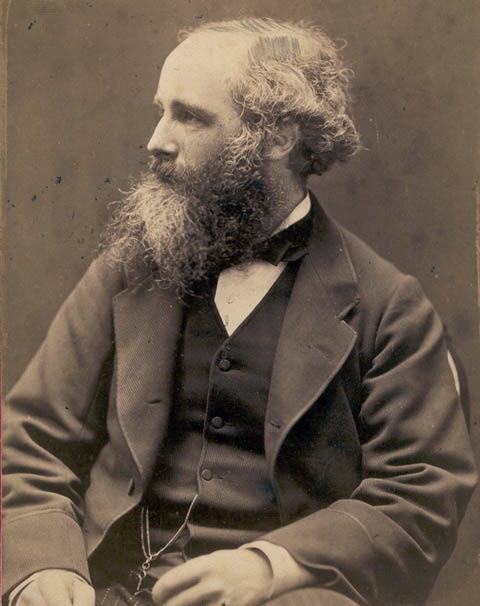
James Clerk Maxwell, born on June 13, 1831, in Edinburgh, Scotland, is a towering figure in the history of science. Renowned for his groundbreaking contributions to physics, particularly in the field of electromagnetism, Maxwell’s work laid the foundation for many of the technological advancements that define the modern world. His life was one of intellectual curiosity, academic excellence, and profound influence on future generations of scientists.
Early Life and Education
James Clerk Maxwell was born into a well-off family at 14 India Street in Edinburgh. His father, John Clerk Maxwell, was a lawyer, and his mother, Frances Cay, played a significant role in his early education. Maxwell’s childhood was marked by a deep curiosity about the natural world. His family moved to Glenlair, a country estate in Kirkcudbrightshire, where Maxwell spent much of his youth exploring the countryside and experimenting with various scientific concepts.
At the age of eight, tragedy struck when Maxwell’s mother passed away, leaving a profound impact on him. His education, initially guided by his mother, was taken over by a series of tutors. However, it wasn’t until he attended the Edinburgh Academy at the age of ten that his formal education began to take shape. Despite being teased by his peers, who nicknamed him “dafty” due to his peculiar behavior and intense focus on his studies, Maxwell excelled academically.
Maxwell’s talent for mathematics and science became evident early on. At just 14 years old, he presented a paper on the properties of oval curves to the Royal Society of Edinburgh—a remarkable achievement for someone so young. This early work hinted at the mathematical prowess that would later define his career.
Academic Pursuits and Early Contributions
Maxwell’s academic journey continued at the University of Edinburgh, where he enrolled at the age of 16. There, he studied under some of the leading scientists of the time, including Sir William Hamilton and James David Forbes. However, it was at the University of Cambridge, where he transferred in 1850, that Maxwell’s brilliance truly began to shine. He joined Peterhouse College but later transferred to Trinity College, believing it offered better opportunities for academic recognition.
In 1854, Maxwell graduated with a degree in mathematics, earning second place in the university’s prestigious mathematical tripos examination. His time at Cambridge was marked by intense intellectual activity, and he quickly became known for his innovative approach to complex scientific problems.
One of Maxwell’s earliest significant contributions was his work on the stability of Saturn’s rings. The problem of understanding these rings had puzzled scientists for years, but Maxwell’s research, conducted while he was a professor at Marischal College in Aberdeen, provided a solution. He demonstrated that the rings could only be stable if they were composed of numerous small particles rather than a solid or fluid mass. This work earned him the Adams Prize in 1857 and established his reputation as a leading mathematician and physicist.
Development of Electromagnetic Theory
Maxwell’s most famous and enduring contribution to science is undoubtedly his formulation of the classical theory of electromagnetism. Building on the experimental work of Michael Faraday, Maxwell sought to express the relationship between electricity, magnetism, and light through a set of mathematical equations.
In a series of papers published in the 1850s and 1860s, Maxwell introduced the concept of the electromagnetic field and proposed that light itself is an electromagnetic wave. His 1865 paper, “A Dynamical Theory of the Electromagnetic Field,” culminated in what we now know as Maxwell’s equations—four partial differential equations that describe the behavior of electric and magnetic fields and their interaction with matter.
Maxwell’s equations were revolutionary. They unified the previously separate fields of electricity and magnetism and demonstrated that light is an electromagnetic phenomenon. This unification of concepts was so profound that it is often referred to as the “second great unification in physics,” the first being Isaac Newton’s unification of celestial and terrestrial mechanics.
Maxwell’s work in electromagnetism laid the groundwork for many technological advancements, including the development of radio, television, and other forms of wireless communication. It also influenced the later work of Albert Einstein, who credited Maxwell’s equations as the foundation for his own theory of relativity.
Contributions to Kinetic Theory and Thermodynamics
In addition to his work on electromagnetism, Maxwell made significant contributions to the kinetic theory of gases and thermodynamics. His 1866 paper on the distribution of molecular velocities in gases, known as the Maxwell-Boltzmann distribution, provided a statistical basis for understanding the behavior of gases at the molecular level. This work was crucial in advancing the field of statistical mechanics and helped explain how temperature and pressure arise from the motion of molecules.
Maxwell’s kinetic theory also introduced the concept of the “Maxwell demon,” a thought experiment that challenges the second law of thermodynamics. The demon, an imaginary being capable of sorting molecules by their speed, appeared to violate the law by decreasing entropy without expending energy. This paradox sparked debates among physicists and continues to be a topic of discussion in modern physics, particularly in the study of information theory and quantum mechanics.
Later Career and Legacy
Maxwell’s career was marked by a series of prestigious academic appointments. After his time at Marischal College, he became a professor of natural philosophy at King’s College London in 1860. It was during his tenure there that he conducted some of his most important experimental work, including his research on the electromagnetic nature of light.
In 1865, Maxwell resigned from King’s College and returned to his family’s estate in Glenlair, where he continued his research in relative seclusion. However, he remained active in the scientific community and was instrumental in the establishment of the Cavendish Laboratory at the University of Cambridge. In 1871, he was appointed as the first Cavendish Professor of Physics, a position that allowed him to design and oversee the construction of the laboratory. The Cavendish Laboratory would go on to become one of the world’s leading centers for experimental physics.
Maxwell’s final years were marked by declining health. Despite suffering from abdominal cancer, he continued to teach and conduct research until his condition worsened. He returned to Glenlair in the summer of 1879 and passed away on November 5, 1879, at the age of 48. His death was a great loss to the scientific community, but his contributions have left an indelible mark on the world.
Historical Context and Impact on Science
To fully appreciate the significance of James Clerk Maxwell’s work, it is important to consider the broader historical context in which he lived. The 19th century was a period of rapid scientific and industrial progress, characterized by the development of new technologies and the expansion of knowledge across various disciplines. Maxwell’s work was at the forefront of this intellectual revolution, bridging the gap between classical physics and the emerging field of electromagnetism.
Maxwell’s equations not only provided a theoretical framework for understanding electromagnetic phenomena but also paved the way for the development of modern physics. His insights into the nature of light and electromagnetic waves were crucial for the later development of quantum mechanics and the theory of relativity. Indeed, Albert Einstein famously remarked that the work of James Clerk Maxwell “changed the world forever.”
In addition to his scientific achievements, Maxwell was also known for his humility, kindness, and dedication to his students. He was a deeply religious man, and his faith influenced his approach to science, which he saw as a means of exploring the divine order of the universe. His ability to combine rigorous scientific inquiry with a sense of wonder and curiosity has made him an enduring figure in the history of science.
Legacy and Modern Relevance
James Clerk Maxwell’s legacy is one of profound influence on both the theoretical and practical aspects of science. His work on electromagnetism, in particular, has had a lasting impact on technology and has shaped the way we understand the natural world.
Today, Maxwell’s equations remain a cornerstone of physics education and research. They are used to design and analyze electrical circuits, antennas, and communication systems, and they continue to inspire new discoveries in fields such as photonics and quantum computing. Maxwell’s contributions to the kinetic theory of gases also continue to be relevant in the study of thermodynamics and statistical mechanics.
In recognition of his contributions, numerous institutions and scientific awards have been named in Maxwell’s honor. The James Clerk Maxwell Foundation, established in Edinburgh, promotes the study of physics and supports young scientists in their research endeavors. Maxwell’s name is also immortalized in the SI unit of magnetic flux, the maxwell, and in the Maxwell-Boltzmann distribution, which remains a fundamental concept in statistical mechanics.
Conclusion: The Enduring Influence of James Clerk Maxwell
James Clerk Maxwell’s life and work represent the pinnacle of scientific achievement. His contributions to electromagnetism, kinetic theory, and thermodynamics have had a lasting impact on the world, influencing everything from the development of modern technology to our understanding of the universe. Maxwell’s ability to see connections between seemingly disparate phenomena and to express these connections through elegant mathematical equations set him apart as one of the greatest physicists of all time.
Maxwell’s legacy continues to inspire scientists and engineers around the world. His work laid the foundation for many of the technological advancements that define our modern lives, and his insights into the nature of light and electromagnetic waves have shaped the course of scientific inquiry for generations. As we continue to explore the mysteries of the universe, the influence of James Clerk Maxwell remains as strong as ever.


