
Introduction
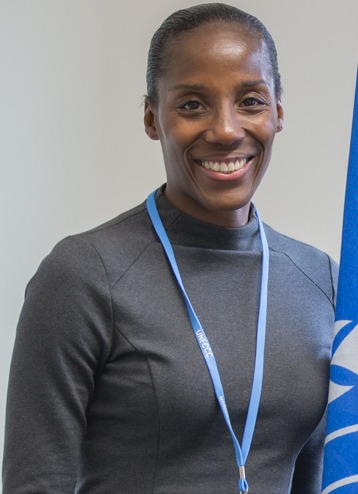
Fiona May, born on December 12, 1969, in Slough, United Kingdom, is a renowned British-Italian long jumper celebrated for her exceptional athletic achievements and contributions to both track and field and entertainment. Her career spanned over two decades, during which she achieved numerous records and accolades. This article provides an in-depth look into Fiona May’s life, exploring her rise to fame, significant accomplishments, and post-athletic career, reflecting on her impact in the world of sports and beyond.
Early Life and Athletic Beginnings
Fiona May was born to Jamaican parents in Slough, a town in Berkshire, England. From a young age, she displayed a natural talent for athletics, particularly in long jumping. Her athletic journey began in earnest when she represented Great Britain at the 1986 Junior World Championships in Athens, where she finished eighth with a jump of 6.11 meters. This early success marked the beginning of a promising career.
The following year, May achieved her first major victory at the European Junior Championships in Birmingham, winning gold with a jump of 6.64 meters. This success was a precursor to her breakthrough into senior athletics. By 1988, she had made her mark on the international stage by winning the Junior World Championships in Sudbury, Canada, with a jump of 6.88 meters. She also competed in the Seoul Olympics, where she qualified for the finals and finished sixth.
Rise to Prominence
Fiona May’s rise to prominence continued throughout the late 1980s and early 1990s. She earned a bronze medal at the European Championships in Split and a bronze in the European Cup in Gateshead. Her performance at the Commonwealth Games in Auckland also earned her a bronze medal. Despite some setbacks, including a disappointing 19th place at the World Championships in Tokyo and missing the Barcelona Olympics in 1992, May remained a formidable competitor.
The mid-1990s marked a turning point in May’s career. In 1993, she won a bronze medal at the European Indoor Championships in Munich. Her performances at the 1993 World Championships in Stuttgart were less successful, with a 14th-place finish. Nevertheless, May’s career was about to take a significant turn.
Transition to Italian Citizenship and Further Success
In 1994, Fiona May obtained Italian citizenship through her marriage to Italian long jumper and pole vaulter Gianni Iapichino. This transition allowed her to compete for Italy, and she quickly made an impact on the international athletics scene. Her debut for Italy came at the European Championships in Helsinki, where she won a bronze medal with a jump of 6.90 meters.
The year 1995 was particularly notable for May. At the World Championships in Gothenburg, Sweden, she won gold with a jump of 6.98 meters, making her one of the most successful long jumpers of her time. The following year, at the 1996 Atlanta Olympics, she won a silver medal with a jump of 7.02 meters, setting a new Italian record.
In 1997, May set another Italian record at the World Indoor Championships in Paris, with a jump of 6.86 meters. Her achievements continued to impress as she won a bronze medal at the World Championships in Athens in 1997 and another gold at the European Indoor Championships in Valencia in 1998. Her performances at these events solidified her status as a leading long jumper.
Continued Achievements and Challenges
Fiona May’s success continued into the late 1990s and early 2000s. She won silver at the European Championships in Budapest with a jump of 7.11 meters, a new Italian record. At the World Championships in Seville in 1999 and the Sydney Olympics in 2000, she secured silver medals. In recognition of her contributions to sports, she was honored with the title of Officer of the Order of Merit of the Italian Republic by President Carlo Azeglio Ciampi in 2000.
May’s final years as a competitive athlete included notable performances at the 2001 World Championships in Edmonton, where she won gold with a jump of 7.02 meters. However, following the birth of her daughter Larissa in 2002, May took a break from competitive athletics. Her return to the sport saw mixed results, including a bronze at the 2003 European Cup in Florence and a ninth-place finish at the World Championships in Paris.
Retirement and Post-Athletic Career
Fiona May retired from competitive athletics in 2005. Her retirement marked the end of a storied career that saw her become one of Italy’s most decorated long jumpers. After retiring from sports, May transitioned into a career in entertainment. She became a prominent figure in Italian media, participating in various television shows and acting roles.
May’s post-athletic career includes appearances on the Italian television show “Ballando con le Stelle,” where she danced with professional dancer Raimondo Todaro. She also acted in Italian TV series such as “Butta la Luna” and “Butta la Luna 2,” addressing themes of racism and integration. In 2011, she appeared as a guest star on the Mediaset sitcom “Così fan tutte.”
Despite her success in entertainment, May’s personal life also saw changes. In 2011, she announced her separation from her husband Gianni Iapichino. Throughout her post-athletic career, Fiona May has continued to be a prominent figure in Italy, engaging in various public and media activities.
Legacy and Impact
Fiona May’s legacy extends beyond her athletic achievements. Her contributions to the sport of long jumping have left an indelible mark on the athletics community. She set multiple records and won numerous medals, becoming a symbol of excellence in the sport. Her transition from representing Great Britain to competing for Italy exemplifies her adaptability and commitment to her athletic career.
May’s influence also extends to her work in entertainment, where she has used her platform to address important social issues and contribute to Italian media. Her post-athletic career has allowed her to remain in the public eye and continue making a positive impact.
Conclusion
Fiona May’s journey from a young athlete in Slough to an international sports icon and media personality is a testament to her talent, determination, and versatility. Her achievements in long jumping and her successful transition to a career in entertainment highlight her multifaceted contributions to both sports and society. As a celebrated figure in athletics and media, Fiona May’s legacy continues to inspire and resonate with audiences worldwide.


