
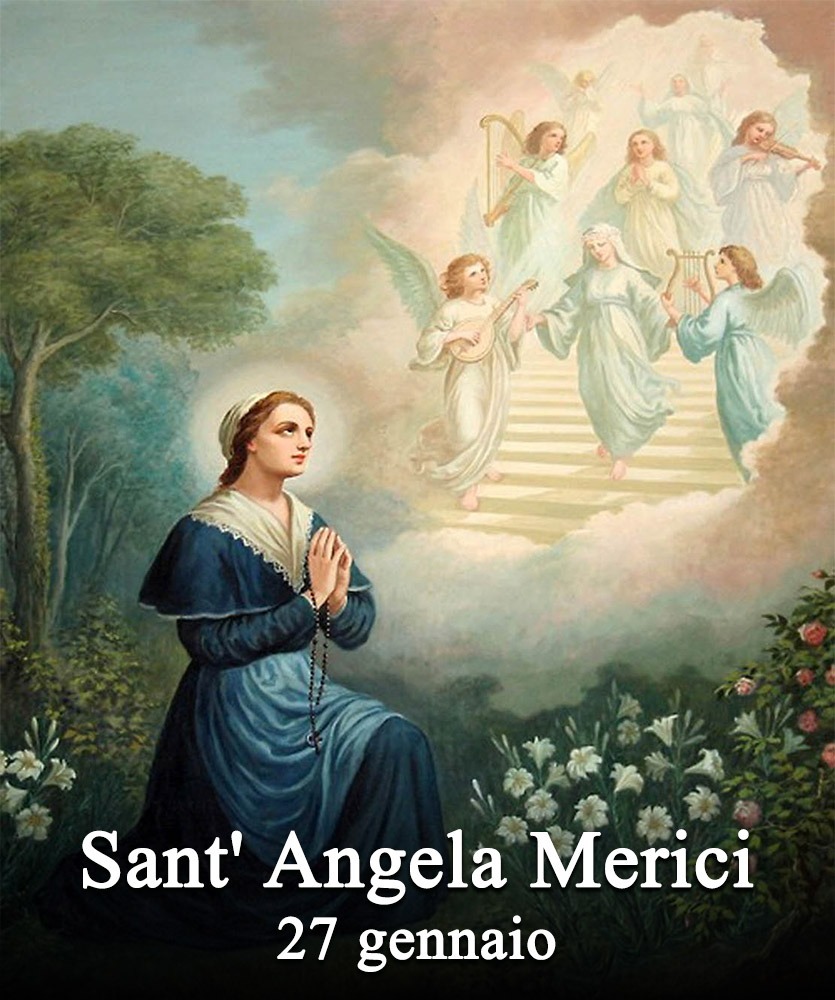
Sant’Angela Merici, born on March 21, 1474, in Desenzano del Garda, near Brescia, Italy, is a pivotal figure in the history of the Catholic Church. Renowned as the founder of the Company of Saint Ursula (Orsoline), she played a significant role in the religious and educational spheres during the Renaissance. Canonized by Pope Pius VII on May 24, 1807, Sant’Angela Merici’s influence continues to resonate within the Church, with her feast day celebrated on January 27, the day of her death in 1540. This article explores the life, legacy, and lasting impact of Sant’Angela Merici, offering detailed insights into her contributions to faith and education.
Early Life and Spiritual Awakening
Angela Merici was born into a modest but devout Christian family in the late 15th century, a time of significant religious and cultural upheaval in Europe. At the age of ten, tragedy struck when Angela lost both of her parents, leaving her and her sister orphaned. The two sisters were taken in by their uncle in Salò, a small town not far from Desenzano. However, this period of relative stability was short-lived as Angela’s sister died suddenly, without having received the final sacraments—a source of deep spiritual anxiety for Angela.
This early loss profoundly impacted Angela, intensifying her religious devotion. She sought solace in prayer, finding comfort in her faith. It is said that during this time of mourning and spiritual crisis, Angela experienced a vision in which she saw her deceased sister in the company of angels, a revelation that reaffirmed her belief in the power of prayer and the grace of God. This vision also marked the beginning of Angela’s lifelong commitment to serving God and educating others in the Christian faith.
At a young age, Angela became a tertiary of the Franciscan order, following the teachings of St. Francis of Assisi. Her life as a Franciscan tertiary deepened her spiritual practice and connected her to a broader community of religious individuals dedicated to poverty, chastity, and obedience. Angela’s early religious experiences laid the groundwork for her later work in founding the Company of Saint Ursula, an order dedicated to the education and spiritual development of young women.
Angela Merici’s Mission: Education and Spiritual Guidance
Angela Merici’s early adult life was marked by a deepening sense of mission. After the death of her uncle, she returned to her childhood home in Desenzano. It was here that Angela began to gather young girls from the town, providing them with basic education and religious instruction. Her humble home became a school where Angela taught the fundamentals of Christian doctrine, emphasizing the importance of a personal relationship with God and the virtues of humility and charity.
Angela’s commitment to education was revolutionary for her time. In an era when women’s roles were largely confined to the domestic sphere, Angela recognized the importance of educating girls, not only in religious matters but also in moral and practical knowledge that would enable them to lead virtuous lives. Her approach was rooted in the belief that educated women would be better equipped to fulfill their roles within the family and community, thereby strengthening the moral fabric of society.
Her work quickly gained recognition, and her reputation as a teacher and spiritual guide spread beyond Desenzano. In 1516, Angela was invited to the city of Brescia, where she established her second school. Brescia, a city with a rich history and strong religious traditions, provided Angela with a larger platform to carry out her mission. It was here, in a modest house near the Church of Saint Afra, that Angela laid the foundation for what would become the Company of Saint Ursula.
The Foundation of the Company of Saint Ursula (Orsoline)
On November 25, 1535, Angela Merici, along with 28 other women, founded the Company of Saint Ursula. This new religious order was unlike any other at the time. The women who joined Angela were not nuns in the traditional sense—they did not live in cloistered convents, nor did they wear habits or take formal vows of poverty, chastity, and obedience. Instead, they lived in their own homes, leading lives of chastity and service within their communities.
The mission of the Company of Saint Ursula was to provide religious education to young girls, preparing them to live devout Christian lives. Angela’s vision was to create a network of women who could teach and guide others in the faith, thereby extending the influence of Christianity within society. The rule of the Company, which was approved by the Bishop of Brescia, Francesco Cornaro, in 1536, emphasized the importance of charity, humility, and the spiritual development of its members.
Angela Merici was elected as the first Superiora and Mother General of the order, a position she held for the rest of her life. Her leadership was marked by a deep spiritual wisdom and a practical approach to the challenges faced by the members of the Company. She was known for her gentle yet firm guidance, always encouraging her followers to live according to the teachings of Christ.
The establishment of the Company of Saint Ursula was a significant development in the history of the Church, particularly in its approach to the education of women. Angela’s innovative model allowed women to engage in religious work without the restrictions of cloistered life, enabling them to have a direct impact on their communities. This model would later inspire the development of other religious orders dedicated to education and social service.
Mystical Experiences and Pilgrimage
Throughout her life, Angela Merici was known for her mystical experiences, which played a crucial role in shaping her spiritual mission. These visions and revelations were seen as divine confirmations of her work and guided her in the establishment of the Company of Saint Ursula.
One of the most significant mystical experiences in Angela’s life occurred during a pilgrimage to the Holy Land in 1524. While on the island of Crete, Angela suddenly lost her sight. Despite this affliction, she continued her pilgrimage, demonstrating her unwavering faith and determination. Remarkably, on her return journey, Angela’s sight was miraculously restored at the same spot where she had lost it. This experience deepened her spiritual resolve and further convinced her of the divine support for her mission.
Angela’s pilgrimage to the Holy Land was not just a journey of personal piety; it was also a symbolic act of devotion that connected her work to the broader Christian tradition. The pilgrimage served as a testament to her faith and underscored the importance of perseverance in the face of adversity. This episode in Angela’s life is often cited as a key moment that solidified her reputation as a holy woman and a leader within the Church.
The Legacy of Sant’Angela Merici and the Ursuline Order
Sant’Angela Merici passed away on January 27, 1540, at the age of 65. By the time of her death, the Company of Saint Ursula had grown to include 150 members. Angela’s vision of a community of women dedicated to the education and spiritual development of young girls had become a reality, and her work laid the foundation for what would become one of the most influential religious orders in the world.
After Angela’s death, the Ursuline Order continued to grow and evolve. Initially, the members of the order lived as “virgins in the world,” practicing a communal life without taking formal religious vows. However, as the order expanded, different branches developed, some of which adopted more traditional monastic practices.
By the mid-16th century, the Ursuline Order had spread across Europe, with branches in France, Germany, and beyond. In some regions, the Ursulines began to live in convents, taking formal vows and dedicating themselves to a life of prayer and service. The order also expanded its educational mission, establishing schools for girls in many cities across Europe.
The Ursuline Order played a crucial role in the Catholic Reformation, providing education to young women and promoting the values of the Church at a time when religious authority was being challenged. The order’s emphasis on education, particularly for women, was revolutionary and had a lasting impact on the role of women within the Church and society.
Today, the legacy of Sant’Angela Merici lives on in the many Ursuline schools and institutions around the world. The order’s commitment to education and the spiritual development of young women remains a central focus of its mission. The Ursulines continue to adapt to the changing needs of society, while staying true to the vision of their founder.
In recognition of her contributions to the Church and her role as a spiritual leader, Angela Merici was beatified by Pope Clement XIII in 1768 and canonized by Pope Pius VII in 1807. Her feast day, January 27, is celebrated by the Catholic Church around the world, honoring her as a model of faith, perseverance, and dedication to the education of women.
Conclusion: The Enduring Influence of Sant’Angela Merici
Sant’Angela Merici’s life and work continue to inspire generations of Catholics and educators. Her innovative approach to religious life and education, particularly for women, was groundbreaking in the 16th century and remains relevant today. The Ursuline Order, founded by Angela, has grown into a global institution, with a presence in countries around the world.
Angela’s legacy is not just in the institutions she founded, but in the lives of the countless women who have been educated and inspired by the Ursulines. Her vision of a community of women dedicated to God and the education of others has had a lasting impact on the Church and continues to shape the way education is approached within the Catholic tradition.
As we reflect on the life of Sant’Angela Merici, we are reminded of the power of faith and the importance of education in shaping the future. Her life serves as a testament to the enduring impact of one woman’s vision and the lasting influence of her work on the world.


