
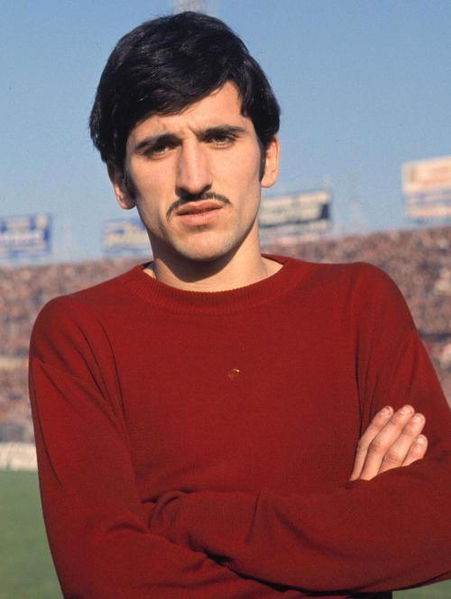
Gigi Meroni, affectionately known as “La Farfalla Granata” (The Maroon Butterfly), was an Italian footballer who captured the hearts of many during the 1960s. His life, tragically cut short, remains a poignant chapter in the history of Italian football. This article delves into the life of Gigi Meroni, exploring his rise to fame, his unique personality, and the impact he had both on and off the field.
Early Life and Introduction to Football
Luigi “Gigi” Meroni was born on February 24, 1943, in Como, Italy. Growing up in a working-class family, Meroni’s early years were marked by the hardships of post-war Italy. His mother, Rosa, was a textile worker, and Gigi lost his father when he was just two years old. Raised alongside his two siblings, Celestino and Maria, Meroni showed an early interest in football, playing in the streets and the Oratorio of San Bartolomeo in Como.
Football became more than just a pastime for Meroni; it was his passion and escape. He joined the local team, Libertas San Bartolomeo, where his talent quickly became apparent. His exceptional dribbling skills, speed, and ability to outmaneuver opponents earned him a spot in the youth team of Como in 1960. At Como, Meroni made his professional debut and began to make a name for himself, scoring three goals in 25 appearances.
Rise to Fame with Genoa
In 1962, Gigi Meroni transferred to Genoa, where his career truly began to flourish. It was here that he started to gain national recognition for his abilities on the pitch. Over two seasons with Genoa, Meroni played 42 matches and scored seven goals. His unorthodox playing style, characterized by quick dribbles and sudden changes of direction, made him a formidable opponent for any defender.
However, Meroni’s time at Genoa was not without controversy. After one match, he refused to undergo a mandatory doping test, claiming that he had forgotten the test kit at his hotel. This incident, coupled with the fact that three of his teammates tested positive for amphetamines, led to a five-match suspension. Despite this setback, Meroni’s talent was undeniable, and his performances on the field continued to impress.
The Torino Years and Stardom
In 1964, Meroni made a significant move to Torino, a transfer that sparked both excitement and controversy. Torino, recovering from the tragic Superga air disaster of 1949 that decimated their team, was on the rise again. Meroni’s transfer fee of 300 million lire was a record for a player of his age, but it was money well spent. Under the guidance of legendary coach Nereo Rocco, Meroni quickly became a fan favorite.
Meroni’s impact at Torino was immediate. His flair on the field, combined with his bohemian lifestyle, made him a unique figure in Italian football. Known for his long hair and love for art and fashion, Meroni defied the conservative norms of the time. He lived with his girlfriend, Cristiana Uderstadt, a former circus performer who was still legally married, a fact that scandalized many but endeared him even more to the fans who saw him as a symbol of freedom and rebellion.
On the field, Meroni formed a lethal attacking partnership with Nestor Combin, a former AC Milan forward. Together, they terrorized Serie A defenses, with Meroni scoring 22 goals in just over 100 appearances for Torino. His performances were not just about goals, though; his creativity, vision, and dribbling made him the engine of the Torino attack.
International Recognition and Controversy
Meroni’s stellar performances for Torino did not go unnoticed, and in 1965, he earned his first call-up to the Italian national team. He made his debut in a World Cup qualifying match against Poland. In 1966, Meroni was part of the Italian squad for the World Cup in England, a tournament remembered for Italy’s shocking elimination at the hands of North Korea.
Meroni’s time with the national team was marked by conflict with coach Edmondo Fabbri. Despite his undeniable talent, Meroni only played one match during the World Cup, a goalless draw against the Soviet Union. This decision was reportedly due to personal disagreements between Meroni and Fabbri, highlighting the friction between Meroni’s free-spirited nature and the rigid structures of the national team.
The Legend Grows and the Tragic End
One of the most memorable moments of Meroni’s career came in 1967 when Torino faced Inter Milan at the San Siro. Inter, managed by the legendary Helenio Herrera, had gone three years without losing a home match. However, Meroni’s brilliance on the day ended that streak. He scored a stunning goal, lobbing the ball over the goalkeeper from the edge of the penalty area, leading Torino to a famous victory.
Tragically, Gigi Meroni’s life was cut short later that same year. On October 15, 1967, after a match against Sampdoria, Meroni was involved in a fatal car accident in Turin. As he crossed the road near Corso Re Umberto, Meroni was struck by a car driven by a young man named Attilio Romero, who would, in a twist of fate, become the president of Torino in 2000.
Meroni was rushed to the Mauriziano Hospital, but despite the efforts of the medical staff, he succumbed to his injuries. His death sent shockwaves through the football community and beyond. Meroni was only 24 years old, and his untimely passing robbed Italian football of one of its brightest stars.
The Aftermath and Legacy
The death of Gigi Meroni devastated the Torino community. His funeral was attended by over 20,000 people, a testament to the impact he had on the city and its people. The club’s chaplain, Don Francesco Ferraudo, faced criticism for conducting the funeral service with religious rites, given Meroni’s unconventional lifestyle.
Meroni was buried in his hometown of Como, but even in death, controversy surrounded him. Two months after his burial, his grave was desecrated by a deranged fan who could not cope with the loss of his idol. The fan exhumed Meroni’s body and removed his liver, an act that shocked the nation and underscored the deep emotional connection many felt with the player.
Gigi Meroni’s legacy lives on in the hearts of Torino fans and Italian football enthusiasts. He is remembered not just for his skills on the pitch but for his individuality and defiance of societal norms. Meroni was a player who lived life on his terms, and his influence extended beyond football into the broader cultural landscape of 1960s Italy.
Conclusion: A Football Icon Beyond the Game
Gigi Meroni’s story is one of talent, rebellion, and tragedy. He was a footballer who captured the imagination of a generation, not just with his performances on the field but with his personality and lifestyle. In an era when conformity was the norm, Meroni stood out as a symbol of individuality and freedom.
His career, though short-lived, left an indelible mark on Italian football. Meroni’s contributions to Torino helped the club rebuild after the Superga tragedy, and his memory continues to be celebrated by the club and its supporters. His untimely death only added to the mystique surrounding him, cementing his status as a legend of the game.
Today, Gigi Meroni is remembered as much for what he represented off the pitch as for what he achieved on it. He was a trailblazer in many ways, and his story serves as a reminder of the fleeting nature of life and the lasting impact one person can have on the world.


