
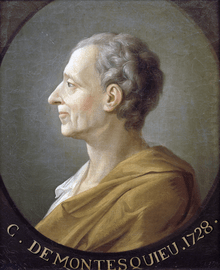
Charles-Louis de Secondat, better known as Montesquieu, was a towering figure in the intellectual landscape of the 18th century. His ideas on governance, liberty, and the separation of powers have profoundly influenced the development of modern political systems. Born on January 18, 1689, in the château of La Brède in the southwest of France, Montesquieu’s life and works continue to resonate today, making him a seminal figure in the history of political thought.
Early Life and Education
Montesquieu was born into a family of minor nobility, and his father, Jacques de Secondat, was a baron, while his mother, Marie-Françoise de Pesnel, was a baroness. The family’s background in law and governance heavily influenced Montesquieu’s early education and career choices. After his mother’s death when he was seven, Montesquieu was sent to the Collège de Juilly, a prestigious school near Paris known for educating the sons of the French aristocracy.
Upon completing his education, Montesquieu followed in his family’s footsteps and pursued legal studies. He graduated with a law degree in 1708 and moved to Paris to begin practicing as an attorney. However, his interests extended beyond law. He was deeply fascinated by the sciences, literature, and the workings of political institutions, which would later shape his philosophical inquiries.
Inheritance and Early Career
In 1715, Montesquieu married Jeanne de Lartigue, a wealthy Protestant heiress. The following year, he inherited the title of Baron de Montesquieu and the office of Président à Mortier in the Parlement of Bordeaux, a regional governmental body. This position granted him considerable influence and financial stability, allowing him to pursue his intellectual interests more vigorously.
Montesquieu became a member of the Bordeaux Academy of Sciences, where he engaged in scientific studies and discussions, although his true passion lay in the realm of political theory and philosophy. His early work reflected a growing interest in understanding the principles that governed human societies.
The “Persian Letters” and Early Fame
Montesquieu’s first major literary success came in 1721 with the publication of the “Persian Letters” (“Lettres persanes”). This work, published anonymously, was a satirical exploration of French society and politics through the eyes of two fictional Persian travelers, Usbek and Rica. By using foreign characters to comment on French customs, religion, and government, Montesquieu was able to critique the absolutist regime of Louis XIV without directly confronting the authorities.
The “Persian Letters” was an instant success, widely read and discussed in intellectual circles across Europe. The work not only established Montesquieu’s reputation as a brilliant satirist but also laid the foundation for his later, more serious contributions to political theory.
Grand Tour of Europe and Intellectual Development
In 1728, Montesquieu embarked on a grand tour of Europe, a journey that significantly influenced his later works. He traveled to Austria, Hungary, Italy, Germany, and the Netherlands before spending an extended period in England. During his time in England, Montesquieu became deeply impressed by the country’s political system, particularly its constitutional monarchy and the separation of powers among the executive, legislative, and judicial branches.
This experience reinforced Montesquieu’s belief in the importance of balanced governance and the dangers of absolute power. His observations during his travels would later inform his magnum opus, “The Spirit of the Laws” (“De l’esprit des lois”).
“The Spirit of the Laws”: A Landmark in Political Theory
In 1748, Montesquieu published “The Spirit of the Laws,” a comprehensive analysis of the laws and governmental structures of various societies. The book was a culmination of twenty years of study, observation, and reflection, and it remains one of the most important works in the history of political thought.
In “The Spirit of the Laws,” Montesquieu explored the relationship between laws, social customs, and the physical environment. He argued that the best form of government varied depending on factors such as climate, geography, and the nature of the populace. However, his most enduring contribution was the articulation of the theory of the separation of powers. Montesquieu argued that to prevent tyranny and protect liberty, political power should be divided among three branches of government: the executive, the legislative, and the judiciary. Each branch should have distinct functions and the ability to check and balance the others.
This theory of the separation of powers had a profound influence on the development of modern democratic governments, particularly in the United States, where it became a foundational principle of the Constitution.
Later Works and Legacy
Following the success of “The Spirit of the Laws,” Montesquieu continued to engage in intellectual pursuits, although he published less frequently. In 1757, he contributed an essay on taste to the “Encyclopédie,” the monumental encyclopedia edited by Denis Diderot and Jean le Rond d’Alembert. This essay reflected his continuing interest in the interplay between culture, society, and governance.
Montesquieu’s later years were marked by declining health, particularly a deterioration in his eyesight. He passed away on February 10, 1755, in Paris at the age of 66. Despite his relatively early death, Montesquieu left an indelible mark on the intellectual landscape of Europe and the broader world.
Historical Context and Intellectual Impact
Montesquieu lived during a period of significant intellectual and political upheaval. The Enlightenment, a movement that emphasized reason, science, and individual rights, was gaining momentum across Europe, challenging traditional authorities and paving the way for modern democratic ideals.
Montesquieu’s works were instrumental in shaping Enlightenment thought. His emphasis on the separation of powers and the need for checks and balances in government directly influenced the architects of the American and French Revolutions. In the United States, his ideas were cited by the Founding Fathers during the drafting of the Constitution, particularly by James Madison, who referred to Montesquieu as “the oracle who is always consulted and cited on this subject.”
In France, Montesquieu’s critiques of absolutism and his advocacy for a more liberal and balanced form of governance resonated with those who sought to reform the ancien régime. Although he did not live to see the French Revolution, his ideas contributed to the ideological groundwork for the revolutionary movements that would soon sweep across Europe.
Montesquieu’s Enduring Legacy
Montesquieu’s legacy is vast and enduring. His ideas on the separation of powers have become a cornerstone of modern democratic governance, ensuring that no single branch of government can become too powerful. This principle has been adopted by numerous countries around the world, demonstrating the far-reaching impact of his work.
Moreover, Montesquieu’s approach to political theory—grounded in empirical observation and analysis—helped to establish political science as a distinct academic discipline. His comparative method, which involved analyzing different societies and their laws in context, remains a fundamental approach in political science today.
Montesquieu’s influence also extends to the realm of literature. The “Persian Letters,” with its innovative use of fictional characters to critique society, has inspired countless writers and thinkers. The work is often seen as a precursor to later satirical works that use the device of the “outsider” to expose the follies and contradictions of a given society.
Conclusion
Charles-Louis de Secondat, Baron de Montesquieu, was a pioneering thinker whose ideas have had a profound and lasting impact on the world. From his early success with the “Persian Letters” to his seminal work, “The Spirit of the Laws,” Montesquieu’s contributions to political theory, law, and literature have shaped the course of history.
As we continue to grapple with the challenges of governance, liberty, and justice in the modern world, Montesquieu’s insights remain as relevant as ever. His advocacy for the separation of powers, his belief in the importance of checks and balances, and his commitment to reason and empirical inquiry continue to inform our understanding of what it means to govern justly and effectively.
Montesquieu’s life and work remind us of the enduring power of ideas to shape societies and inspire change. His legacy is not only one of intellectual achievement but also one of practical significance, as his theories continue to guide the design and function of governments around the world.


