
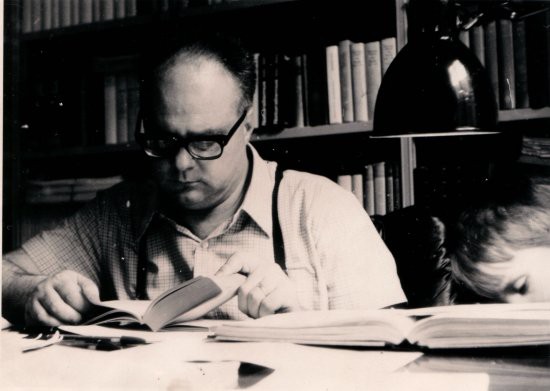
Mazzino Montinari, born on April 4, 1928, in Lucca, Italy, was an influential Italian philosopher, historian, and philologist whose work fundamentally reshaped the study of Friedrich Nietzsche. His scholarly pursuits, often in collaboration with Giorgio Colli, led to the creation of the authoritative Italian edition of Nietzsche’s works, a monumental project that has had a lasting impact on Nietzsche studies worldwide. Montinari’s life and work offer a fascinating glimpse into the rigorous world of philosophical scholarship, marked by intellectual rigor, deep historical insight, and a commitment to uncovering the truth about one of the most enigmatic philosophers of the modern era.
Early Life and Education
Mazzino Montinari grew up in a time of great political and social upheaval in Italy. The experience of living through World War II and its aftermath had a profound impact on his intellectual development. He attended the Liceo Classico “Machiavelli” in his hometown of Lucca, where he was fortunate enough to have Giorgio Colli as his philosophy teacher. Colli, a distinguished philosopher and scholar in his own right, introduced the young Montinari to a wide range of philosophical texts and ideas, fostering in him a deep appreciation for classical literature and critical thinking.
Under Colli’s mentorship, Montinari developed a passion for reading primary texts and engaging in open, critical discussions about their meanings. It was during this period that Montinari first encountered the works of Friedrich Nietzsche, whose ideas would come to dominate much of his later academic career. Montinari’s early exposure to Nietzsche was markedly different from the fascist appropriations of Nietzschean philosophy that were prevalent in Italy at the time. Colli’s approach emphasized the complexities and subtleties of Nietzsche’s thought, setting the stage for Montinari’s lifelong engagement with the German philosopher.
After completing his secondary education, Montinari was admitted to the prestigious Scuola Normale Superiore in Pisa, one of Italy’s most renowned institutions of higher learning. Initially, he pursued studies in philosophy but later shifted his focus to history under the guidance of Delio Cantimori, a prominent historian. In 1949, Montinari graduated with a thesis on the heretical movements in Lucca, which reflected his growing interest in the intersections between history, philosophy, and religion.
Early Career and Political Engagement
Following his graduation, Montinari received a scholarship from the Scuola Normale Superiore that allowed him to study in Frankfurt, Germany, in 1950. This period abroad deepened his engagement with German culture and philosophy, further enhancing his understanding of Nietzsche’s intellectual milieu. Upon returning to Italy, Montinari embarked on a career that blended scholarly work with political activism, reflecting the turbulent intellectual atmosphere of post-war Europe.
From 1950 to 1957, Montinari was involved in various cultural and political activities in Rome and Berlin. He worked with the Italian Communist Party’s publishing house, Rinascita, and briefly served as the director of its bookstore. During his time in Berlin, Montinari was deeply immersed in the cultural life of East Germany, translating and editing works related to Marxism and the history of the labor movement. His translation of Franz Mehring’s History of German Social Democracy into Italian is a notable contribution from this period, reflecting his commitment to exploring the historical dimensions of socialist thought.
Montinari’s work during these years was not limited to politics. He also engaged in extensive translation work, bringing German philosophical and historical texts to Italian readers. His translations included significant works by thinkers like Arthur Schopenhauer and Johann Wolfgang von Goethe, as well as critical editions of Nietzsche’s writings. This period of intense intellectual activity laid the groundwork for Montinari’s later scholarly achievements.
The Nietzsche Project: A Monumental Scholarly Achievement
Mazzino Montinari’s most enduring legacy is undoubtedly his work on Friedrich Nietzsche. In 1958, Montinari moved to Florence, where he began collaborating with Giorgio Colli on what would become one of the most significant editorial projects in the history of philosophy: the critical edition of Nietzsche’s complete works and letters. This project, published by the Turin-based publisher Einaudi, aimed to correct the numerous errors and distortions that had plagued previous editions of Nietzsche’s writings, many of which had been manipulated by Nietzsche’s sister, Elisabeth Förster-Nietzsche, to align with her nationalist and anti-Semitic views.
The project required meticulous research and a deep understanding of both Nietzsche’s philosophy and the broader historical context in which he wrote. Montinari and Colli traveled extensively to access original manuscripts and archives, including the Nietzsche Archive in Weimar, Germany. Their work culminated in a critical edition that not only restored Nietzsche’s texts to their original form but also provided extensive annotations and commentary, making the philosopher’s complex ideas more accessible to scholars and readers.
Montinari’s role in this project was crucial. While Colli was primarily responsible for the philosophical aspects, Montinari focused on the philological and historical dimensions, ensuring the accuracy and integrity of the texts. The publication of the Kritische Gesamtausgabe, or Critical Complete Edition, of Nietzsche’s works was a landmark event in Nietzsche studies, providing a foundation for all subsequent scholarship on the philosopher.
Academic Career and Contributions to German Studies
In addition to his work on Nietzsche, Mazzino Montinari made significant contributions to the study of German literature and philosophy more broadly. In the early 1970s, he began teaching German language and literature at the University of Urbino, later moving to the University of Florence, and finally, the University of Pisa. His academic career was marked by a commitment to rigorous scholarship and a passion for teaching, which inspired generations of students.
Montinari’s scholarly work extended beyond Nietzsche to include studies on other key figures in German intellectual history, such as Heinrich Heine, Johann Wolfgang von Goethe, and Thomas Mann. His translations and critical editions of these authors’ works were widely acclaimed for their accuracy and depth of insight. Montinari also published numerous articles and essays in leading academic journals, exploring topics ranging from the methodology of textual criticism to the philosophical implications of German Romanticism.
One of Montinari’s notable achievements was his work on the relationship between Nietzsche and the French intellectual tradition. He explored how Nietzsche’s ideas were received and interpreted in France, particularly in the context of the décadence movement. His essays on this topic offered new perspectives on the transnational flow of ideas and highlighted Nietzsche’s influence on French literature and philosophy.
International Recognition and Legacy
Mazzino Montinari’s contributions to the field of philosophy and German studies did not go unnoticed. Over the course of his career, he received numerous international accolades, including the prestigious Gundolf Prize, which is awarded for promoting German culture abroad. His work on Nietzsche was widely recognized as a turning point in the study of the philosopher, influencing scholars around the world.
Montinari’s scholarship was not only rigorous but also deeply humane. He approached Nietzsche’s work with a sense of moral responsibility, seeking to uncover the true meaning of the philosopher’s ideas while resisting the distortions that had plagued his legacy. This ethical commitment is evident in Montinari’s careful editorial work, which sought to present Nietzsche’s thought in all its complexity and nuance.
Montinari’s death on November 24, 1986, marked the end of an era in Nietzsche studies, but his influence continues to be felt. The critical edition of Nietzsche’s works that he co-edited with Giorgio Colli remains the gold standard for Nietzsche scholarship, and his essays and translations continue to be cited by scholars in the field. Montinari’s legacy is that of a scholar who dedicated his life to the pursuit of truth, rigor, and intellectual integrity.
Conclusion
Mazzino Montinari was a towering figure in the world of philosophy and German studies. His work on Friedrich Nietzsche not only revolutionized the understanding of the philosopher’s ideas but also set new standards for scholarly rigor and editorial practice. Montinari’s life was one of dedication to the highest ideals of scholarship, marked by a deep engagement with the texts and ideas that shaped modern thought.
As we reflect on Montinari’s contributions, it becomes clear that his legacy extends far beyond the confines of academia. His work serves as a reminder of the importance of intellectual honesty and the need to approach even the most challenging ideas with an open mind and a critical eye. Montinari’s scholarship continues to inspire and challenge, making him a figure of enduring significance in the study of philosophy and beyond.


