
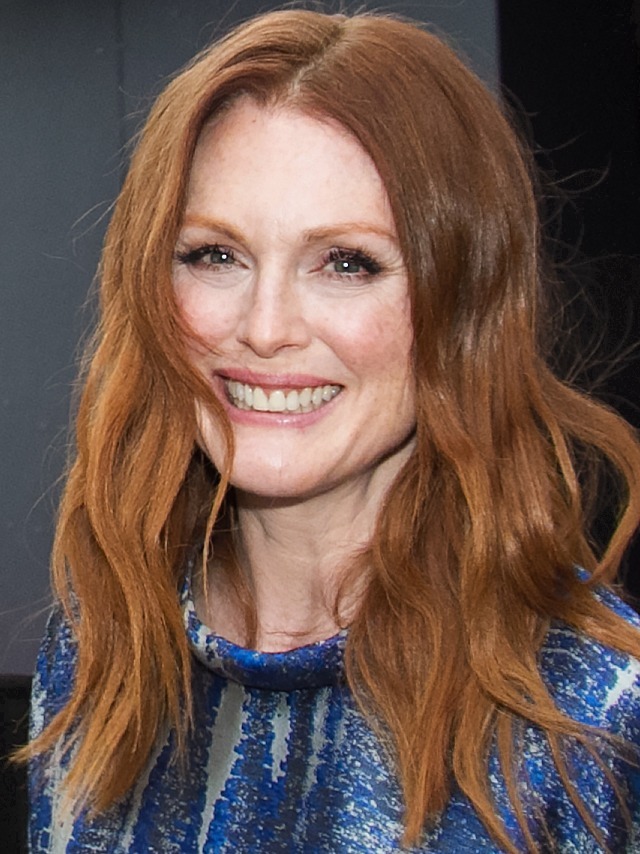
Julianne Moore, born Julie Anne Smith on December 3, 1960, in Fayetteville, North Carolina, is a distinguished American actress known for her versatility, depth, and remarkable ability to portray complex characters. With a career spanning over three decades, Moore has garnered critical acclaim and numerous awards, including an Academy Award, a British Academy Film Award (BAFTA), and two Golden Globe Awards. This article delves into the life of Julianne Moore, exploring her rise to fame, significant career milestones, and her lasting impact on the film industry.
Early Life and Education
Julianne Moore was born to Anne Love, a social worker and psychiatrist, and Peter Moore Smith, a military judge, lawyer, and helicopter pilot. Her diverse heritage includes Albanian roots from her father’s side and Scottish ancestry from her mother, a fact often highlighted by her striking red hair and freckles.
Moore’s early life was marked by constant movement due to her father’s military career. She lived in various parts of the United States and Europe, including Germany, where she attended the Frankfurt American High School. In 1979, she graduated and pursued a Bachelor of Fine Arts degree from Boston University. Her exposure to different cultures and environments during her formative years likely contributed to her adaptability and range as an actress.
The Beginnings of a Storied Career
After graduating from Boston University, Julianne Moore moved to New York City in 1983, where she initially worked as a waitress to support herself while pursuing her acting career. She began her career on stage, appearing in various Off-Broadway productions, which laid the groundwork for her future success. One of her early notable performances was in the play Serious Money, which caught the attention of critics and television producers alike.
Moore’s television breakthrough came with the soap opera As the World Turns, where she portrayed a dual role as half-sisters Frannie and Sabrina Hughes. Her performance was so compelling that it earned her a Daytime Emmy Award in 1988 for Outstanding Ingenue in a Drama Series. During this time, she also adopted her now-famous stage name, Julianne Moore, to distinguish herself from other actresses registered with the Screen Actors Guild.
Transition to Film and Early Success
Julianne Moore made her film debut with minor roles in movies like Tales from the Darkside: The Movie (1990) and The Hand That Rocks the Cradle (1992). However, it wasn’t until her role in Robert Altman’s Short Cuts (1993) that she gained significant attention in the film industry. Her portrayal of Marian Wyman, a character embroiled in personal turmoil, showcased her ability to convey deep emotional complexity. This role earned her critical acclaim and set the stage for her future success in Hollywood.
Throughout the 1990s, Moore’s career continued to ascend as she took on a diverse range of roles. In 1995, she starred in Todd Haynes’ Safe, a film that would mark the beginning of a long and fruitful collaboration between the actress and the director. In Safe, Moore played Carol White, a woman who becomes increasingly sensitive to the environment around her, leading to an ambiguous illness. Her nuanced performance was widely praised and solidified her reputation as a serious actress capable of tackling challenging roles.
Breakthrough and Recognition
The late 1990s saw Julianne Moore’s star rise even higher with a series of critically acclaimed performances. In 1997, she starred in Boogie Nights, directed by Paul Thomas Anderson, where she played Amber Waves, a pornographic actress with a complex personal life. The role earned her an Academy Award nomination for Best Supporting Actress, bringing her widespread recognition and acclaim.
Moore continued to take on challenging roles, displaying her remarkable range as an actress. In 1999, she starred in The End of the Affair, a romantic drama that earned her another Academy Award nomination, this time for Best Actress. Her portrayal of Sarah Miles, a woman torn between love and faith, was praised for its emotional depth and authenticity.
Establishing Herself as a Leading Actress
As the 2000s began, Julianne Moore had firmly established herself as one of Hollywood’s leading actresses. In 2002, she delivered two standout performances that further solidified her place in the industry. She starred in Todd Haynes’ Far from Heaven and Stephen Daldry’s The Hours. In Far from Heaven, Moore portrayed Cathy Whitaker, a 1950s housewife who grapples with her husband’s homosexuality and her feelings for a black man. The role earned her another Academy Award nomination for Best Actress and won her the Volpi Cup for Best Actress at the Venice Film Festival.
In The Hours, Moore played Laura Brown, a 1950s housewife struggling with her unfulfilling life. The film, which also starred Meryl Streep and Nicole Kidman, was a critical success, and Moore’s performance garnered her a nomination for the Academy Award for Best Supporting Actress. Notably, she was one of the few actresses to be nominated for two Oscars in the same year for two different roles, a testament to her extraordinary talent.
Continued Success and Versatility
Throughout the 2000s, Julianne Moore continued to demonstrate her versatility by taking on a wide range of roles in both independent films and major Hollywood productions. She appeared in films such as The Hours (2002), The Forgotten (2004), Children of Men (2006), and A Single Man (2009), each time delivering powerful performances that were widely praised by critics.
One of her most memorable roles during this period was in Children of Men, directed by Alfonso Cuarón. Moore played Julian Taylor, a leader of an underground resistance movement in a dystopian future where humanity faces extinction. Her performance, though brief, was impactful and contributed to the film’s critical success.
Moore’s ability to seamlessly transition between genres was further showcased in A Single Man, where she played Charley, a close friend of the protagonist, portrayed by Colin Firth. The film, directed by fashion designer Tom Ford, was a critical success, and Moore’s performance was highlighted for its emotional depth and complexity.
Academy Award Victory and Later Career
In 2014, Julianne Moore achieved a career milestone by winning the Academy Award for Best Actress for her role in Still Alice. In the film, Moore portrayed Alice Howland, a linguistics professor diagnosed with early-onset Alzheimer’s disease. Her performance was lauded for its sensitivity, realism, and the dignity with which she portrayed a woman grappling with the devastating effects of the disease. The role earned her numerous accolades, including a BAFTA Award, a Golden Globe Award, and a Screen Actors Guild Award.
Following her Oscar win, Moore continued to take on diverse and challenging roles. In 2015, she starred in Freeheld, based on the true story of a terminally ill police officer fighting for her pension benefits to be passed on to her domestic partner. Moore’s performance was praised for its emotional depth and authenticity.
In 2017, she starred in Wonderstruck, directed by Todd Haynes, and Suburbicon, directed by George Clooney. Both films showcased her ability to bring nuance and complexity to her characters, even in supporting roles.
Personal Life and Advocacy
Julianne Moore’s personal life has been relatively private, though she has spoken openly about her beliefs and values. She married director Bart Freundlich in 2003, and the couple has two children, Caleb and Liv. Moore is known for her advocacy on issues such as gun control, LGBTQ+ rights, and women’s rights. She has been involved with various charitable organizations and has used her platform to raise awareness about important social issues.
Moore is also a published author, having written a series of children’s books titled Freckleface Strawberry, inspired by her own childhood experiences. The books have been well-received and adapted into a stage musical.
Legacy and Impact on Cinema
Julianne Moore’s legacy in Hollywood is marked by her extraordinary versatility, her ability to take on complex and challenging roles, and her unwavering commitment to her craft. She is one of the few actresses who has successfully navigated both independent cinema and mainstream Hollywood, earning critical acclaim in both arenas.
Her performances in films like Boogie Nights, Far from Heaven, The Hours, and Still Alice have left an indelible mark on the film industry, showcasing her range and depth as an actress. Moore’s ability to portray a wide array of characters, from vulnerable and troubled individuals to strong and resilient women, has made her one of the most respected and admired actresses of her generation.
Moore’s influence extends beyond her acting career. Her advocacy work and commitment to social issues have also made her a role model for many. As she continues to take on new roles and challenges, Julianne Moore’s impact on cinema and society is sure to endure for years to come.
Conclusion: The Enduring Appeal of Julianne Moore
Julianne Moore’s career is a testament to her talent, versatility, and dedication to her craft. From her early days on the stage to her rise as one of Hollywood’s most respected actresses, Moore has consistently delivered performances that captivate audiences and critics alike. Her ability to portray a wide range of characters with depth and authenticity has earned her numerous accolades and a place among the greats in cinema history.
As she continues to take on new challenges, Julianne Moore’s legacy as a trailblazing actress and advocate for social change remains strong. Her work both on and off the screen serves as an inspiration to aspiring actors and activists, proving that it is possible to make a difference through art and advocacy.


