
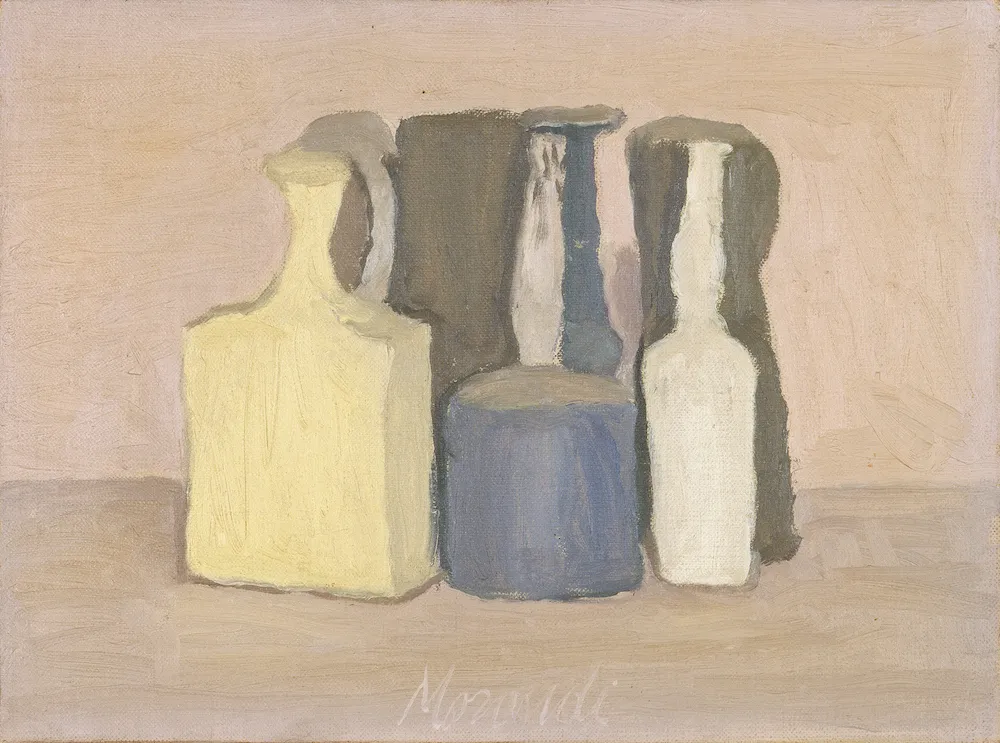
Giorgio Morandi is often remembered as one of the most significant Italian painters of the 20th century. His work, characterized by subtlety, restraint, and a profound sense of contemplation, has made a lasting impact on the world of art. Born in Bologna on July 20, 1890, Morandi’s journey from a young artist with a deep reverence for the masters of the past to a revered figure in modern art is a story of dedication, quiet rebellion, and an unwavering commitment to his vision.
Early Life and Artistic Beginnings
Giorgio Morandi was born into a modest middle-class family in Bologna, Italy. From a young age, Morandi exhibited a natural talent for art, which led him to enroll in the Accademia di Belle Arti di Bologna in 1907. His early years at the academy were marked by academic excellence, but as he grew older, Morandi began to develop his own distinct style, which eventually put him at odds with some of his professors.
During this formative period, Morandi was heavily influenced by the works of European masters such as Paul Cézanne, Henri Rousseau, Pablo Picasso, and André Derain. These artists, with their innovative approaches to form and color, inspired Morandi to explore his own artistic voice. However, it wasn’t just contemporary artists that influenced him; Morandi also had a deep appreciation for the Italian masters of the past, such as Giotto, Masaccio, and Paolo Uccello. His visit to Florence in 1910, where he admired their masterpieces, left a lasting impression on him.
Morandi’s early works were a blend of these influences, but even in these early pieces, one could discern the beginnings of the unique style that would later define his career.
The Path to Recognition
Morandi graduated from the Accademia di Belle Arti in 1913, and soon after, he began to exhibit his work. His first significant exhibition took place in 1914 at the Hotel Baglioni in Bologna, where he displayed his work alongside other emerging artists such as Osvaldo Licini, Mario Bacchelli, Giacomo Vespignani, and Severo Pozzati. This exhibition marked the beginning of Morandi’s association with the Italian Futurists, a group known for their radical departure from traditional art forms and their embrace of modernity.
Although Morandi exhibited with the Futurists at the Galleria Sprovieri in Rome that same year, he never fully embraced the movement’s ethos. Instead, he gravitated towards a more introspective and contemplative approach to art, which set him apart from his peers.
The Metaphysical Period
The outbreak of World War I had a profound impact on Morandi’s work. During the war years, he developed a style that would later be recognized as his “metaphysical period.” This phase, influenced by the metaphysical school of art led by Giorgio de Chirico, saw Morandi creating works that were imbued with a sense of mystery and quiet introspection. His paintings from this period, though few in number, are considered some of the most significant in his oeuvre.
Morandi’s metaphysical works are characterized by their stillness and their focus on everyday objects arranged in simple, yet enigmatic compositions. These paintings evoke a sense of timelessness and have been interpreted as meditations on the nature of existence and the passage of time.
The 1920s: A Return to Simplicity
As the 1920s progressed, Morandi’s work began to evolve towards the style that would define the rest of his career. He moved away from the metaphysical influences of de Chirico and began to focus on the still lifes for which he is best known. These works, often featuring simple arrangements of bottles, vases, and other everyday objects, are marked by their subtle use of color and light, as well as their meticulous attention to composition.
Morandi’s still lifes are deceptively simple. On the surface, they may appear to be straightforward depictions of mundane objects, but upon closer inspection, they reveal a deep complexity and a profound sense of introspection. Each object in Morandi’s compositions is carefully placed, and the relationships between the objects are meticulously considered. The result is a body of work that transcends the ordinary and invites viewers to engage in a quiet contemplation of the world around them.
During this period, Morandi remained largely in Bologna, choosing to live a life of relative seclusion. However, he maintained connections with Italy’s intellectual and artistic circles, including a close friendship with the writer and publisher Leo Longanesi. This friendship provided Morandi with a vital link to the broader cultural developments of the time.
Teaching and Artistic Recognition
In addition to his work as a painter, Giorgio Morandi also had a long career as an educator. After teaching in local drawing schools for several years, Morandi was appointed as a professor of engraving at the Accademia di Belle Arti di Bologna in 1930. This position, which he was awarded “for clear fame” and without competition, allowed him to influence a new generation of artists while continuing to refine his own practice.
Morandi’s reputation continued to grow throughout the 1930s and 1940s. He participated in numerous exhibitions, including the prestigious Venice Biennale and the Rome Quadriennale, where his work was increasingly recognized for its quiet power and originality. In 1939, at the third edition of the Rome Quadriennale, Morandi was awarded second prize for painting, an achievement that solidified his status as one of Italy’s leading artists.
World War II and Beyond
The outbreak of World War II once again had a profound impact on Morandi’s life and work. In the summer of 1943, as the war intensified, Morandi retreated to the Apennine mountains to escape the conflict. During this period of seclusion, he created a series of landscape paintings that are among his most celebrated works. These landscapes, like his still lifes, are characterized by their simplicity and their focus on the interplay of light and shadow.
In the post-war years, Morandi’s work continued to garner critical acclaim. In 1948, he was awarded the first prize for painting at the Venice Biennale, a prestigious honor that brought renewed attention to his work. This recognition further cemented Morandi’s reputation as a master of modern art, and his work began to attract interest from collectors and institutions around the world.
International Acclaim and Legacy
As Morandi’s fame grew, so too did his influence on the international art scene. His work was exhibited in major galleries and museums across Europe and the United States, where it was celebrated for its quiet intensity and its ability to evoke deep emotion through simple means. Morandi’s influence can be seen in the work of many contemporary artists who have drawn inspiration from his approach to composition and his focus on the everyday.
Despite his growing fame, Morandi remained a deeply private individual. He continued to live in Bologna, leading a quiet life dedicated to his art. His work remained consistent in its focus and style, with each new painting representing a further refinement of his artistic vision.
Morandi’s health began to decline in the 1950s, but he continued to work until his death on June 18, 1964. He was laid to rest in the Certosa cemetery in Bologna, where his grave has become a site of pilgrimage for art lovers from around the world.
The Enduring Influence of Giorgio Morandi
Today, Giorgio Morandi is remembered as one of the most important Italian artists of the 20th century. His work, with its emphasis on simplicity, stillness, and the quiet beauty of everyday objects, has had a lasting impact on the world of art. Morandi’s paintings continue to be celebrated for their ability to evoke deep emotion and contemplation, and they remain a touchstone for artists and collectors alike.
Morandi’s legacy is not just limited to his paintings; his approach to art, characterized by a deep sense of humility and a commitment to the craft, has inspired generations of artists. His work serves as a reminder that true artistic mastery is not about grand gestures or elaborate techniques, but about the ability to see the world with clarity and to express that vision with honesty and precision.
In a world that is often characterized by noise and distraction, Giorgio Morandi’s work offers a moment of quiet reflection. His paintings invite us to slow down, to look closely, and to appreciate the beauty that can be found in the simplest of things. It is this ability to find profundity in the ordinary that makes Morandi’s work so enduringly powerful and relevant.
As we continue to explore and appreciate the legacy of Giorgio Morandi, we are reminded of the timeless nature of his art. His work speaks to the universal human experience, and it will continue to resonate with audiences for generations to come.


