
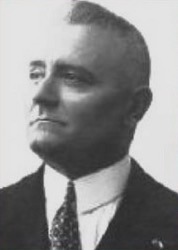
Cesare Mori, a name etched in the annals of Italian history, is often remembered as “The Iron Prefect.” Born on December 22, 1871, in Pavia, Italy, Mori’s legacy is one of iron-fisted law enforcement, a relentless pursuit of justice, and a complex relationship with the political powers of his time. His life and career offer a fascinating glimpse into the struggles against organized crime in early 20th-century Italy, particularly his battle against the Mafia in Sicily. This article explores the life, fame, and enduring legacy of Cesare Mori, delving into his early years, his rise to prominence, and the lasting impact of his methods and ideals.
Early Life and Career Beginnings
Cesare Mori’s early life was marked by hardship. Born in Pavia, he was initially raised in an orphanage, where he was given the provisional name “Primo,” a name that would remain with him as his second name throughout his life. It wasn’t until 1879 that he was officially recognized by his biological parents, who gave him his permanent name. Mori’s early experiences of abandonment and adversity likely shaped his character, instilling in him a resolve and determination that would define his later career.
Mori pursued his education at the prestigious Military Academy in Turin, where he honed the discipline and rigor that would become his trademarks. After completing his studies, he began his career in the police force, with his first assignment in Taranto, Puglia. It was here that he met his future wife, Angelina Salvi. Mori’s early years in law enforcement saw him stationed in various parts of Italy, but it was his transfer to Sicily in 1904 that would set the stage for his most significant achievements.
The Sicilian Challenge: First Encounters with the Mafia
Mori’s arrival in Sicily marked the beginning of his lifelong battle against organized crime. Stationed in Castelvetrano, in the province of Trapani, Mori quickly earned a reputation for his uncompromising approach to law enforcement. His methods were unconventional, characterized by a combination of strategic thinking, relentless determination, and a willingness to bend, if not outright break, the rules to achieve his objectives.
In Sicily, Mori faced the daunting task of confronting the Mafia, a deeply entrenched criminal organization with roots in the island’s social, economic, and political fabric. The Mafia was more than just a criminal enterprise; it was a shadow government, exerting control over local communities through fear, violence, and corruption. Mori recognized that defeating such an adversary required more than just conventional policing—it demanded a comprehensive and radical approach.
Mori’s early efforts in Sicily were met with both success and resistance. He conducted numerous arrests and survived several assassination attempts, a testament to the dangers of his work. However, his aggressive tactics also led to accusations of abuse of power, though these charges were consistently dismissed in court. Despite the controversies, Mori’s resolve remained unshaken. His work in Sicily was only the beginning of a campaign that would later escalate to a full-scale war against the Mafia.
World War I and Continued Anti-Mafia Efforts
With the outbreak of World War I, Mori’s focus temporarily shifted away from the Mafia as he was called back to the mainland to serve in Florence as a vice-questore (vice-commissioner). However, the end of the war saw Mori return to Sicily, where the post-war environment had given rise to an increase in brigandage, a form of rural banditry that was often linked to the Mafia.
Mori was appointed to lead special units tasked with combating this resurgence of criminal activity. His approach was both swift and brutal. In one notable operation, Mori orchestrated the arrest of over three hundred individuals in a single night in the town of Caltabellotta. The operation was hailed as a significant victory against the Mafia, though Mori himself was quick to point out that the real threat—the deeper, more insidious ties between the Mafia and the political and economic elite—remained largely untouched.
Mori’s recognition of the Mafia’s connections to the higher echelons of society was a key insight that would later inform his broader strategy against organized crime. He understood that to truly defeat the Mafia, it was not enough to target the foot soldiers and low-level operatives. The battle had to extend to the corrupt officials, landowners, and politicians who provided the Mafia with its power and protection.
The Iron Prefect: Mori’s Appointment in Palermo
Cesare Mori’s reputation as a tough, unyielding lawman caught the attention of Italy’s fascist regime, particularly Benito Mussolini. In 1924, Mussolini appointed Mori as the Prefect of Trapani, and shortly thereafter, in 1925, he was promoted to the position of Prefect of Palermo, the capital of Sicily. It was in this role that Mori would earn the moniker “The Iron Prefect,” a title that reflected both his stern demeanor and his ruthless methods.
Mussolini granted Mori extraordinary powers, giving him “carte blanche” to restore state authority in Sicily by any means necessary. This mandate was a double-edged sword: while it allowed Mori to act with unprecedented freedom, it also placed him under immense pressure to deliver results in a region where the Mafia’s influence was deeply entrenched.
Mori’s tenure as Prefect of Palermo was marked by a series of bold and controversial actions. He launched a relentless campaign against the Mafia, targeting not only the criminal underworld but also the social and economic structures that supported it. Mori’s strategy involved a combination of direct action—such as the infamous “Siege of Gangi,” where he deployed hundreds of police and military personnel to root out Mafia strongholds—and legal measures, including the revocation of firearms licenses and the imposition of strict controls on land management.
One of Mori’s most significant moves was the creation of a provincial commission in Trapani in 1925, which was tasked with overseeing the issuance of permits for land guardianship and campieraggio (land management), activities traditionally controlled by the Mafia. By bringing these activities under state control, Mori struck at the heart of the Mafia’s economic power.
The Siege of Gangi and Other Notable Operations
The Siege of Gangi, conducted on January 1, 1926, stands as one of the most dramatic episodes in Cesare Mori’s campaign against the Mafia. Gangi, a small town in the Madonie mountains, was a notorious stronghold for various Mafia families and bandits. The town’s remote location and rugged terrain made it a difficult target for law enforcement, but Mori was undeterred.
In a meticulously planned operation, Mori deployed a large force of police and Carabinieri to encircle the town. His men conducted house-to-house searches, arresting suspected criminals and confiscating weapons. Women and children were sometimes taken as hostages to force the surrender of male relatives who were hiding or on the run. The operation was brutal, but it was also effective. By the end of the siege, dozens of Mafia members had been captured, and the town’s criminal networks were severely disrupted.
The success of the Siege of Gangi and other operations like it earned Mori widespread acclaim. Newspapers hailed his efforts as a decisive blow against the Mafia, and Mussolini himself praised Mori for his results. However, these victories came at a cost. Mori’s methods, which included coercion, intimidation, and the use of torture, sparked criticism and controversy. Some viewed him as a hero who was willing to do whatever it took to defeat the Mafia, while others saw him as a tyrant who trampled on civil liberties in the name of law and order.
The Complex Legacy of Cesare Mori
Cesare Mori’s legacy is a subject of ongoing debate. On one hand, his actions in Sicily during the 1920s undeniably weakened the Mafia’s hold on the island, leading to a significant reduction in crime and a temporary restoration of state authority. The statistics from his tenure are impressive: in 1925, Palermo saw 268 homicides and 298 robberies; by 1926, those numbers had dropped to 77 and 46, respectively. These results were lauded by the fascist regime, which used them to bolster its image as a strong, decisive government capable of restoring order.
However, the darker aspects of Mori’s legacy cannot be overlooked. His methods were often extralegal, relying on a combination of fear and force that, while effective in the short term, raised serious ethical and legal questions. Moreover, while Mori succeeded in dismantling some Mafia networks, he was unable to strike at the organization’s core. The so-called “Cupola”—the upper echelons of the Mafia, which included influential politicians, landowners, and businessmen—remained largely intact. In some cases, Mori’s actions even served to consolidate the power of these elites by eliminating their rivals within the Mafia.
Mori’s relationship with the fascist regime was also complex. Initially, he was seen as a loyal servant of the state, a man who shared Mussolini’s vision of a strong, centralized Italy. However, as Mori’s campaign against the Mafia progressed, he began to clash with elements of the regime who were themselves complicit in organized crime. These tensions ultimately led to Mori’s marginalization within the government. In 1929, he was appointed to the Senate, a position that effectively removed him from active duty and relegated him to a more symbolic role.
Despite his sidelining, Mori continued to speak out against the Mafia and its allies within the state. His memoirs, published in 1932 under the title Con la mafia ai ferri corti (With the Mafia at Close Quarters), offered a candid account of his experiences and a scathing critique of the government’s failure to fully eradicate organized crime. These writings further alienated him from the fascist authorities, who were eager to portray the Mafia as a problem that had been solved under their rule.
Conclusion: The Iron Prefect’s Enduring Influence
Cesare Mori died on July 5, 1942, in Udine, Italy. His body was laid to rest in his birthplace of Pavia, a city that had long been associated with his early struggles and formative years. Nearly a century after his death, Mori’s life and work continue to be the subject of study and debate. His efforts to combat the Mafia, while not without flaws, represent a significant chapter in the history of Italian law enforcement and the ongoing fight against organized crime.
Mori’s story is also a reminder of the complexities and contradictions that often accompany the pursuit of justice. His willingness to employ extreme measures in the name of public order reflects a broader tension between the demands of security and the principles of legality and human rights. As such, Mori’s legacy serves as both an inspiration and a cautionary tale for those who seek to uphold the rule of law in the face of seemingly insurmountable challenges.
In the years since his death, Cesare Mori has been portrayed in films, books, and documentaries, most notably in the 1977 film Il prefetto di ferro (The Iron Prefect), directed by Pasquale Squitieri and starring Giuliano Gemma as Mori. While these depictions have varied in their accuracy and tone, they have collectively contributed to the enduring image of Mori as a man who, for better or worse, was willing to go to extraordinary lengths to achieve his vision of justice.
Today, as Italy and other nations continue to grapple with the threat of organized crime, the legacy of Cesare Mori remains relevant. His life serves as a testament to the challenges of confronting deeply entrenched criminal organizations and the moral and ethical dilemmas that such efforts inevitably entail. Whether viewed as a hero or a controversial figure, Cesare Mori’s impact on the history of crime and law enforcement in Italy is undeniable.


