
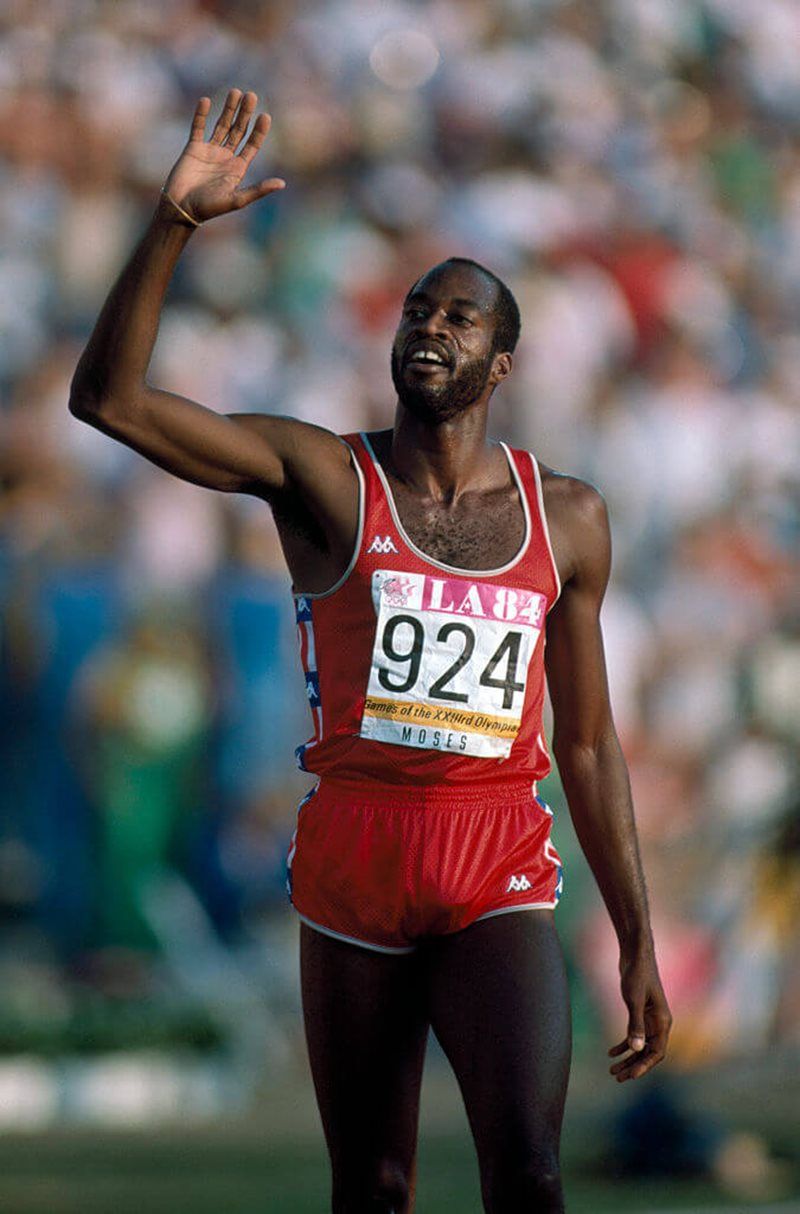
Edwin Moses, born on August 31, 1955, in Dayton, Ohio, is a name synonymous with excellence and dominance in the world of athletics, particularly in the 400-meter hurdles. His extraordinary career, marked by an unprecedented winning streak, world records, and Olympic gold medals, has left an indelible mark on the sport. Moses’s life and achievements extend beyond the track, encompassing his academic pursuits, his contributions to sports governance, and his work in promoting fair play and anti-doping initiatives. This article delves into the life and accomplishments of Edwin Moses, exploring the nuances of his career, the scientific approach that defined his training, and his lasting impact on the world of athletics.
Early Life and Academic Excellence
Edwin Corley Moses was born into a family that valued education highly. Both of his parents were educators, which naturally fostered a strong emphasis on academic achievement in the Moses household. This focus on education would later become a defining characteristic of Moses’s life, as he would go on to earn two degrees, one in physics and another in engineering, from Morehouse College in Atlanta, Georgia. His academic background, particularly in the sciences, would play a crucial role in his approach to athletics, setting him apart from many of his contemporaries.
Despite his academic inclinations, Moses was also a talented athlete from a young age. However, his athletic career did not begin with immediate success. Unlike many of his peers, Moses did not have access to top-tier training facilities. At Morehouse College, there was no dedicated track, and Moses had to make do with public facilities to practice. Initially, he focused on the 110-meter hurdles and the 400-meter sprint, but he eventually found his calling in the 400-meter hurdles, a decision that would change the course of his life.
The Scientific Approach to Athletics
Moses’s transition to the 400-meter hurdles was not a hasty decision. He applied his knowledge of physics and biomechanics to determine that this event was best suited to his physical attributes, particularly his long stride and height of 6 feet 2 inches (188 cm). At a time when most athletes were taking 14 to 15 strides between hurdles, Moses’s long legs allowed him to take just 13 strides, enabling him to maintain a consistent rhythm and reduce energy expenditure over the course of the race.
This scientific approach to training and competition was revolutionary. Moses meticulously analyzed every aspect of his performance, from the mechanics of his stride to his diet and recovery protocols. He even purchased a computer to log and analyze his training data—an uncommon practice among athletes in the 1970s and 1980s. This methodical approach helped him fine-tune his technique and maintain his competitive edge over the years.
Moses’s ability to maintain his form and speed throughout the race, particularly in the grueling final 100 meters, became one of his hallmarks. His stride pattern allowed him to hurdle with the same leg throughout the race, which was a significant advantage over his competitors, who often had to alternate legs, leading to inconsistency and inefficiency.
Dominance on the Track: The Making of a Legend
Edwin Moses’s ascent to athletic stardom began at the 1976 Montreal Olympics. Despite being relatively unknown on the international stage, Moses stunned the world by winning the gold medal in the 400-meter hurdles with a world-record time of 47.64 seconds. His performance was not only a personal triumph but also a pivotal moment in the history of track and field, as it marked the beginning of an era of dominance that would last for nearly a decade.
Moses’s victory in Montreal was just the beginning. From 1977 to 1987, he went on an unprecedented winning streak, claiming victory in 122 consecutive races, including 107 finals. During this period, Moses broke his own world record three times, with his final record of 47.02 seconds set in 1983 remaining unbroken for several years. His dominance in the 400-meter hurdles was so complete that it took nearly a decade for any athlete to defeat him. This incredible winning streak was finally broken on June 4, 1987, when he was narrowly beaten by fellow American Danny Harris in a race in Madrid.
Moses’s success was not limited to world records and individual races; he also excelled on the biggest stages. He won gold medals at the 1984 Los Angeles Olympics, repeating his feat from 1976 and solidifying his status as one of the greatest hurdlers of all time. Moses’s ability to perform under pressure, combined with his unparalleled consistency, made him a legend in the sport.
Beyond the Track: Contributions to Sports and Society
While Edwin Moses’s athletic achievements are well-documented, his contributions off the track are equally noteworthy. After his competitive career, Moses became an influential figure in sports governance and advocacy. He played a crucial role in reforming the eligibility rules for Olympic athletes, particularly in the area of amateurism. At the time, strict rules prohibited athletes from earning money while maintaining their amateur status, which was a requirement for Olympic participation.
Moses advocated for changes that would allow athletes to receive financial support for training and competition without jeopardizing their eligibility. His efforts were instrumental in the eventual relaxation of these rules, which paved the way for athletes to pursue their careers without facing financial hardship.
In addition to his work on eligibility reform, Moses became a leading voice in the fight against doping in sports. He was a founding member and the first Chairman of the World Anti-Doping Agency (WADA) in 1999, where he helped develop and implement policies aimed at eradicating drug use in sports. Moses’s commitment to fairness and integrity in athletics has had a lasting impact on the sport, ensuring that future generations of athletes can compete on a level playing field.
The Legacy of Edwin Moses
Edwin Moses’s legacy in the world of athletics is unparalleled. His dominance in the 400-meter hurdles, his innovative approach to training, and his contributions to sports governance have left an indelible mark on the sport. Moses is widely regarded as the greatest 400-meter hurdler in history, and his records and achievements continue to inspire athletes around the world.
Moses’s influence extends beyond the track. His work with WADA and his advocacy for athletes’ rights have helped shape the modern landscape of international sports. His commitment to clean competition and fair play has set a standard for athletes and administrators alike.
In recognition of his contributions to the sport, Moses has received numerous accolades, including the Jesse Owens Award from USA Track & Field in 1981, which honors outstanding athletes who exemplify excellence both on and off the field. He was also inducted into the USA Track & Field Hall of Fame in 1994, cementing his place among the legends of the sport.
Moses’s impact is not confined to the past; he continues to be active in the athletic community, participating in various initiatives aimed at promoting sports and healthy lifestyles. His story serves as a reminder of the power of discipline, intelligence, and perseverance in achieving greatness.
Personal Life and Interests
Despite his fame and success, Edwin Moses has always maintained a low profile when it comes to his personal life. Known for his intellectual pursuits, Moses is an avid reader and a member of a reading circle. His passion for knowledge is evident in his academic achievements and his scientific approach to athletics. Moses’s love for learning has been a constant throughout his life, and it has undoubtedly contributed to his success both on and off the track.
In addition to his work in sports governance, Moses has also explored other interests, including a brief foray into the sport of bobsledding. In 1990, he competed in a two-man bobsleigh event in Winterberg, Germany, where he won a bronze medal alongside Olympic bobsledder Brian Shimer. This achievement showcased Moses’s versatility as an athlete and his willingness to take on new challenges.
Moses’s personal life has been marked by a commitment to excellence, whether in athletics, education, or his various professional endeavors. His disciplined approach to life has earned him respect not only as an athlete but also as a role model and leader in the sports community.
Conclusion
Edwin Moses’s story is one of extraordinary talent, relentless determination, and a commitment to excellence that transcends sports. His achievements on the track, particularly in the 400-meter hurdles, have set a standard that few athletes have ever approached. Beyond his athletic prowess, Moses has made significant contributions to the world of sports through his advocacy for athlete rights and his work in anti-doping.
Moses’s legacy is one of inspiration, not only for athletes but for anyone who strives for greatness in their chosen field. His life is a testament to the power of hard work, intelligence, and integrity, and his impact on the world of athletics will be felt for generations to come.


