
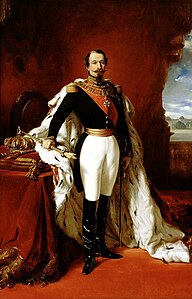
Napoléon III, born Charles-Louis Napoléon Bonaparte on April 20, 1808, in Paris, is a historical figure whose life and reign profoundly impacted 19th-century Europe. As the nephew of the legendary Napoléon Bonaparte, his life was shaped by both his illustrious family name and the tumultuous political landscape of post-Napoleonic Europe. Despite facing numerous challenges, including exile, imprisonment, and political opposition, Napoléon III rose to prominence, eventually becoming the Emperor of the French and leaving a complex legacy that continues to be studied and debated.
Early Life and Exile
Napoléon III was born into a Europe still reeling from the consequences of the Napoleonic Wars. His father, Louis Bonaparte, was the King of Holland, and his mother, Hortense de Beauharnais, was the daughter of Josephine, Napoléon I’s first wife. The fall of Napoléon I in 1815 and the subsequent dismantling of his empire marked the beginning of a long period of exile for the Bonaparte family. Young Charles-Louis was taken to Switzerland, where he was raised under the shadow of his uncle’s legacy.
During his formative years, Napoléon III was exposed to the revolutionary ideals that had shaped the French Revolution and the Napoleonic era. His education was steeped in the principles of liberalism and nationalism, which later influenced his political ideology. The Bonaparte name, however, made him a target of the reactionary monarchies that dominated Europe after the Congress of Vienna. This forced him to live a life of constant movement, from Switzerland to Italy and eventually to England.
Political Aspirations and Early Attempts
Napoléon III’s first significant foray into politics came in 1830 when he joined the Carbonari, a secret society advocating for Italian unification and liberal reforms. His involvement in the Carbonari’s activities in Italy and later in France demonstrated his commitment to the revolutionary ideals of his youth. However, these early attempts at political action were met with failure. He was forced to flee Rome in 1831 after a failed uprising and continued his efforts in France, where he faced opposition from King Louis-Philippe, who viewed him as a threat to his throne.
In 1836, Napoléon III made his first attempt to seize power in France by leading a coup in Strasbourg. The coup failed, and he was arrested and exiled to the United States. This setback did not deter him; instead, it fueled his determination to restore the Bonaparte legacy. He returned to Europe in 1837, continuing his efforts to garner support for his cause.
Rise to Power and Presidency
The revolutionary wave that swept across Europe in 1848 provided Napoléon III with the opportunity he had been waiting for. The February Revolution in France led to the abdication of King Louis-Philippe and the establishment of the Second Republic. Sensing his moment, Napoléon III returned to France from England, where he had been living in exile. Capitalizing on his family name and the public’s nostalgia for the Napoleonic era, he successfully ran for the presidency of the Second Republic, winning the election in December 1848 with a landslide victory.
As President, Napoléon III quickly moved to consolidate his power. Despite his initial promises to uphold the republican constitution, he harbored ambitions to restore the empire. In December 1851, after just three years in office, he staged a coup d’état, dissolving the National Assembly and declaring himself Emperor of the French. On December 2, 1852, he officially took the title Napoléon III, marking the beginning of the Second French Empire.
The Second French Empire
Napoléon III’s reign as Emperor was characterized by both significant achievements and notable failures. Domestically, he embarked on a series of ambitious modernization projects. He oversaw the transformation of Paris under the direction of Baron Haussmann, resulting in the wide boulevards and grand architecture that define the city to this day. His government also implemented economic reforms that promoted industrialization and economic growth, contributing to a period of relative prosperity in France.
However, Napoléon III’s foreign policy was more controversial. He sought to re-establish France as a dominant European power, engaging in a series of military conflicts aimed at expanding French influence. One of his early successes was the Crimean War (1853-1856), where France, alongside Britain and the Ottoman Empire, defeated Russia. This victory bolstered Napoléon III’s prestige and reinforced France’s role in European affairs.
Involvement in Italian Unification
One of the most significant episodes of Napoléon III’s foreign policy was his involvement in the Italian Wars of Independence. In 1858, he met with the Italian statesman Count Camillo di Cavour, Prime Minister of the Kingdom of Sardinia, at Plombières-les-Bains. The two leaders reached a secret agreement: France would support Sardinia in a war against Austria, in exchange for the territories of Nice and Savoy.
The ensuing conflict, the Second Italian War of Independence (1859), saw French and Sardinian forces successfully defeat the Austrians, leading to the unification of much of Italy under the rule of King Victor Emmanuel II. While Napoléon III’s intervention was instrumental in the unification process, his decision to negotiate a premature peace with Austria at Villafranca, without consulting his Italian allies, left many in Italy feeling betrayed. Despite this, his actions in Italy earned him a place in the history of Italian unification.
The Mexican Adventure
One of the most controversial and ultimately disastrous ventures of Napoléon III’s reign was the French intervention in Mexico. In 1861, France, alongside Britain and Spain, sought to recover debts owed by the Mexican government. However, Napoléon III had larger ambitions; he wanted to establish a French-controlled monarchy in Mexico, which he believed would counterbalance the growing influence of the United States in the Americas.
In 1864, he installed Archduke Maximilian of Austria as Emperor of Mexico, hoping to create a friendly regime in the region. However, the venture quickly turned into a quagmire. The Mexican resistance, led by President Benito Juárez, proved more resilient than expected, and the United States, following the end of the Civil War, began to pressure France to withdraw its forces. In 1867, Maximilian was captured and executed by Mexican forces, marking the humiliating end of the French intervention.
Decline and Fall
The latter years of Napoléon III’s reign were marked by increasing domestic opposition and a series of foreign policy blunders that weakened his position. The rise of Prussia under Otto von Bismarck posed a significant threat to France’s dominance in Europe. Tensions between the two nations culminated in the Franco-Prussian War of 1870-1871, which proved disastrous for Napoléon III.
The war began disastrously for France, with Napoléon III himself being captured by Prussian forces at the Battle of Sedan on September 2, 1870. His capture led to the collapse of the Second French Empire and the proclamation of the Third Republic. Napoléon III was taken as a prisoner to Germany, where he remained until the end of the war.
Exile and Death
After his release from captivity, Napoléon III went into exile in England, where he lived in relative obscurity. He spent his final years at Camden Place in Chislehurst, Kent, where he continued to write and reflect on his political career. Despite his earlier successes, his later years were marked by regret and a sense of unfulfilled potential.
Napoléon III died on January 9, 1873, at the age of 64, following complications from surgery. His death marked the end of the Bonapartist dream of a restored French Empire. However, his legacy continues to be a subject of debate among historians, with some viewing him as a visionary leader who modernized France, while others criticize his authoritarian tendencies and his disastrous foreign policies.
Legacy and Historical Impact
The legacy of Napoléon III is complex and multifaceted. On one hand, he is remembered for his role in modernizing France, particularly through his ambitious public works projects and economic reforms. His vision of a modern, industrialized France helped lay the foundations for the country’s future development. The transformation of Paris during his reign has left a lasting impact on the city, making it one of the most iconic capitals in the world.
On the other hand, Napoléon III’s foreign policy ventures, particularly the Mexican expedition and the Franco-Prussian War, are often cited as significant failures that ultimately led to the downfall of the Second French Empire. His inability to effectively manage the growing power of Prussia and his miscalculation in declaring war on Bismarck’s Germany resulted in a humiliating defeat for France and the loss of his throne.
Furthermore, his authoritarian rule, characterized by press censorship and political repression, has drawn criticism from those who view him as a leader who prioritized power over democratic principles. The Second Empire, while initially popular, eventually became associated with corruption and inefficiency, contributing to its collapse.
Conclusion: A Controversial Emperor
Napoléon III remains a controversial figure in French history. His life was a study in contrasts—he was a man who sought to emulate his uncle’s greatness but was ultimately undone by his own ambitions and miscalculations. His reign was marked by both significant achievements and profound failures, making him a subject of enduring interest for historians and scholars.
While his dreams of restoring the glory of the Napoleonic Empire were never fully realized, Napoléon III’s impact on France and Europe is undeniable. His efforts to modernize France left a lasting legacy, even as his foreign policy blunders led to his downfall. Today, he is remembered as a complex and enigmatic figure, whose life and reign continue to fascinate and inspire debate.
Napoléon III’s story is a reminder of the delicate balance between power and responsibility, and the consequences that can arise when that balance is disrupted. His life serves as a cautionary tale for leaders who seek to wield power without considering the broader implications of their actions. In the end, Napoléon III’s legacy is a testament to the enduring influence of the Bonaparte name and the complex legacy of the Napoleonic era.


