
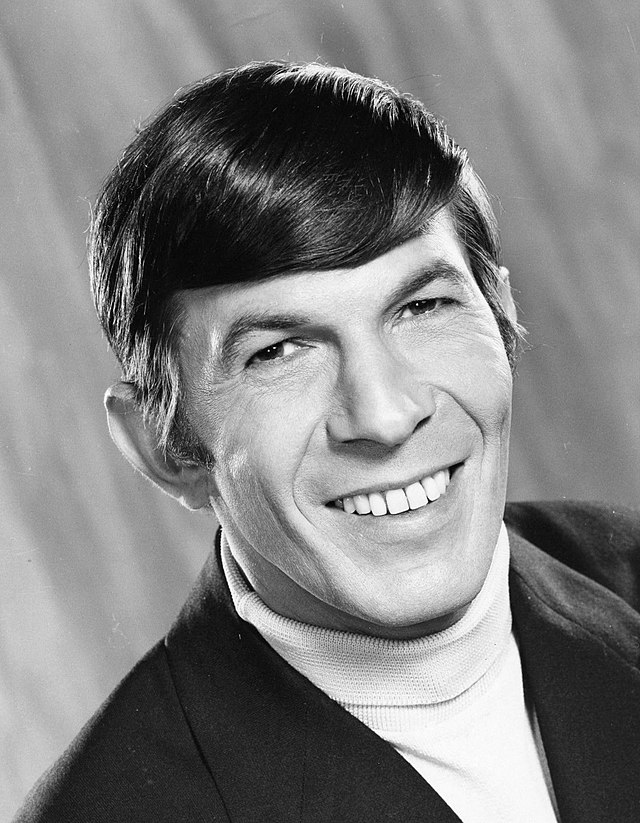
Introduction: The Man Behind the Vulcan
Leonard Nimoy, born on March 26, 1931, in Boston, Massachusetts, is a name that has become synonymous with the character he portrayed on the iconic science fiction series Star Trek: Spock. As the half-human, half-Vulcan first officer of the starship USS Enterprise, Nimoy’s portrayal of Spock left an indelible mark on popular culture, making him a beloved figure to millions of fans around the world. However, Nimoy’s career and life extended far beyond the confines of the Star Trek universe, encompassing a rich array of artistic endeavors, including acting, directing, photography, poetry, and more.
Early Life: From Boston to the Stage
Leonard Nimoy was born to Jewish immigrants from Ukraine, Max and Dora Nimoy, who settled in Boston. Growing up in a working-class neighborhood, Nimoy was drawn to the arts from a young age. He began acting in local theater productions as a child and quickly realized that he wanted to pursue acting as a career. His early experiences on stage provided a foundation for what would become a lifelong passion for performance.
Nimoy’s interest in acting led him to enroll in drama classes at Boston College and later at the Pasadena Playhouse in California, a well-known training ground for actors. However, like many aspiring actors, Nimoy faced the harsh realities of the profession and struggled to find steady work in his early years. To support himself, he took on a variety of odd jobs, from selling vacuum cleaners to driving a taxi.
Breaking into Hollywood: The Road to Stardom
Nimoy’s first significant break in Hollywood came in the 1950s when he began to land small roles in films and television series. His early work included appearances in westerns, war films, and crime dramas, where he often played villains or characters of ambiguous morality. Despite his versatility as an actor, Nimoy found it challenging to secure leading roles.
In 1965, Nimoy’s career took a pivotal turn when he was cast as Spock in Star Trek, a new science fiction television series created by Gene Roddenberry. The role of Spock, an alien with a logical mind and an outwardly emotionless demeanor, was initially offered to Martin Landau, who turned it down. Nimoy, however, saw the potential in the character and brought a unique depth to the role, blending Spock’s rationality with subtle hints of his inner emotional struggles.
The Birth of Spock: An Icon is Born
Star Trek premiered in 1966, and while it was not an immediate success, it quickly developed a devoted fanbase. Spock, with his pointed ears, arched eyebrows, and stoic demeanor, became one of the most recognizable characters in television history. Nimoy’s portrayal of Spock was both nuanced and compelling, as he masterfully conveyed the character’s internal conflict between his human and Vulcan sides.
Spock’s unique perspective, grounded in logic yet deeply humane, resonated with audiences, making him a cultural icon. The character’s catchphrases, such as “Live long and prosper,” became part of the cultural lexicon. Spock’s Vulcan salute, which Nimoy created based on a traditional Jewish blessing, further cemented the character’s place in popular culture.
Despite the character’s popularity, Nimoy struggled with the limitations that came with being so closely identified with Spock. He feared being typecast and found it challenging to break away from the shadow of the character. This struggle led him to publish his first autobiography in 1975, titled I Am Not Spock, where he explored the complexities of his relationship with the character and his desire to be recognized for his broader body of work.
Beyond Spock: A Multi-Faceted Career
After the original Star Trek series ended in 1969, Nimoy sought to diversify his career. He appeared in a variety of television shows and films, including the highly successful Mission: Impossible series, where he played the role of Paris, a master of disguise. Nimoy also explored his passion for theater, taking on roles in productions such as Fiddler on the Roof and Equus.
Nimoy’s talents extended beyond acting; he was also an accomplished director. He directed two of the most successful Star Trek films, Star Trek III: The Search for Spock (1984) and Star Trek IV: The Voyage Home (1986), the latter of which was particularly well-received for its humor and environmental message. Nimoy’s directorial work extended beyond the Star Trek franchise, including the hit comedy Three Men and a Baby (1987), which showcased his versatility as a filmmaker.
In addition to his work in film and television, Nimoy was an accomplished photographer and poet. His photography often explored themes of identity and transformation, while his poetry reflected his introspective nature. Nimoy published several volumes of poetry and photography, including You & I and Shekhina, which were well-received by critics and fans alike.
The Return of Spock: Embracing the Legacy
Despite his efforts to distance himself from the character of Spock, Nimoy eventually came to embrace the role that had defined much of his career. In 1995, he published a second autobiography titled I Am Spock, in which he reflected on how the character had become an integral part of his life and legacy. Nimoy acknowledged that Spock had given him a platform to explore broader issues of humanity, identity, and morality, both on-screen and off.
Nimoy continued to be involved with the Star Trek franchise, reprising his role as Spock in several films, including Star Trek: The Motion Picture (1979) and the Star Trek reboot films directed by J.J. Abrams in 2009 and 2013. His appearances in these films served as a bridge between the original series and the new generation of Star Trek fans.
Nimoy also made notable guest appearances in other science fiction series, including Fringe, where he played the enigmatic character Dr. William Bell. His presence in these series underscored his enduring influence in the science fiction genre and his ability to bring depth and gravitas to complex characters.
Personal Life: A Journey of Self-Discovery
Leonard Nimoy’s personal life was as multifaceted as his career. He was married twice, first to actress Sandra Zober in 1954, with whom he had two children, Adam and Julie. The couple divorced in 1987, and Nimoy later married Susan Bay in 1989. Throughout his life, Nimoy was known for his introspective nature and his commitment to personal growth.
In his later years, Nimoy became an advocate for health and wellness, particularly after being diagnosed with chronic obstructive pulmonary disease (COPD), a condition he attributed to years of smoking. He publicly spoke about the dangers of smoking and encouraged others to quit, using his platform to raise awareness about the disease.
Nimoy was also deeply connected to his Jewish heritage, which influenced many aspects of his life and work. The Vulcan salute, for example, was inspired by a gesture from Jewish religious practices. Nimoy’s exploration of spirituality and identity was evident in his art and writings, where he often delved into themes of transformation and self-discovery.
Legacy: The Enduring Impact of Leonard Nimoy
Leonard Nimoy passed away on February 27, 2015, at the age of 83, leaving behind a legacy that continues to resonate with fans and the broader cultural landscape. His portrayal of Spock not only redefined science fiction but also created a character that has become a symbol of logic, empathy, and the search for identity.
Nimoy’s contributions to the arts, whether through acting, directing, photography, or poetry, reflect a lifelong commitment to exploring the human experience. He was a pioneer in using science fiction as a lens to examine social and ethical issues, and his work has inspired countless individuals to think critically about the world around them.
The impact of Nimoy’s work can be seen in the enduring popularity of Star Trek, which continues to inspire new generations of fans. The values that Spock embodied—rationality, compassion, and curiosity—remain relevant in today’s world, and Nimoy’s portrayal of the character continues to serve as a touchstone for discussions about diversity, inclusion, and the human condition.
Final Thoughts: Leonard Nimoy’s Lasting Influence
Leonard Nimoy’s life and career are a testament to the power of storytelling and the impact that a single character can have on popular culture. While he may have initially struggled with the overwhelming association with Spock, Nimoy ultimately embraced the character and used it as a platform to explore deeper themes of identity, morality, and humanity.
As an artist, Nimoy was constantly evolving, never content to rest on his laurels. His work across multiple disciplines—acting, directing, photography, poetry—demonstrates a relentless curiosity and a desire to understand the world and his place in it. Nimoy’s legacy is not just that of an actor who played a beloved character, but of a creative force who used his talents to engage with the world in meaningful ways.
Today, Leonard Nimoy is remembered not just as Spock, but as a multifaceted artist and a thoughtful human being who left an indelible mark on the world. His contributions to the arts and his portrayal of Spock will continue to inspire and challenge audiences for generations to come.


