
Introduction
Robert Noyce, often dubbed the “Mayor of Silicon Valley,” was an American physicist and entrepreneur who co-founded Fairchild Semiconductor and Intel Corporation. His groundbreaking work in the development of the integrated circuit laid the foundation for the technological revolution that has shaped the modern world. Born on December 12, 1927, in Burlington, Iowa, Noyce’s life is a testament to innovation, resilience, and the relentless pursuit of progress.
Early Life and Education
Robert Norton Noyce was born into a family with deep intellectual roots. His father, a minister, and his mother, a college graduate, instilled in him the value of education from a young age. Noyce exhibited an early interest in mechanics and science, which eventually led him to pursue higher education in physics. In 1949, he earned his Bachelor’s degree in Physics from Grinnell College. His academic journey didn’t end there; Noyce went on to earn a Ph.D. in Physics from the Massachusetts Institute of Technology (MIT) in 1953.
The Birth of the Integrated Circuit
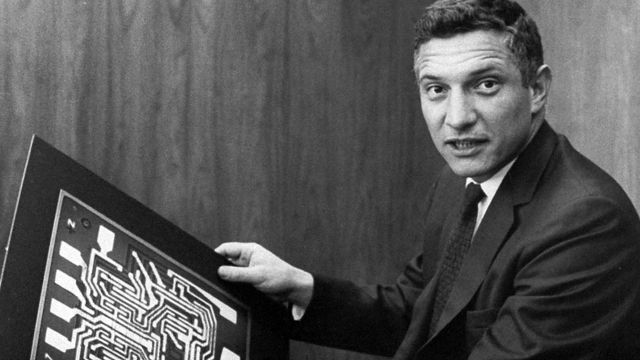
Noyce’s contribution to technology is most notably recognized through his co-invention of the integrated circuit, a pivotal innovation that revolutionized electronics and computing. In the late 1950s, while working at Fairchild Semiconductor, Noyce and his colleague Jack Kilby independently developed the first working models of the integrated circuit. Noyce’s version, made of silicon, became the standard for the industry, due to its scalability and cost-effectiveness.
The invention of the integrated circuit cannot be overstated. It is the bedrock upon which modern computing is built. This innovation allowed for the miniaturization of electronic devices, leading to the development of personal computers, smartphones, and countless other technologies that are integral to contemporary life.
Founding of Fairchild Semiconductor
In 1957, Noyce, along with seven other engineers, left Shockley Semiconductor Laboratory to form Fairchild Semiconductor. This group, later known as the “Traitorous Eight,” sought to create a company where innovation was nurtured, and contributions were rewarded. At Fairchild, Noyce played a crucial role in advancing semiconductor technology, and the company quickly became a leader in the industry.
Fairchild Semiconductor’s success was a catalyst for the growth of Silicon Valley as a hub of technological innovation. The company not only pioneered new technologies but also became a breeding ground for future entrepreneurs who would go on to start their own influential companies.
The Creation of Intel Corporation
In 1968, Noyce co-founded Intel Corporation with Gordon Moore, another member of the Traitorous Eight. Intel’s first major product was the 1103, the first commercially available dynamic random-access memory (DRAM) chip, which marked a significant advancement in memory technology. However, it was the introduction of the Intel 4004 microprocessor in 1971 that truly solidified Intel’s place as a technological powerhouse. The microprocessor, essentially a computer on a chip, revolutionized computing by making powerful processing capabilities available in a compact form.
Under Noyce’s leadership, Intel grew rapidly, becoming one of the most influential companies in the world. The success of Intel not only brought fame and fortune to Noyce but also further cemented his reputation as one of the key figures in the rise of Silicon Valley.
Recognition and Awards
Robert Noyce’s contributions to technology and industry did not go unnoticed. Throughout his career, he received numerous accolades for his work. In 1978, he was awarded the IEEE Medal of Honor for his contributions to the development of the integrated circuit. The following year, he received the National Medal of Science, one of the highest honors a scientist in the United States can receive. In 1990, he was posthumously awarded the Charles Stark Draper Prize by the National Academy of Engineering, recognizing his impact on modern engineering and technology.
Personal Life and Legacy
Despite his professional success, Robert Noyce faced challenges in his personal life. Known for his intense work ethic, Noyce often struggled to balance his career with his personal life. He was married twice and had four children. His first marriage, to Elizabeth Bottomley, ended in divorce. He later married Ann Bowers, who was also deeply involved in the tech industry.
Noyce was not just a brilliant scientist and entrepreneur; he was also a mentor and inspiration to many in the tech industry. His leadership style was characterized by a willingness to take risks, an openness to new ideas, and a deep respect for the creativity and intelligence of those around him. These qualities made him a beloved figure in Silicon Valley and beyond.
The “Mayor of Silicon Valley”
The nickname “Mayor of Silicon Valley” was not given to Noyce lightly. He was not only a pioneer in the field of semiconductors but also played a crucial role in shaping the culture and ethos of Silicon Valley. Noyce believed in a collaborative approach to innovation, where ideas were freely exchanged, and individuals were encouraged to pursue their passions. This philosophy helped foster an environment where creativity and entrepreneurship could thrive, and it continues to influence the culture of Silicon Valley to this day.
The Legacy of Robert Noyce
Robert Noyce passed away on June 3, 1990, at the age of 62, due to a heart attack. His death was a significant loss to the tech community, but his legacy lives on through the countless innovations that stemmed from his work. Today, Noyce is remembered not only for his technological contributions but also for his role in creating the environment that allowed Silicon Valley to become the global center of innovation.
Intel’s headquarters in Santa Clara, California, is named the Robert Noyce Building in his honor. The Grinnell College science building, the Robert N. Noyce ’49 Science Center, also bears his name, recognizing his contributions to science and technology.
Conclusion
Robert Noyce’s life is a story of innovation, leadership, and the relentless pursuit of excellence. From his early days as a curious child in Iowa to his role as one of the key architects of the digital age, Noyce’s contributions have had a profound impact on the world. His work in developing the integrated circuit and founding Intel has shaped the course of technology, making him one of the most influential figures in the history of computing. As we continue to rely on the technologies that Noyce helped create, his legacy remains as relevant today as it was during his lifetime.


