
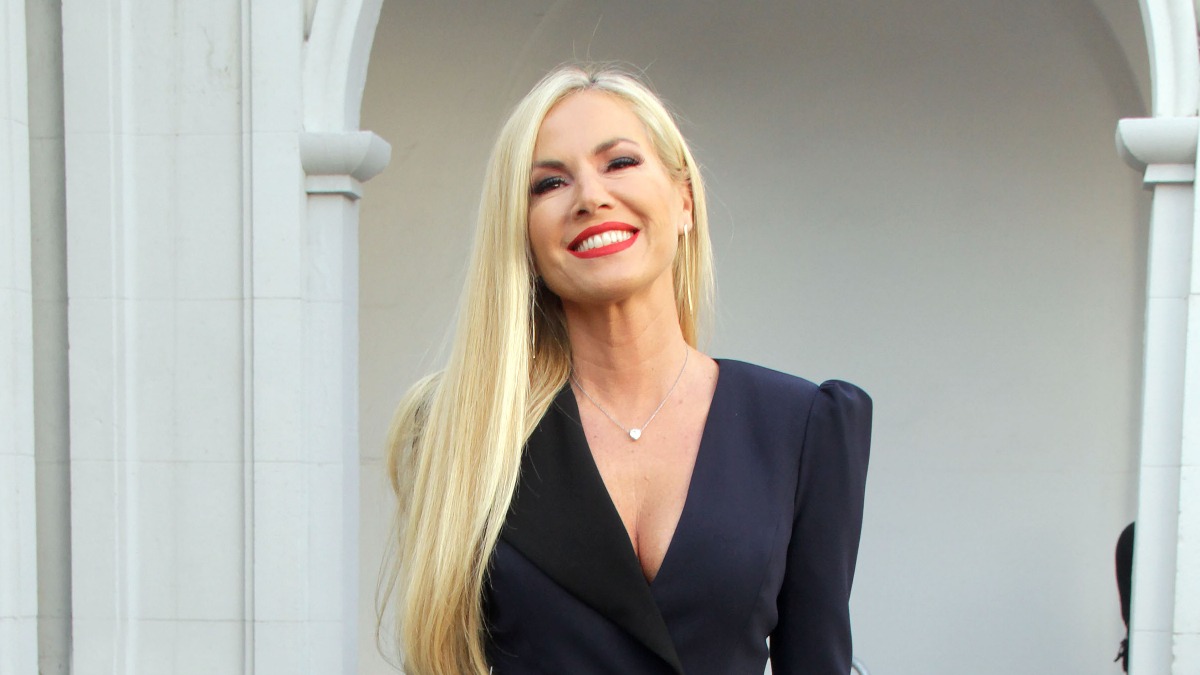
Federica Panicucci is a prominent Italian television presenter, radio host, and media personality, whose career spans over three decades. Born on October 27, 1967, in Cecina, a small town in the province of Livorno, Italy, Panicucci has become a household name in the Italian entertainment industry. This article will explore her life, career, and the milestones that have defined her journey to fame.
Early Life and Initial Career
Federica Panicucci was born into a typical Italian family in Cecina. From a young age, she exhibited a keen interest in the performing arts, which later translated into her career in television. Her initial foray into the entertainment world was through modeling, which provided her with the exposure and confidence to pursue a career in television.
Her television debut came in 1987 when she was selected as a “centralinista” (telephone operator) for the popular Italian television show “Portobello,” hosted by the iconic Enzo Tortora. This role, though minor, marked the beginning of Panicucci’s long and illustrious career in television.
Rise to Fame in the 1990s
In 1988, Panicucci’s career took a significant turn when she became an announcer for Rai Tre, one of Italy’s national television channels. Her charm and on-screen presence quickly caught the attention of producers, and she was soon cast in the role of a “hostess” on the game show “Il gioco delle coppie,” which aired on Canale 5 and was hosted by Marco Predolin. This exposure solidified her position in the Italian television landscape.
The early 1990s were a pivotal period for Panicucci. In 1991, she joined the afternoon television program “Unomania” on Italia 1, initially hosting a segment called “Twin Clips,” which focused on music. Her success in this role led to her becoming the main host of “Unomania” in the fall of 1992, replacing Gabriella Golia. This was a significant step forward in her career, as it showcased her ability to engage with a young audience and manage a variety show format.
Panicucci’s real breakthrough came in 1993 when she co-hosted the prestigious music festival “Festivalbar” alongside Rosario Fiorello and Amadeus. The show, which was a staple of Italian summer television, brought Panicucci national fame. She continued to host “Festivalbar” for two more years, further cementing her status as one of Italy’s leading television personalities.
Diversification and Continued Success
By the mid-1990s, Federica Panicucci had established herself as a versatile presenter capable of handling a wide range of television formats. In 1996, she transitioned to RAI, Italy’s public broadcasting company, where she co-hosted the show “Arrivano gli uomini” with the legendary Adriano Celentano. This move to RAI was significant, as it represented her ability to transition between different networks while maintaining her popularity.
Panicucci’s career continued to flourish as she took on more varied roles. She hosted “Jammin’ Night,” a music show dedicated to live performances, first on her own and later alongside Natalia Estrada and Lorena Forteza. During this period, she also began working alongside Pippo Baudo, one of Italy’s most respected television hosts, on several high-profile events, including “Il ballo delle debuttanti” and “La notte delle muse.”
Radio and Television in the 2000s
The 2000s were a period of continued success and diversification for Panicucci. She returned to RAI in 2000, where she hosted several afternoon and pre-evening programs on Rai 2, including “Affari di cuore,” “Batticuore,” and “Scherzi d’amore.” These shows were centered around themes of love and relationships, and Panicucci’s warm and engaging style made them popular with viewers.
In addition to her television work, Panicucci also had a successful career in radio. From 1996 to 2003, she was a presenter on Radio Deejay, one of Italy’s most popular radio stations, where she hosted the program “Dear Deejay.” This role allowed her to reach a different audience and further expanded her influence in the Italian media landscape.
In 2003, Panicucci took on a new challenge as the co-host of “Bulldozer,” a comedy show on Rai Due, alongside Enrico Bertolino. The show, which aired in the late evening, was a departure from her previous work and demonstrated her versatility as a presenter.
Return to Mediaset and Continued Television Presence
In 2006, Panicucci returned to Mediaset, the network where she had found early success. She initially hosted “Comedy Club,” a variety show that unfortunately was canceled after just one episode due to low ratings. However, Panicucci bounced back later that year when she co-hosted the first season of “La pupa e il secchione” with Enrico Papi. The show was a major success and marked Panicucci’s return to the spotlight.
From 2006 onwards, Panicucci also became the host of “La superclassifica,” a radio program on Radio 101, where she presented the weekly music chart published by the magazine “TV Sorrisi e Canzoni.” This role allowed her to continue her involvement in the music industry, which had been a significant part of her early career.
Personal Life and Public Image
Federica Panicucci’s personal life has often been the subject of media attention. In 2006, she married DJ Mario Fargetta, with whom she had two children, Sofia and Mattia. The couple was considered one of Italy’s most glamorous media pairs until their separation in 2015. Despite the challenges in her personal life, Panicucci has maintained a positive public image, known for her professionalism and dedication to her work.
Recent Career Highlights
In 2009, Panicucci made a return to prime-time television with the show “Cupido,” but the program did not perform well and was considered a flop. However, this setback did not diminish her standing in the industry. Later that year, she was selected to replace Barbara D’Urso as the host of “Mattino Cinque,” a morning talk show on Canale 5. This role has been one of Panicucci’s most enduring, as she continues to host the show to this day, making her a familiar face to millions of Italian viewers every weekday morning.
In January 2011, Panicucci also took over as the host of “Domenica Cinque,” a Sunday afternoon program on Canale 5, once again succeeding Barbara D’Urso. Her ability to step into high-profile roles and maintain the success of these programs speaks to her skill and adaptability as a television host.
Legacy and Influence
Federica Panicucci’s career is a testament to her versatility and resilience in the highly competitive world of Italian television. From her early days as a model and television announcer to becoming one of the most recognizable faces on Italian television, Panicucci has consistently demonstrated her ability to connect with audiences across different formats and genres.
Her career, marked by both successes and challenges, reflects the evolving landscape of Italian media. Panicucci has successfully navigated the transition from traditional television to the digital age, maintaining her relevance in an industry that has undergone significant changes over the past three decades.
The Nuances of Federica Panicucci’s Career
Understanding Federica Panicucci’s career requires an appreciation of the broader context of Italian television and media. The 1980s and 1990s were periods of significant growth and change in Italian television, with the rise of private networks like Mediaset challenging the dominance of the state broadcaster RAI. Panicucci’s ability to transition between these networks and succeed in both reflects her adaptability and understanding of the industry’s dynamics.
Moreover, Panicucci’s career highlights the role of women in Italian television. As a female host, she has often been at the forefront of major television events and programs, breaking barriers in an industry that has traditionally been dominated by male presenters. Her success has paved the way for other women in Italian media, making her a trailblazer in her own right.
Conclusion
Federica Panicucci is more than just a television host; she is a cultural icon in Italy, representing the evolution of the Italian entertainment industry over the past 30 years. Her career, characterized by perseverance, versatility, and a deep connection with her audience, offers valuable lessons in resilience and adaptability. As she continues to host popular television programs, Panicucci remains a beloved figure in Italian television, with a legacy that will undoubtedly influence future generations of media personalities.


