
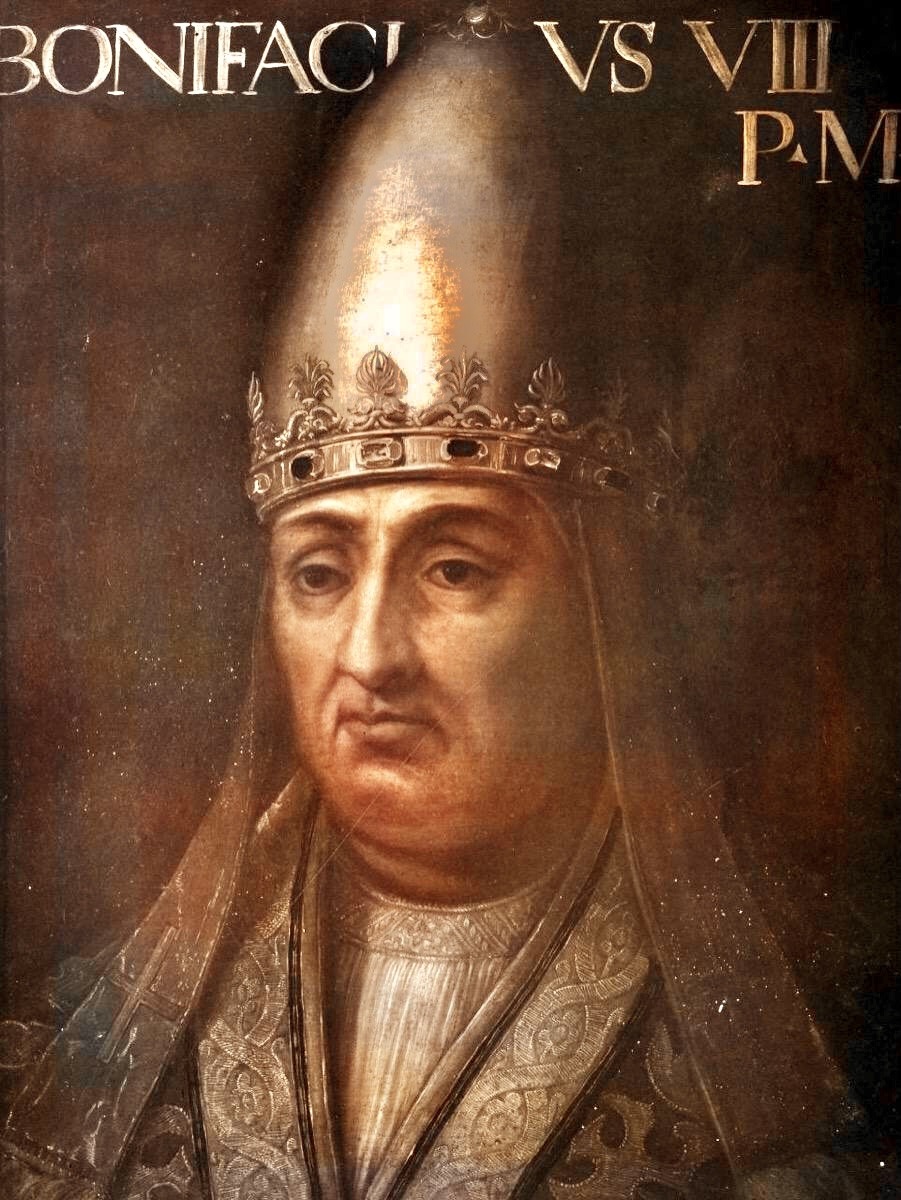
Pope Boniface VIII, born Benedetto Caetani between 1230 and 1235 in Anagni, Italy, stands as one of the most controversial and consequential figures in the history of the Catholic Church. His papacy, which began in 1294 and lasted until his death in 1303, was marked by significant ecclesiastical, political, and cultural conflicts. As a leader who wielded his power with a firm hand, Boniface VIII’s tenure as pope is a vivid illustration of the complexities and tensions between spiritual authority and temporal power during the medieval period.
Early Life and Ecclesiastical Rise
Benedetto Caetani hailed from a prominent family with roots tracing back to the Lombards, specifically the Caetani family of Pisa. Born into a noble lineage, Benedetto’s early life was shaped by his family’s influence and connections within the church. His father, Roffredo, and mother, Emilia Patrasso di Guarcino, ensured that young Benedetto received a robust education, which laid the foundation for his future ecclesiastical career.
By 1260, Benedetto had secured a canonry at Todi with the blessing of Pope Alexander IV, a move that marked the beginning of his rapid ascent within the church hierarchy. His studies in law, particularly canon law, at the University of Bologna equipped him with the legal acumen that would prove essential throughout his career. His deep understanding of church law and governance quickly distinguished him, leading to several important diplomatic missions, including those accompanying Cardinal Simon de Brion (the future Pope Martin IV) to France and Cardinal Ottobono Fieschi (the future Pope Adrian V) to England.
Benedetto’s prominence within the church was further solidified in 1281 when he was appointed Cardinal Deacon of San Nicola in Carcere by Pope Martin IV. A decade later, under Pope Nicholas IV, he was ordained as a priest and took the title of Cardinal Priest of Santi Silvestro e Martino ai Monti. His accumulation of prebends, canonries, and other benefices not only expanded his wealth but also elevated the Caetani family to one of the most powerful in Italy.
The Election of Boniface VIII
The death of Pope Nicholas IV in 1292 led to a prolonged and contentious conclave, ultimately resulting in the election of Pietro del Morrone, a hermit who reluctantly ascended to the papacy as Celestine V. Recognizing Celestine’s lack of experience and capability in managing the complexities of the papal office, Benedetto Caetani, an expert in canon law, became one of Celestine’s closest advisors. He played a crucial role in convincing Celestine that a pope could legally abdicate, a decision that Celestine ultimately made, paving the way for a new conclave.
In December 1294, after Celestine V’s abdication, Benedetto Caetani was elected pope by the College of Cardinals, taking the name Boniface VIII. His election marked a significant turning point in the church, as Boniface immediately set about asserting the authority of the papacy over both spiritual and temporal matters.
Boniface VIII’s Papal Reforms and Policies
One of Boniface VIII’s first acts as pope was to move the papal seat back to Rome from Naples, where Celestine V had relocated it to escape the influence of King Charles II of Anjou. Boniface sought to restore the prestige and independence of the papacy by revoking many of Celestine’s decisions and reestablishing the central authority of the church.
Boniface’s papacy was marked by his efforts to strengthen the power of the papacy in both ecclesiastical and political arenas. He sought to mediate disputes between warring factions in Italy and beyond, often intervening in conflicts to assert the church’s authority. One of the most notable examples was his involvement in the conflict between the Aragonese and the Angevins over the control of Sicily. Although Boniface supported Charles II of Anjou, his efforts to broker peace through the Treaty of Anagni ultimately failed, leading to his first significant defeat when he was forced to crown Frederick III of Aragon as King of Sicily in 1296.
The First Jubilee Year
Despite his political setbacks, Boniface VIII’s papacy is perhaps best remembered for the institution of the first Jubilee Year in 1300. Inspired by the spontaneous pilgrimage of thousands of faithful to Rome at the turn of the century, Boniface seized the opportunity to capitalize on this popular movement by establishing the Jubilee as a year of universal pardon and indulgence. The papal bull “Antiquorum habet fida relatio,” issued on February 22, 1300, formally instituted the Jubilee, declaring that it would be celebrated every hundred years.
The Jubilee Year of 1300 was a resounding success, attracting pilgrims from across Europe to Rome and significantly boosting the city’s economy. The influx of pilgrims not only brought considerable revenue to the church but also reinforced the spiritual and temporal authority of the papacy. The Jubilee became a cornerstone of Catholic tradition, celebrated regularly in the centuries that followed, and remains a significant religious event to this day.
Conflict with Philip IV of France
The latter part of Boniface VIII’s papacy was dominated by his fierce conflict with Philip IV of France, also known as Philip the Fair. The dispute began over Philip’s attempts to tax the French clergy without papal consent, a move that Boniface vehemently opposed. In 1296, Boniface issued the bull “Clericis laicos,” which forbade secular rulers from taxing the clergy without the express permission of the pope. This was followed by another bull, “Unam sanctam,” in 1302, which asserted the supremacy of the papal authority over all secular rulers, declaring that salvation was only possible through the Roman pontiff.
Philip IV, determined to resist what he saw as an overreach of papal authority, convened an assembly of French nobles and clergy at the Louvre in 1303. This assembly accused Boniface VIII of numerous crimes, including heresy, simony, and even murder. The situation escalated rapidly, leading to one of the most dramatic and humiliating episodes in papal history.
The Outrage of Anagni
In September 1303, Philip IV dispatched Guillaume de Nogaret, a lawyer and fierce critic of Boniface VIII, to Italy with instructions to bring the pope to France for trial. Nogaret, along with Sciarra Colonna, a member of a powerful Roman family that opposed Boniface, led an armed force to the town of Anagni, where Boniface was staying. The group stormed the papal palace, capturing the pope in what became known as the “Outrage of Anagni.”
During his captivity, Boniface VIII was subjected to insults, threats, and even physical violence, including the infamous “slap of Anagni,” a symbolic act of defiance against papal authority. The people of Anagni, outraged by the treatment of the pope, eventually rose up against the invaders, forcing Nogaret and his men to flee. Boniface was freed, but the ordeal left him physically and mentally weakened.
Death and Legacy
Boniface VIII returned to Rome under the protection of the powerful Orsini family, but his health had been irreparably damaged by the events at Anagni. Suffering from kidney stones and gout, as well as the psychological trauma of his capture, Boniface VIII died on October 11, 1303. He was buried in St. Peter’s Basilica in a chapel designed by the renowned architect Arnolfo di Cambio.
The legacy of Boniface VIII is complex and deeply contested. On one hand, he is remembered as a pope who sought to assert the absolute authority of the papacy over all earthly powers, a vision that both defined and ultimately undermined his pontificate. His conflict with Philip IV set the stage for the Avignon Papacy, a period of nearly seventy years when the papacy was effectively under the control of the French crown, a direct consequence of Boniface’s attempts to challenge royal authority.
On the other hand, Boniface VIII’s institution of the Jubilee Year has had a lasting impact on Catholic tradition and practice. The Jubilee continues to be a significant religious event, symbolizing repentance, forgiveness, and the renewal of faith.
In Dante Alighieri’s “Divine Comedy,” Boniface VIII is placed in the Eighth Circle of Hell, among the simoniacs, a reflection of the widespread contemporary criticism of his policies and actions. This portrayal has contributed to the enduring image of Boniface as a deeply flawed and controversial figure.
Nevertheless, Boniface VIII remains a pivotal figure in the history of the Catholic Church. His papacy encapsulates the tensions between spiritual authority and temporal power, a theme that has resonated throughout the history of the papacy. His bold, and often contentious, actions continue to be the subject of scholarly debate, reflecting the complexities and challenges of leading the Catholic Church during a period of profound change and conflict.
Boniface VIII’s story is a reminder of the delicate balance that the papacy has often had to navigate between its spiritual mission and its temporal ambitions, a balance that continues to shape the role of the pope in the modern world.


