
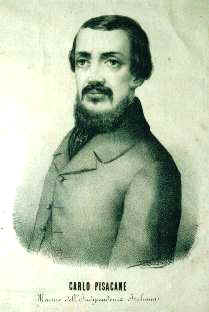
Carlo Pisacane, a name that resonates with the echoes of 19th-century Italian revolutionary fervor, is a figure whose life was marked by unwavering commitment to the cause of Italian unification and social justice. Born into aristocracy on August 22, 1818, in Naples, Pisacane’s life was destined to be one of dramatic turns, heroic endeavors, and ultimately, tragic demise. This detailed exploration of his life offers a comprehensive look into the age, fame, and key life highlights of Carlo Pisacane, a man who sacrificed everything for his ideals.
Early Life and Military Beginnings
Carlo Pisacane was born into a noble family in Naples. His father, Duke Gennaro Pisacane of San Giovanni, passed away when Carlo was just eight years old, leaving the family in a precarious financial situation. His mother, Nicoletta Basile de Luna, remarried General Michele Tarallo, and Pisacane was soon enrolled in military training.
At the tender age of 12, Pisacane began his military career at the Military School of San Giovanni, located in Carbonara. His early exposure to military discipline and training laid the foundation for his later involvement in revolutionary activities. By 1830, Pisacane had moved to the prestigious Nunziatella Military School, where he would remain until 1838, successfully passing his final examinations and solidifying his status as a competent military officer.
Romantic Turmoil and the Path to Revolution
Pisacane’s return to Naples in 1843 marked the beginning of a tumultuous period in his personal life. He reconnected with Enrichetta Di Lorenzo, a woman he had loved in his youth. Enrichetta, however, was married with three children, and their rekindled romance led to scandal and eventual separation from her husband. This chapter in Pisacane’s life is significant not only for the emotional turmoil it caused but also because it propelled him towards a deeper involvement in revolutionary causes.
In 1847, amid growing political unrest in Europe, Pisacane and Enrichetta fled Italy for France. Their journey was fraught with challenges, including being pursued by Bourbon police and traveling under false identities. Their time in London and France exposed Pisacane to influential intellectuals and revolutionaries, further shaping his political ideologies.
Military Experience and the First Italian War of Independence
Pisacane’s brief stint in the French Foreign Legion, where he served as a sub-lieutenant in Algeria, was cut short by news of the anti-Austrian uprisings in Lombardy-Venetia. He returned to Italy, eager to lend his military expertise to the cause of Italian independence. As a captain commanding the 5th Company of Lombard Volunteer Corps, Pisacane fought valiantly against Austrian forces, even sustaining injuries in battle.
The defeat of the Piedmontese forces in the First Italian War of Independence was a significant blow to Pisacane. Disillusioned but not deterred, he continued his revolutionary activities, this time focusing on the short-lived Roman Republic of 1849. Alongside prominent figures like Giuseppe Mazzini and Giuseppe Garibaldi, Pisacane played a crucial role in defending the Republic against French intervention. His efforts were ultimately in vain, as the Republic fell, and Pisacane was arrested. However, he was soon released thanks to the intervention of his wife, Enrichetta.
Intellectual Pursuits and Shift Towards Socialism
Following the fall of the Roman Republic, Pisacane and Enrichetta sought refuge in Switzerland, where he turned to writing. His works, including articles on the wars he had participated in, reflect a deepening commitment to revolutionary ideals. Influenced by the works of Russian anarchist Mikhail Bakunin and French utopian socialism, Pisacane’s political views evolved towards advocating for social justice and the empowerment of the working class.
By 1850, Pisacane had moved to Genoa, where he would spend the next seven years. It was during this period that he penned his significant work, “Guerra combattuta in Italia negli anni 1848-49,” a detailed account of the military campaigns in which he had participated. This work not only showcased his military acumen but also his evolving belief in the necessity of radical social change in Italy.
The Sapri Expedition and Legacy
Pisacane’s most famous and ultimately tragic endeavor was the Sapri Expedition of 1857. Alongside 24 other revolutionaries, Pisacane embarked on the steamer Cagliari from Genoa, intending to incite an uprising in southern Italy. The expedition was grounded in Pisacane’s belief in “Propaganda of the Deed,” the idea that revolutionary actions could inspire mass movements and lead to societal change.
The expedition faced numerous challenges from the outset, including the failure to rendezvous with a ship carrying weapons and bad weather. Despite these setbacks, Pisacane and his comrades managed to land on the island of Ponza, where they liberated over 300 prisoners. However, as they moved inland, they were met with resistance from Bourbon forces and local peasants, who were incited by local authorities to view the revolutionaries as brigands.
On July 2, 1857, Pisacane and his remaining followers were attacked by the very people they had hoped to liberate. The attack led to the massacre of most of the revolutionaries, including Pisacane himself, who died at the age of 38. The Sapri Expedition, although a failure in its immediate objectives, left a lasting legacy in the Italian unification movement. Pisacane’s martyrdom and the ideals he fought for continued to inspire future generations of Italian patriots.
The Historical Context and Impact of Pisacane’s Ideals
Carlo Pisacane’s life and legacy must be understood within the broader context of the 19th-century European revolutionary movements. The mid-1800s were a period of intense social and political upheaval across Europe, with nationalist and socialist ideas gaining traction among intellectuals and the working class alike. Pisacane was deeply influenced by these currents, particularly the ideas of anarchism and socialism that were beginning to challenge traditional power structures.
Pisacane’s concept of “Propaganda of the Deed” was particularly innovative and influential. While it did not achieve immediate success, the idea that direct action could spark widespread revolutionary fervor was a significant departure from the more gradualist approaches of some of his contemporaries. This concept would later be adopted and adapted by various revolutionary movements across Europe and beyond.
Moreover, Pisacane’s critique of the existing social order and his advocacy for the rights of the poor and disenfranchised set him apart from many of his fellow Italian nationalists. While figures like Mazzini and Garibaldi focused primarily on national unification, Pisacane recognized that true freedom and justice required addressing the deep social inequalities that plagued Italian society. In this sense, he can be seen as a precursor to the later socialist and anarchist movements that would play a significant role in European politics.
Conclusion: A Revolutionary Remembered
Carlo Pisacane’s life was marked by a relentless pursuit of justice and a deep commitment to the cause of Italian unification. From his early military career to his intellectual pursuits and ultimately his tragic death in the Sapri Expedition, Pisacane embodied the revolutionary spirit of his time. Though his life was cut short at the age of 38, his ideas and actions left an indelible mark on the history of Italy.
Today, Pisacane is remembered not only as a martyr for Italian independence but also as a visionary who understood that political freedom must be accompanied by social justice. His legacy continues to inspire those who seek to challenge oppression and fight for a more just and equitable world. As we reflect on his life, it is clear that Carlo Pisacane was more than just a revolutionary—he was a true champion of the people, whose ideas remain relevant in our ongoing struggles for freedom and equality.


