
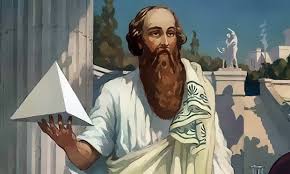
Pythagoras of Samos is one of the most enigmatic figures in the history of mathematics and philosophy. Often hailed as the first pure mathematician, Pythagoras’ influence extends beyond mathematics into the realms of music, astronomy, and mysticism. His life, shrouded in mystery and myth, has been the subject of countless interpretations, each adding layers to the legend of the man who established the foundations of the mathematical sciences. Born around 570 BCE on the Greek island of Samos, Pythagoras’ contributions to mathematics, particularly the Pythagorean theorem, have made him a towering figure in Western intellectual history. This article delves into his life, his mathematical discoveries, and the broader impact of his philosophical and religious teachings.
Early Life: The Formative Years
Pythagoras was born to Mnesarchus, a merchant from Tyre, and Pythais, a native of Samos. His upbringing was marked by travel and exposure to diverse cultures, as his father’s trade took them across the Mediterranean. This early exposure to different peoples and ideas likely played a significant role in shaping Pythagoras’ inquisitive nature and his later pursuits in knowledge.
The accounts of Pythagoras’ early life are sparse, with many details obscured by the passage of time and the mythical embellishments that later biographers added to his story. It is believed that he received a robust education, learning to play the lyre, recite the works of Homer, and engage in the study of poetry. His intellectual journey was influenced by several key figures, most notably Pherekydes, a philosopher who is often credited with being one of Pythagoras’ primary mentors.
Around the age of eighteen to twenty, Pythagoras is said to have traveled to Miletus to study under Thales, one of the preeminent philosophers of the time. Although Thales was an elderly man by this time, his teachings in mathematics and astronomy had a profound impact on Pythagoras. Thales is believed to have sparked Pythagoras’ interest in the mathematical principles underlying the natural world, and he advised the young philosopher to travel to Egypt to further his studies.
Travels and Learning: The Egyptian Influence
Around 535 BCE, Pythagoras heeded Thales’ advice and traveled to Egypt, which was at the time a center of knowledge and learning. His time in Egypt was pivotal in shaping his philosophical and mathematical ideas. The Egyptian priests, who were the custodians of knowledge, welcomed Pythagoras into their ranks, and he spent several years studying in their temples. It is here that Pythagoras is believed to have acquired knowledge of geometry, a field in which the Egyptians had made significant advances, particularly in relation to land measurement and architecture.
The influence of Egyptian religious practices and beliefs on Pythagoras was also profound. The rituals, the emphasis on purity, and the notion of the immortality of the soul found echoes in the teachings Pythagoras would later propagate through his own school. His time in Egypt imbued him with a sense of the mystical and the spiritual, elements that would become central to his philosophical outlook.
The Persian Conquest and Babylonian Captivity
In 525 BCE, the Persian king Cambyses II invaded Egypt, marking the end of Egyptian independence and the beginning of Persian domination. During this conquest, Pythagoras was captured and taken to Babylon, a city that was at the height of its cultural and scientific achievements under the rule of the Persian Empire. Babylon was a melting pot of knowledge, where Greek, Egyptian, and Mesopotamian ideas intermingled.
In Babylon, Pythagoras is believed to have been exposed to a wide array of mathematical and astronomical knowledge. The Babylonians were particularly advanced in their understanding of astronomy and had developed complex mathematical techniques for predicting celestial events. These experiences in Babylon further deepened Pythagoras’ mathematical knowledge and contributed to the development of his own theories upon his return to the Greek world.
Return to Samos and the Founding of His School
Pythagoras eventually returned to Samos around 520 BCE, after the death of Cambyses II and the subsequent upheavals in the Persian Empire. Upon his return, he found his homeland under the control of the tyrant Polycrates, who had established an alliance with the Persians. The political situation in Samos was unstable, and this, coupled with Pythagoras’ growing disillusionment with the tyranny of Polycrates, led him to leave Samos for southern Italy, specifically the city of Croton.
It was in Croton that Pythagoras established his most famous institution, a school that was part philosophical society, part religious order. The Pythagorean school was revolutionary in its approach, blending rigorous mathematical study with spiritual and ethical teachings. Pythagoras himself became the head of this school, and his followers, known as Pythagoreans, were deeply devoted to their master and the doctrines he espoused.
Pythagorean Doctrine: Mathematics and Mysticism
The Pythagorean school was characterized by its belief that mathematics was the foundation of all reality. Pythagoras taught that numbers were the essence of all things, and that understanding the relationships between numbers could reveal the underlying order of the universe. This belief in the primacy of mathematics was revolutionary and laid the groundwork for the development of mathematical thought in Western philosophy.
One of the most famous mathematical discoveries attributed to Pythagoras is the Pythagorean theorem, which states that in a right-angled triangle, the square of the length of the hypotenuse is equal to the sum of the squares of the lengths of the other two sides. Although the theorem was known to the Babylonians and Indians long before Pythagoras, he is credited with providing the first known proof, thus cementing his legacy in the annals of mathematics.
Pythagoras’ mathematical teachings were not limited to geometry. He and his followers also explored the properties of numbers, classifying them into categories such as even and odd, triangular, and perfect numbers. For the Pythagoreans, numbers had a mystical quality, and they believed that understanding the nature of numbers could lead to spiritual enlightenment.
The Pythagorean belief in the mystical significance of numbers extended to music as well. Pythagoras discovered that the intervals between harmonious musical notes could be expressed as simple ratios of whole numbers. This discovery, known as the “harmony of the spheres,” suggested that the same mathematical principles governing music also governed the cosmos. This idea had a profound influence on later thinkers and laid the groundwork for the study of musical harmony and acoustics.
The Pythagorean Community: Philosophy and Way of Life
The Pythagorean community was more than just a school; it was a way of life. The members, both men and women, lived communally, sharing their possessions and adhering to strict ethical and dietary codes. They practiced vegetarianism, avoided eating beans, and refrained from wearing animal skins. These practices were believed to purify the soul and bring the individual closer to the divine.
The Pythagoreans also believed in the transmigration of souls, a doctrine that held that the soul was immortal and, upon death, would be reincarnated in a new body. This belief in the immortality of the soul was central to Pythagorean philosophy and influenced the ethical and spiritual practices of the community.
The Pythagorean community was hierarchical, with an inner circle known as the “mathematikoi” who lived permanently within the school and adhered to the strictest rules. They were the true disciples of Pythagoras, dedicating their lives to the study of mathematics and the pursuit of spiritual purification. The outer circle, known as the “akousmatics,” lived outside the school and followed a less rigorous regimen but were still devoted to the teachings of Pythagoras.
Political Involvement and Persecution
Despite their attempts to remain apolitical, the Pythagoreans became embroiled in the political life of Croton. The city was a major center of power in southern Italy, and the influence of the Pythagorean community grew as they attracted followers from among the city’s elite. This influence inevitably led to tensions with other political factions, and the Pythagoreans were perceived as a threat to the established order.
Around 508 BCE, the Pythagorean school in Croton was attacked by a rival faction led by a nobleman named Cylon. The reasons for the attack are not entirely clear, but it is believed that political jealousy and fear of the growing power of the Pythagoreans played a role. The school was destroyed, and many of Pythagoras’ followers were killed or scattered. Pythagoras himself fled to the nearby city of Metapontum, where he is believed to have died shortly thereafter, either from natural causes or, according to some accounts, by taking his own life in despair over the destruction of his school.
Legacy and Historical Impact
The death of Pythagoras did not mark the end of his influence. His teachings continued to be propagated by his followers, and the Pythagorean school survived in various forms for centuries. The mathematical and philosophical ideas that originated with Pythagoras and his disciples became foundational to the development of Western thought. The Pythagorean theorem remains one of the most important and widely known principles in mathematics, and the idea that the universe is governed by mathematical laws continues to be a central tenet of modern science.
Pythagoras’ influence extended beyond mathematics. His ideas about the harmony of the spheres and the transmigration of souls resonated with later philosophical traditions, particularly Platonism and Neoplatonism. The Pythagorean emphasis on the ethical and spiritual dimensions of life also left a lasting legacy in the fields of ethics and religious philosophy.
Conclusion: Pythagoras as a Timeless Figure
Pythagoras is a figure who transcends the boundaries of mathematics and philosophy. His life and teachings represent a unique blend of scientific inquiry and spiritual wisdom, and his influence can be seen in many of the fundamental concepts that continue to shape our understanding of the world. Whether viewed as a mathematician, a philosopher, or a mystic, Pythagoras remains a symbol of the enduring power of knowledge and the quest for understanding.
As we reflect on the life of Pythagoras, we are reminded of the profound impact that one individual can have on the course of history. His contributions to mathematics, his philosophical teachings, and his vision of a universe governed by harmony and order have left an indelible mark on human civilization. Pythagoras’ legacy is not just a collection of mathematical theorems and philosophical doctrines; it is a testament to the power of ideas to transcend time and continue to inspire future generations.


