
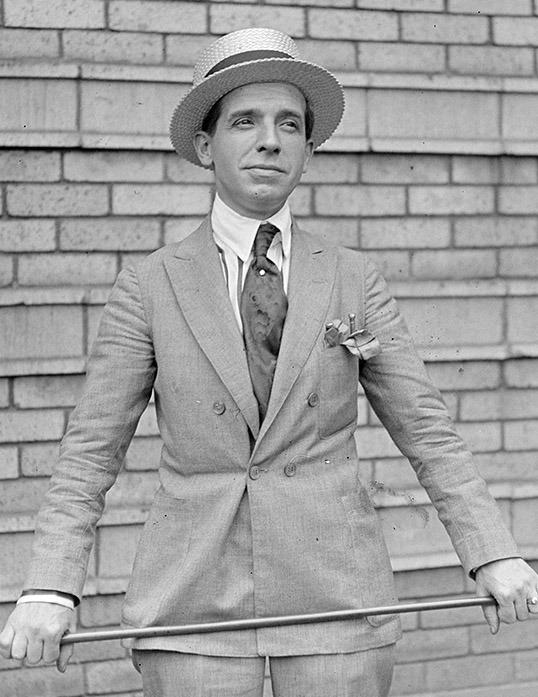
Charles Ponzi, born Carlo Pietro Giovanni Guglielmo Tebaldo Ponzi on March 3, 1882, in Lugo, Italy, is a name synonymous with financial deception. Ponzi’s life is a complex tale of ambition, cunning, and the pitfalls of greed, leading to one of the most infamous financial schemes in history—the Ponzi scheme. This article delves into the life of Charles Ponzi, exploring his rise to fame, the mechanics of his fraudulent scheme, and the eventual downfall that solidified his legacy as one of the most notorious swindlers in financial history.
Early Life and Background
Charles Ponzi was born into a relatively well-off family in Lugo, a small town near Ravenna, Italy. Despite his comfortable upbringing, Ponzi was not particularly inclined toward academic pursuits. He spent much of his youth in Parma before enrolling at the University of Rome La Sapienza. However, his academic career was short-lived; Ponzi found himself more interested in the allure of wealth and the opportunities that lay beyond the shores of Italy.
In 1903, at the age of 21, Ponzi made the bold decision to emigrate to the United States, lured by the promise of the American Dream. He arrived in Boston with just $2.50 in his pocket, having lost the rest of his money to gambling during the voyage. This inauspicious start in America was a harbinger of the turbulent life that awaited him.
Struggles and Early Schemes
Upon his arrival in the United States, Ponzi struggled to find steady work. His early years in America were marked by a series of low-paying jobs, including working as a dishwasher in a restaurant. Although he was eventually promoted to waiter, his dishonest behavior—skimming money from the till and shortchanging customers—led to his dismissal.
In 1907, seeking new opportunities, Ponzi moved to Canada, where he found employment at the Banco Zarossi in Montreal. The bank, founded by Italian immigrant Luigi Zarossi, catered primarily to the Italian community, offering attractive interest rates that were twice the standard rate at the time. However, Ponzi soon discovered that the bank was operating on shaky financial ground. Zarossi was using funds from new deposits to pay interest on earlier deposits—a practice that would later become known as a Ponzi scheme.
When the bank eventually collapsed, Zarossi fled to Mexico with the remaining funds, leaving Ponzi unemployed and stranded in Canada. Desperate for money, Ponzi forged a check, which led to his arrest and a three-year prison sentence. This period in prison marked the beginning of Ponzi’s long and tumultuous relationship with the law.
The Birth of the Ponzi Scheme
After serving his sentence in Canada, Ponzi returned to the United States in 1911, only to be arrested again—this time for smuggling Italian immigrants across the border. He served another two years in prison in Atlanta. It was during this time that Ponzi began to conceive the idea that would make him infamous.
After his release, Ponzi settled in Boston and married Rose Gnecco, an Italian-American woman, in 1918. To support his new life, Ponzi tried his hand at various ventures, including writing a trade guide for businesses. However, it was a simple letter from a Spanish company that would spark the idea for his grand scheme.
The letter contained an International Reply Coupon (IRC), a voucher that could be exchanged for postage stamps from another country. Ponzi realized that due to post-World War I inflation, the value of these coupons varied significantly between countries. He theorized that he could buy IRCs cheaply in countries with weaker economies, exchange them for U.S. postage stamps, and sell the stamps at a profit.
Seeing the potential for enormous profits, Ponzi began to solicit investments from friends and acquaintances, promising a 50% return on their investment within 45 days, or 100% within 90 days. The promise of such high returns was irresistible, and money began pouring in.
The Scheme Takes Off
In December 1919, Ponzi established the Securities Exchange Company to handle the investments. Word of his seemingly miraculous returns spread rapidly, and within months, Ponzi was receiving millions of dollars from investors across New England. By May 1920, he had amassed over $420,000, a staggering sum at the time. Ponzi’s growing wealth allowed him to live a lavish lifestyle, complete with luxury homes, cars, and extravagant parties.
However, the success of Ponzi’s scheme was built on a house of cards. He was not actually investing in IRCs as he claimed. Instead, he was using the money from new investors to pay off earlier ones, creating the illusion of profitability. This type of operation, where returns to earlier investors are paid using the capital from newer investors rather than from profit, is now widely known as a Ponzi scheme.
The Downfall
As Ponzi’s fame grew, so did the scrutiny of his operations. In July 1920, the Boston Post began publishing articles questioning the legitimacy of Ponzi’s investment scheme. The newspaper’s investigation revealed that the volume of IRCs needed to sustain Ponzi’s profits far exceeded the actual number in circulation, raising suspicions about the true source of his returns.
On August 10, 1920, federal agents raided Ponzi’s offices, and the investigation revealed the full extent of his fraud. Ponzi was arrested and charged with multiple counts of mail fraud. In November 1920, he was convicted and sentenced to five years in federal prison. Ponzi’s scheme had defrauded investors of an estimated $15 million—equivalent to over $200 million today.
Despite serving his sentence, Ponzi’s legal troubles were far from over. After being released on parole, he was immediately indicted on state charges by the Commonwealth of Massachusetts. Faced with these new charges, Ponzi fled to Florida, where he attempted to resurrect his fraudulent activities under the alias Charles Borelli. He was quickly apprehended and sentenced to another year in prison.
After serving his time in Florida, Ponzi attempted to flee to Italy, but he was caught in New Orleans and extradited to Massachusetts to serve out the remainder of his sentence. In 1934, after years of legal battles and multiple prison sentences, Ponzi was finally deported to Italy, his American dream shattered.
Later Years and Legacy
Upon his return to Italy, Ponzi struggled to regain his footing. His wife, Rose, who had stood by him during his trials, eventually divorced him and remained in the United States. Ponzi made several unsuccessful attempts to restart his financial schemes in Italy, but his reputation as a swindler preceded him, and he found it difficult to find new victims.
In the late 1930s, Ponzi moved to Brazil, where he found work as a translator and later as an agent for Ala Littoria, an Italian airline. However, his life in Brazil was far from glamorous. He lived in relative obscurity and poverty, a far cry from the lavish lifestyle he had once enjoyed. On January 18, 1949, Charles Ponzi died in a charity hospital in Rio de Janeiro, penniless and largely forgotten by the world.
The Enduring Legacy of the Ponzi Scheme
Despite his ignominious end, Charles Ponzi’s name lives on through the financial fraud that bears his name—the Ponzi scheme. His story serves as a cautionary tale about the dangers of greed and the allure of get-rich-quick schemes. Ponzi’s scheme was not the first of its kind, but its scale and impact were unprecedented at the time, and it has since become the archetype for similar frauds.
Ponzi schemes continue to plague the financial world, with high-profile cases such as Bernie Madoff’s 2008 scheme, which defrauded investors of billions of dollars, serving as a stark reminder of the enduring appeal of such scams. These schemes exploit the trust and greed of investors, promising high returns with little or no risk—promises that are, in reality, too good to be true.
The legacy of Charles Ponzi is a complex one. While he is often vilified as a con artist and criminal, his story also highlights the vulnerabilities of financial systems and the ease with which they can be manipulated. His life is a testament to the fact that financial fraud is not a modern invention but a timeless problem that continues to evolve with the times.
Conclusion
Charles Ponzi’s life is a narrative of ambition, deception, and the ultimate downfall that comes from living beyond one’s means and exploiting the trust of others. His name may be synonymous with fraud, but his story is also a reflection of the human tendency to be seduced by the promise of easy wealth.
Today, Ponzi’s legacy endures as a reminder to investors and regulators alike to remain vigilant against financial schemes that promise the impossible. His life, while tragic, provides valuable lessons about the importance of skepticism, due diligence, and the recognition that if something seems too good to be true, it probably is.


