
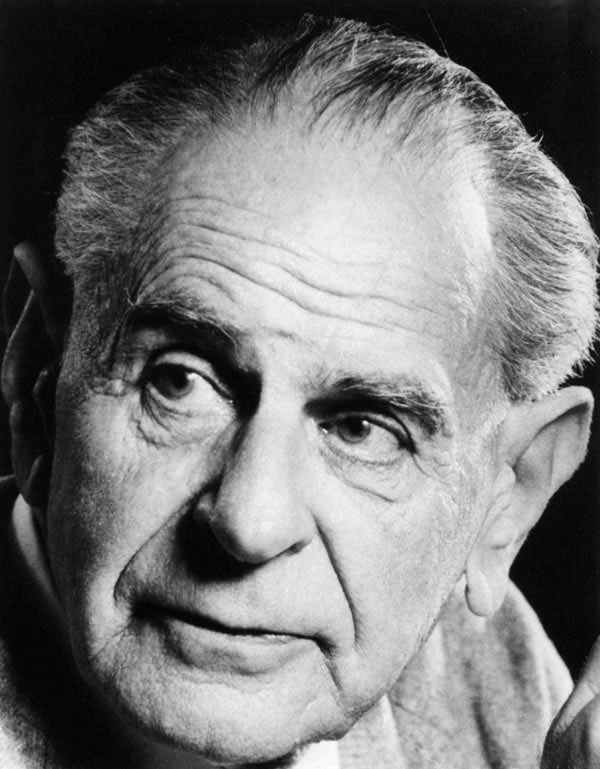
Karl Raimund Popper, born on July 28, 1902, in Vienna, Austria, is a towering figure in 20th-century philosophy, particularly in the philosophy of science. His intellectual legacy has carved a distinct line in the epistemological debate, so much so that it’s often said there is a “before Popper” and an “after Popper” in philosophy. His contributions have reshaped how we understand scientific inquiry, critical thinking, and the demarcation between science and non-science.
Early Life and Education
Popper grew up in Vienna, a city rich in intellectual and cultural history, which profoundly influenced his early development. His father was a lawyer and a bibliophile, exposing young Karl to a vast array of books and ideas from an early age. This environment nurtured his inquisitive mind, leading him to study at the University of Vienna, where he initially dabbled in mathematics and theoretical physics. However, his interests soon shifted towards philosophy, a field in which he would later leave an indelible mark.
Popper’s early intellectual journey was marked by an encounter with the Vienna Circle, a group of philosophers and scientists who advocated for logical positivism. This school of thought held that only statements verifiable through empirical observation or logical proof were meaningful. However, Popper would soon challenge this view, setting the stage for his revolutionary ideas.
The Birth of Critical Rationalism
Popper’s critique of the prevailing epistemological views culminated in his first major work, The Logic of Scientific Discovery, published in 1934. In this book, Popper rejected the notion that scientific theories are derived from inductive reasoning—a process where general principles are inferred from specific observations. Instead, he argued for falsifiability as the criterion for scientific validity. According to Popper, a theory is scientific only if it can, in principle, be proven false by observation or experiment.
This idea was groundbreaking. Prior to Popper, it was widely believed that science advanced through the accumulation of observational evidence that gradually confirmed theories. Popper turned this notion on its head, asserting that no amount of empirical evidence could ever confirm a theory with absolute certainty. Instead, scientific theories could only be tentatively accepted until they were falsified by new evidence.
Popper illustrated this with the example of swans. Observing numerous white swans might lead one to believe that all swans are white. However, the discovery of a single black swan would immediately falsify this theory. Thus, Popper emphasized that the strength of a scientific theory lies in its ability to withstand rigorous attempts at falsification.
Intellectual Impact and Philosophical Battles
Popper’s ideas did not go unchallenged. His rejection of induction and his emphasis on falsifiability placed him at odds with the Vienna Circle and other schools of thought, such as Marxism, Psychoanalysis, and various forms of historicism. Popper argued that these ideologies, which claimed to have discovered immutable laws of history or human nature, were pseudoscientific because they were not falsifiable. They could explain away any counter-evidence, making them impervious to refutation.
In his later work, The Open Society and Its Enemies, Popper applied his philosophy of science to political theory. He critiqued totalitarian regimes and ideologies that claimed to possess ultimate truth, such as those of Plato, Hegel, and Marx. Popper championed the concept of the “open society,” where individuals are free to criticize and improve upon existing knowledge and institutions. He argued that this openness is essential for both scientific progress and a healthy, functioning democracy.
Popper’s critiques extended to astrology and other forms of the occult, which he dismissed as non-scientific because they could not be tested and falsified. In astrology, for example, predictions are often vague and can be retroactively interpreted to fit almost any outcome, making them immune to disproof.
Life in Exile: New Zealand and Beyond
Fearing the rise of Nazism in Europe, Popper, who was of Jewish descent, left Austria in 1937. He emigrated to New Zealand, where he took up a teaching position at the University of Canterbury in Christchurch. It was during this time that Popper wrote some of his most influential works on social and political philosophy, including The Poverty of Historicism and The Open Society and Its Enemies.
In these works, Popper continued to develop his ideas on the dangers of totalitarianism and the importance of critical thinking and open debate. He argued that the belief in historical inevitability, whether in the form of Marxist revolution or any other kind of determinism, leads to tyranny and oppression. Instead, Popper advocated for a piecemeal approach to social engineering, where policies are tested and revised in light of their practical outcomes.
After World War II, Popper moved to the United Kingdom, where he joined the faculty of the London School of Economics. His reputation as a leading philosopher of science and a defender of liberal democracy grew, and he became a sought-after speaker and thinker on issues of science, politics, and education.
Later Years and Legacy
Popper retired from active teaching in 1969 but continued to write and lecture well into his later years. He was knighted by Queen Elizabeth II in 1965, a testament to his significant contributions to philosophy and society. Popper received numerous other honors and awards throughout his life, including membership in prestigious institutions like the Royal Society and the International Academy for Philosophy of Science.
In his later works, Popper addressed a range of topics, from the philosophy of mind to the nature of scientific discovery. He remained a vocal critic of any form of dogmatism or authoritarianism, whether in science, politics, or religion. Popper’s philosophy emphasized the provisional nature of knowledge and the importance of remaining open to new ideas and evidence.
Popper passed away on September 17, 1994, in Kenley, London. His death marked the end of an era, but his ideas continue to influence thinkers across various disciplines. His concept of falsifiability remains a cornerstone of scientific methodology, and his defense of the open society resonates with those who value freedom, democracy, and the relentless pursuit of truth.
Popper’s Enduring Influence
Today, Karl Popper’s legacy endures in both the philosophy of science and broader intellectual discourse. His insistence on critical scrutiny and the willingness to abandon even cherished beliefs in the face of contrary evidence remains a powerful reminder of the rigor and humility that true scientific inquiry demands.
In the age of information, where misinformation and ideological echo chambers abound, Popper’s ideas are more relevant than ever. The open society, with its emphasis on free exchange of ideas and respect for evidence, is crucial for the progress of knowledge and the protection of democratic values. As we navigate the complexities of the modern world, Popper’s philosophy offers a guiding light—a reason that illuminates the path to understanding and wisdom.


