
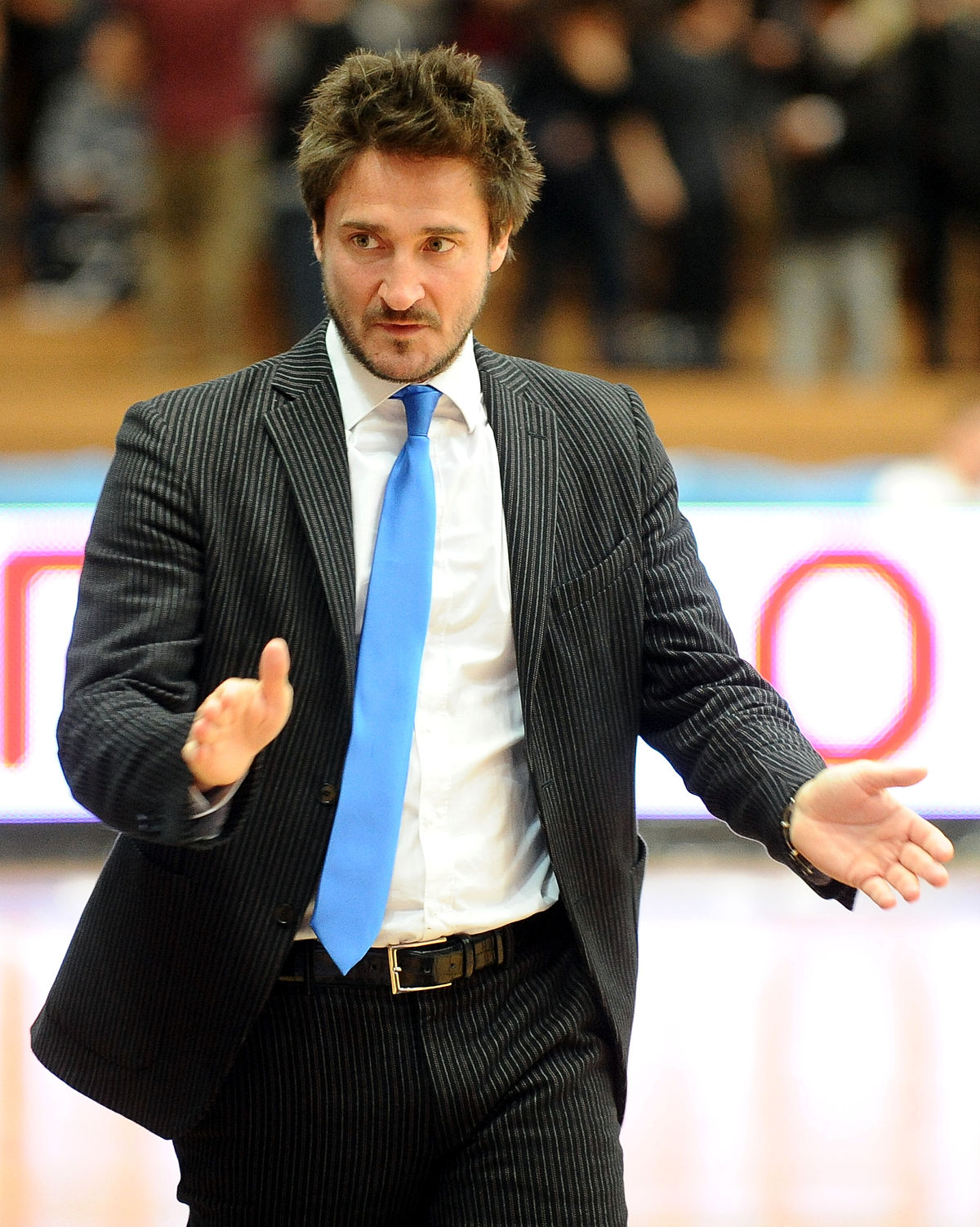
Gianmarco Pozzecco, born on September 15, 1972, in Gorizia, Italy, is one of the most colorful and dynamic figures in the world of basketball. Known for his flamboyant style both on and off the court, Pozzecco has carved out a unique place in Italian and international basketball, first as a player and later as a coach. His career has been marked by impressive highs, moments of controversy, and a personality that has captivated fans and media alike. This article delves into the life and career of Gianmarco Pozzecco, exploring his journey from a promising young talent to one of the most talked-about names in basketball.
Early Life and Basketball Beginnings
Gianmarco Pozzecco was born in Gorizia, a town in northeastern Italy, but he considers himself proudly Triestino, having grown up in the nearby city of Trieste. Despite his strong ties to Trieste, Pozzecco never played professionally for his hometown team, which is a testament to the twists and turns that his career would take.
Pozzecco’s basketball journey began in Udine, where he joined the youth ranks and quickly made a name for himself with his speed, creativity, and an instinctive feel for the game. Standing at just 180 cm (about 5’11”), Pozzecco was not the tallest player, but what he lacked in height, he more than made up for in agility and court vision. He made his debut in professional basketball with Pallacanestro Udine in 1991, competing in Serie B1, Italy’s third-tier basketball league.
Rise to Prominence with Livorno and Varese
In 1993, Pozzecco’s career took a significant step forward when he joined the Serie A team Livorno. It was here that he began to showcase the flair and talent that would become his trademarks. Known for his speed, unpredictability, and a sharp three-point shot, Pozzecco quickly became a fan favorite. He ended the season with an average of 10 points per game, playing just 17 minutes per game—a clear indication of his efficiency on the court.
Pozzecco’s growing reputation attracted the attention of Pallacanestro Varese, one of Italy’s most storied basketball clubs. He joined Varese in the summer of 1994, and it was here that he experienced some of the most successful and memorable moments of his playing career. During his time with Varese, Pozzecco emerged as a leader on the court, guiding the team through the challenges of Serie A2 and helping them secure promotion back to Serie A, where they belonged.
Pozzecco’s performances in the late 1990s were nothing short of spectacular. His ability to orchestrate plays, combined with his knack for scoring, made him one of the top playmakers in the league. He led the Italian league in assists for seven consecutive years, a testament to his exceptional vision and passing ability. In 1999, Pozzecco played a pivotal role in leading Varese to the Italian Championship and the Italian Supercup, further solidifying his status as one of the best point guards in the country.
The “Pozzecco Phenomenon” and Media Stardom
By the early 2000s, Gianmarco Pozzecco had become more than just a basketball player—he had become a media personality. His eccentricity, combined with his undeniable talent, created what many referred to as the “Pozzecco Phenomenon.” His fiery red hair, flamboyant style, and charismatic personality made him a magnet for attention, both on and off the court.
Pozzecco’s fame extended beyond the basketball court. He co-hosted the television show “Candid Camera Show” on Italia 1 alongside Samantha De Grenet, further boosting his popularity. His appearances on television and his unique personality made him a household name in Italy, even among those who were not basketball fans. His popularity often surpassed that of other basketball legends in Italy, such as Dino Meneghin and Carlton Myers.
In 2001, Pozzecco reached the peak of his playing career when he became the top scorer in the Italian league, averaging an impressive 27 points per game. This achievement, combined with his assist-leading abilities, made him one of the most complete players in Italian basketball history.
Attempting the NBA Dream
Following his success in Italy, Pozzecco set his sights on the NBA, the world’s premier basketball league. In the summer of 2001, he traveled to the United States to try his luck with NBA teams. He participated in the NBA Summer League with the Toronto Raptors, hoping to earn a spot on their roster. However, despite his undeniable talent and basketball IQ, Pozzecco’s age (29 years old) and relatively small stature for an NBA player (compared to the physically imposing players in the league) proved to be significant obstacles.
His time in the United States was a humbling experience, and after failing to secure an NBA contract, Pozzecco returned to Italy. The disappointment of not making it to the NBA marked a turning point in his career, and he struggled to regain the same level of motivation and drive that had fueled his earlier success.
Return to Italy and the Fortitudo Bologna Chapter
In 2002, Pozzecco signed with Fortitudo Bologna, one of the top teams in Italy. The move was seen as a fresh start for Pozzecco, and he was expected to bring his experience and leadership to a team that had high ambitions both domestically and in Europe.
With Fortitudo Bologna, Pozzecco reached the final of the EuroLeague (then known as the European Champions Cup) and finished as runners-up in the Italian league. However, his time with Fortitudo was marked by increasing frustration over his lack of playing time. Pozzecco, who had always thrived as the focal point of his teams, found it difficult to adjust to a reduced role. His frustration boiled over in April 2005, when he infamously grabbed the coaching board from his coach’s hands during a game. This outburst led to the termination of his contract with Fortitudo.
After his departure from Bologna, Pozzecco briefly played in Spain’s second division, a move that many saw as a step down for a player of his caliber. His motivation waned, and it seemed that his best playing days were behind him.
Love-Hate Relationship with the Italian National Team
Gianmarco Pozzecco’s relationship with the Italian national team was complex, to say the least. He made his debut for the national team in 1997 and was part of the squad that finished sixth in the 1998 FIBA World Championship. However, his fiery temperament and larger-than-life personality often put him at odds with coaches.
In 1999, Pozzecco was left out of the squad that won the EuroBasket championship, a decision that deeply hurt him. His exclusion was largely attributed to his clashes with head coach Bogdan Tanjević, who found Pozzecco’s behavior difficult to manage.
Despite this setback, Pozzecco was given another chance under coach Carlo Recalcati, who had previously coached him at Varese. In 2003, during a training camp in Bormio, Pozzecco’s impulsive nature got the better of him again. Frustrated by the strictness of the training camp, he took the team’s minibus without permission in the middle of the night in search of some fun. This incident led to his temporary expulsion from the team.
However, Recalcati saw the value in having Pozzecco on the team and recalled him for the 2004 Athens Olympics. Pozzecco played a crucial role in Italy’s run to the silver medal, proving that, despite his off-court antics, he could still deliver when it mattered most. He also participated in the 2005 EuroBasket, where he was one of the few bright spots in an otherwise disappointing campaign for Italy.
Retirement from Playing and Transition to Coaching
By 2006, Gianmarco Pozzecco’s playing career was winding down. He spent a brief and largely uneventful stint in Russia with Khimki Moscow, which many saw as a form of exile due to his increasingly difficult-to-manage personality. However, Pozzecco’s love for basketball never waned, and in 2007, he returned to Italy, signing with Orlandina Basket in Capo d’Orlando, Sicily.
Pozzecco officially retired from professional basketball in May 2008, announcing his decision publicly after his final game in Avellino. It was the end of an era for one of Italian basketball’s most charismatic figures.
However, retirement from playing did not mean the end of Pozzecco’s involvement in basketball. In November 2012, he began his coaching career with UPEA Capo d’Orlando, taking over a team that was struggling in Italy’s Legadue (second division). Despite the team’s poor start to the season, Pozzecco managed to guide them to an 11th-place finish, showing that his knowledge of the game could translate from playing to coaching.
Coaching Career and Achievements
Pozzecco’s coaching career has been marked by the same passion and intensity that characterized his playing days. In the 2013/14 season, he led Orlandina to a second-place finish in the regular season and a finals appearance in the playoffs, where they lost to Aquila Basket Trento. His success with Orlandina caught the attention of other clubs, and in June 2014, he signed a two-year contract to coach Pallacanestro Varese, returning to the club where he had enjoyed some of his best playing days.
Pozzecco’s return to Serie A as a head coach began with a victory in the local derby against Cantù. However, his tenure with Varese was short-lived, as he resigned in February 2015, citing differences with the club’s management.
He then took on the role of assistant coach with Cedevita Zagreb in Croatia, where he worked under his former teammate Veljko Mršić. This experience allowed Pozzecco to broaden his coaching horizons and gain valuable experience in a different basketball culture.
In March 2018, Pozzecco returned to Italy to coach Fortitudo Bologna in Serie A2, a move that was seen as a homecoming of sorts. However, his time with Fortitudo was brief, and he left the club in June of the same year.
In 2019, Pozzecco was appointed head coach of Dinamo Sassari, a club competing in Italy’s top league. His tenure with Sassari was a success, as he led the team to victory in the FIBA Europe Cup, defeating Germany’s S.Oliver Würzburg in the final. He also won the Italian Supercup in the 2019/20 season, adding another trophy to his growing list of coaching achievements.
Recent Years and National Team Leadership
The 2020/21 season proved to be a challenging one for Pozzecco. Dinamo Sassari’s campaign in the Basketball Champions League ended in disappointment, and their domestic season was marred by inconsistency. Pozzecco’s tenure with Sassari came to an end in June 2021, as the club decided to part ways with their charismatic coach.
Pozzecco’s coaching journey took a significant turn when he was appointed assistant coach at Olimpia Milano under Ettore Messina, one of Europe’s most respected coaches. During his time with Milano, Pozzecco added the Italian Cup and Serie A title to his resume, further cementing his reputation as a successful coach.
In 2022, Pozzecco was appointed head coach of the Italian national team, succeeding Romeo Sacchetti. His first major tournament in charge was the EuroBasket 2022, where he led Italy to the quarterfinals before losing to France in a hard-fought overtime game. Pozzecco’s emotional leadership style was on full display, and his ability to connect with players was evident throughout the tournament.
In October 2023, Pozzecco took on a new challenge as the head coach of ASVEL Lyon-Villeurbanne in France. However, his tenure was short-lived, and he was relieved of his duties in early 2024 after failing to turn around the team’s fortunes.
Legacy and Impact
Gianmarco Pozzecco’s impact on basketball goes beyond statistics and trophies. He has brought a sense of joy and passion to the game, both as a player and a coach. His flamboyant style, emotional leadership, and ability to connect with fans have made him one of the most beloved figures in Italian basketball.
Pozzecco’s journey is a testament to the highs and lows of a life dedicated to basketball. From his days as a flashy point guard to his role as a coach on the sidelines, Pozzecco has always been true to himself—unpredictable, passionate, and deeply in love with the game. His legacy in Italian basketball is secure, and his story continues to inspire both players and fans alike.


