
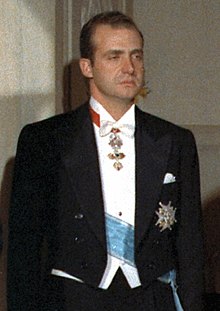
Early Life and Royal Origins
Re Juan Carlos di Borbone, born Juan Carlos de Borbón y Borbón-Dos Sicilias, entered the world on January 5, 1938, in Rome, Italy. His birth in the Italian capital, rather than in Spain, reflects the tumultuous period his family was navigating at the time. The Spanish Civil War had torn the country apart, and with the rise of Republican forces, the Bourbon family, who had long held the Spanish throne, sought refuge in Mussolini’s Italy. Juan Carlos was the son of Juan de Borbón, the Count of Barcelona, and Maria Mercedes of Bourbon-Two Sicilies, making him a direct descendant of King Alfonso XIII of Spain.
Return to Spain and Franco’s Dictatorship
Following the conclusion of the Spanish Civil War and World War II, which solidified Francisco Franco’s rule over Spain, the Bourbon family cautiously returned to Madrid in 1948. This return marked the beginning of Juan Carlos’s education, which was meticulously designed to prepare him for a future role in the Spanish monarchy, should circumstances ever allow it.
Franco’s regime, which began in 1939, had reinstated the Spanish monarchy in name but not in practice. Franco himself retained all royal powers, serving as Spain’s de facto ruler while keeping the Bourbon family in a state of limbo. Despite being the legitimate heirs to the Spanish throne, the Bourbons were relegated to a secondary role, living under the shadow of Franco’s authoritarian rule. However, the family enjoyed certain privileges and protection, particularly from the Spanish clergy, who were staunch supporters of the regime.
Marriage and Family Life
Juan Carlos’s personal life took a significant turn in the early 1960s when he met and married Princess Sofia of Greece and Denmark. Their union, which took place in Athens in 1962, was a significant event, merging two royal families with deep European roots. Sofia, the daughter of King Paul I of Greece and Queen Frederica of Hanover, brought her own royal pedigree to the marriage. The couple had three children: Elena, Cristina, and their son Felipe, who would later become the King of Spain.
Ascension to the Throne
The 1960s were a period of gradual change for Juan Carlos. In 1963, Francisco Franco, whose health was beginning to decline, named Juan Carlos as his official successor, but with the title of King. This designation was formalized in 1969, as Franco prepared for the inevitable transition of power. By 1973, Juan Carlos had assumed the role of acting head of state, as Franco’s deteriorating health made it increasingly difficult for him to govern.
On November 20, 1975, Francisco Franco passed away, suffering from Parkinson’s disease. Just two days later, on November 22, 1975, Juan Carlos I was officially crowned King of Spain. His ascension marked a turning point in Spanish history, as the country began to move away from Franco’s dictatorial rule towards a new era of democracy.
The Democratic Transition
One of King Juan Carlos I’s most significant achievements was his role in Spain’s transition from dictatorship to democracy. Almost immediately after his coronation, he began working towards a new democratic constitution, which was officially adopted in 1978. This constitution was not only widely accepted but also laid the foundation for modern Spain as a constitutional monarchy. The transition was marked by a series of institutional reforms, all championed by the new king, that shifted Spain from a fascist dictatorship to a democratic state.
However, the transition was not without its challenges. In 1981, just three years after the new constitution was enacted, a faction within the Spanish Civil Guard and the military attempted a coup d’état, seeking to restore authoritarian rule. King Juan Carlos I played a decisive role in quashing the coup, addressing the nation on live television and affirming his commitment to the democratic process. His actions during this critical moment not only solidified his position as a beloved monarch but also reinforced Spain’s dedication to its newfound democracy.
International Recognition and Influence
King Juan Carlos I’s influence extended beyond Spain’s borders. His commitment to democracy and his role in Spain’s peaceful transition earned him international acclaim. In 1998, he was invited to address the Italian Parliament, becoming the first foreign head of state to do so in the history of the Italian Republic. This was a significant recognition of his efforts to promote democratic values not only in Spain but throughout Europe.
King Juan Carlos was also known for his diplomatic tact and his ability to navigate complex international relationships. This was evident in 2007 when he chose not to attend the beatification of nearly 500 martyrs from the Spanish Civil War, a decision that helped avoid reigniting old political and religious tensions. That same year, his confrontation with Venezuelan President Hugo Chávez during a summit—where he famously told Chávez to “shut up” after the latter insulted a former Spanish prime minister—became a defining moment in his international reputation.
Public Perception and Legacy
Over the years, King Juan Carlos I became a symbol of Spain’s successful transition to democracy. His popularity was reflected in numerous public opinion polls, including one that named him the greatest Spaniard of all time, ahead of historical figures such as Christopher Columbus, Pablo Picasso, and Miguel de Cervantes. Another poll revealed that 80% of Spaniards believed the democratic transition would not have been possible without him.
However, his later years were not without controversy. Despite his earlier successes, the king faced increasing scrutiny over various issues, including allegations of corruption and criticism of his personal life. These controversies ultimately led to his abdication on June 19, 2014, in favor of his son Felipe, who became King Felipe VI.
Historical Context and Nuances
To fully understand the significance of King Juan Carlos I’s reign, it is essential to consider the broader historical context in which he operated. Spain’s history in the 20th century was marked by extreme political turmoil, from the fall of the monarchy to the rise of a republic, followed by a brutal civil war and the establishment of Franco’s dictatorship. When Juan Carlos was born, Spain was a country divided, with deep scars from the civil war and a society polarized by competing ideologies.
Franco’s rule, which lasted from 1939 until his death in 1975, was characterized by repression, censorship, and a strict authoritarian regime. The decision to name Juan Carlos as his successor was a strategic one, aimed at preserving the Francoist legacy while restoring the monarchy. However, Franco likely underestimated Juan Carlos’s commitment to democracy and his ability to lead Spain through a peaceful transition.
Juan Carlos’s reign is also notable for the way he balanced his royal duties with the evolving political landscape of Spain. As a monarch, he had to navigate the complex relationship between the monarchy and the democratic institutions that were being built around him. This required not only political acumen but also a deep understanding of Spain’s social and cultural dynamics.
Conclusion
Re Juan Carlos di Borbone is a figure whose life and legacy are deeply intertwined with the history of modern Spain. From his birth in exile to his ascension to the throne, and ultimately, his role in Spain’s transition to democracy, Juan Carlos’s story is one of resilience, adaptability, and commitment to the principles of democracy. His reign, which lasted nearly four decades, was marked by significant achievements and challenges, both domestically and internationally.
Although his later years were marred by controversy, the impact of his leadership during Spain’s critical transition period cannot be overstated. His abdication in favor of his son marked the end of an era, but his legacy as a key figure in Spain’s modern history remains intact. Today, King Juan Carlos I is remembered not only as a monarch but as a pivotal figure who helped shape the Spain of the 21st century.
The story of Re Juan Carlos di Borbone is a testament to the power of leadership in times of change and the enduring influence of the monarchy in shaping the course of a nation’s history.


