
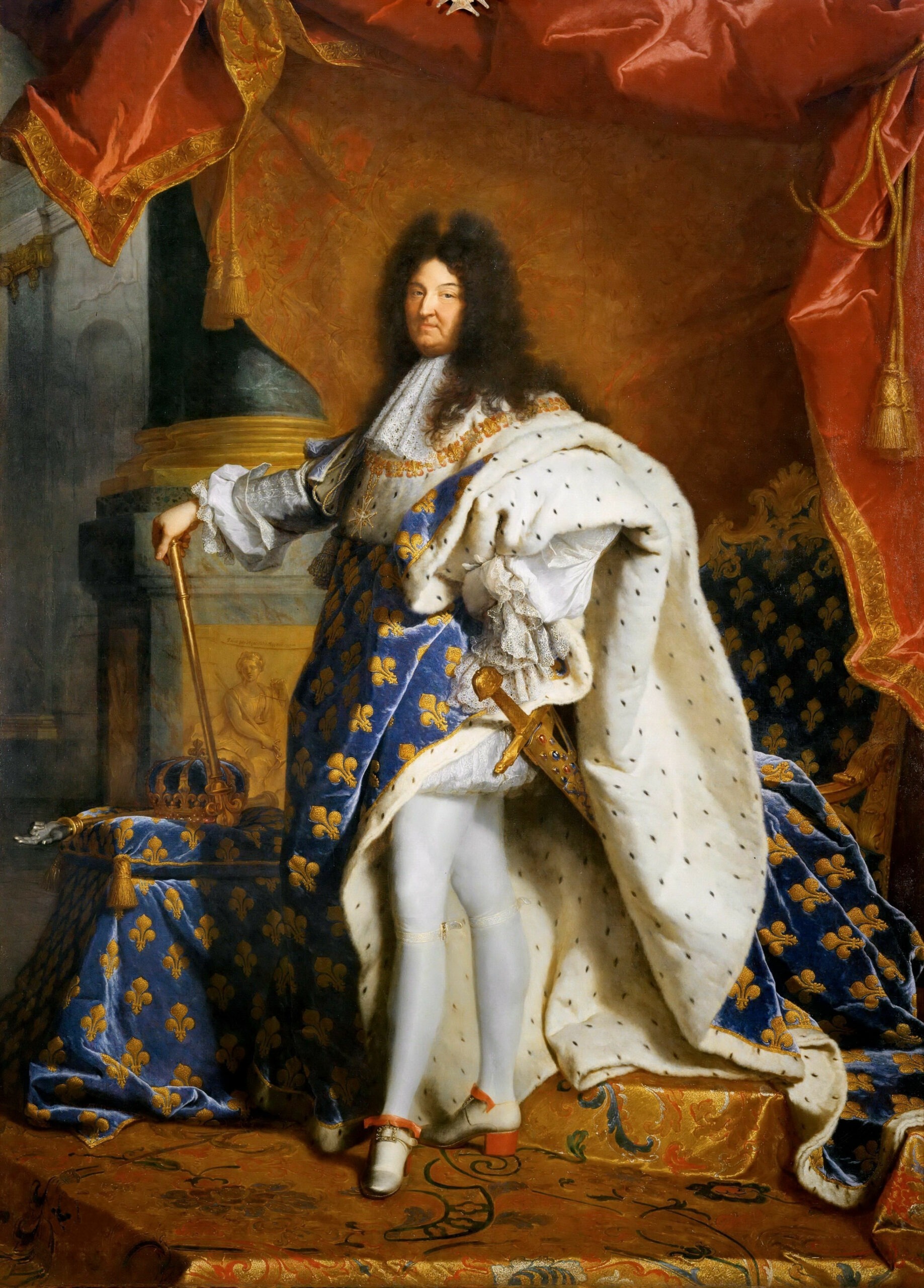
Louis XIV of France, also known as Re Luigi XIV, was one of the most powerful and influential monarchs in European history. His reign, which lasted for an astonishing 72 years, not only shaped the future of France but also had a significant impact on the development of absolute monarchy in Europe. Often referred to as the “Sun King” (Le Roi Soleil), Louis XIV is remembered for his lavish lifestyle, his centralization of power, and his role in making France a dominant European power.
Early Life and Ascension to the Throne
Louis XIV was born on September 5, 1638, in Saint-Germain-en-Laye, France, to King Louis XIII and Anne of Austria. His birth was considered miraculous since his parents had been married for 23 years without producing an heir. His second name, Dieudonné (Deodato in Italian), meaning “God-given,” reflects the divine interpretation of his birth.
Louis XIV became king at the tender age of five, following the death of his father in 1643. However, due to his young age, the kingdom was governed by his mother and her chief minister, Cardinal Mazarin, for the next 18 years. It wasn’t until Mazarin’s death in 1661 that Louis XIV assumed full control of the French government, marking the beginning of his personal rule.
The Establishment of Absolute Monarchy
Louis XIV’s reign is often cited as the epitome of absolute monarchy. He believed in the divine right of kings, a doctrine that posits that monarchs are chosen by God and are answerable only to Him. This belief allowed Louis to centralize power and rule without the need for a parliamentary system. The phrase “L’état, c’est moi” (“I am the state”), often attributed to him, encapsulates his approach to governance.
To solidify his power, Louis XIV worked diligently to reduce the influence of the nobility. He appointed commoners like Jean-Baptiste Colbert, the son of a merchant, as Controller-General of Finances and the Marquis de Louvois, the son of a chancellor, as Minister of War. By selecting individuals outside of the traditional aristocracy, Louis ensured that his authority would not be overshadowed by powerful nobles.
The Construction of Versailles
One of the most enduring symbols of Louis XIV’s reign is the Palace of Versailles. Originally a modest hunting lodge, Versailles was transformed into the grandest royal palace in Europe under Louis’s direction. The construction of Versailles was not just an architectural project but a political strategy. By moving the royal court to Versailles in 1682, Louis was able to keep the nobility under his watchful eye, thus preventing any potential rebellions.
Versailles became the center of political power in France and the epitome of royal grandeur. The palace was home to numerous artists, writers, and musicians, including Jean Racine, Molière, and the composer Jean-Baptiste Lully. The opulence of Versailles was a reflection of Louis XIV’s belief in the divine nature of his kingship and his desire to project an image of unchallengeable power.
Military Campaigns and Foreign Policy
Louis XIV’s reign was marked by numerous military campaigns, aimed at expanding French territory and influence. Early in his reign, he successfully led France in the War of Devolution (1667-1668) against Spain, gaining control of several Spanish territories in the Netherlands.
However, his most ambitious and controversial military endeavor was the War of Spanish Succession (1701-1714). The conflict arose when the childless Charles II of Spain died, leaving the Spanish throne to Louis XIV’s grandson, Philip of Anjou. This move alarmed other European powers, particularly Austria and England, who feared that the union of France and Spain under one family would disrupt the balance of power in Europe.
The war was long and costly, draining France’s resources and leading to widespread suffering among the French population. Although the Treaty of Utrecht in 1713 allowed Philip to remain King of Spain, it required him to renounce any claim to the French throne, thus preventing the unification of the two crowns.
Religious Policies and the Edict of Fontainebleau
Louis XIV was a staunch Catholic and saw religious unity as essential to the strength of his kingdom. His most controversial religious policy was the revocation of the Edict of Nantes in 1685, which had previously granted religious freedom to the Protestant Huguenots. The revocation, known as the Edict of Fontainebleau, led to the persecution of Huguenots, many of whom fled France, resulting in a significant loss of skilled labor and economic decline.
This decision was driven by Louis’s belief that religious division threatened the unity of the state. However, it also reflected his desire to exert absolute control over every aspect of French life, including religion.
The Legacy of Louis XIV
Louis XIV’s reign left a profound legacy on France and Europe. His centralization of power and the development of a highly efficient state bureaucracy set the standard for future European monarchies. His reign also saw the flourishing of French culture, with the arts, literature, and fashion reaching new heights under his patronage.
However, the latter part of his reign was marked by decline. The heavy taxation required to fund his wars and the opulent lifestyle at Versailles placed a tremendous burden on the French people. By the time of his death in 1715, France was facing significant financial difficulties, and the seeds of discontent that would eventually lead to the French Revolution had been sown.
The Final Years and Death
The final years of Louis XIV’s reign were marked by personal tragedy and political setbacks. He outlived most of his immediate family, including his son, grandson, and great-grandson, leaving the throne to his five-year-old great-grandson, Louis XV. The War of Spanish Succession, while securing the Bourbon dynasty’s hold on Spain, had drained France’s treasury and weakened its position in Europe.
Louis XIV died on September 1, 1715, just days before his 77th birthday. He succumbed to gangrene, ending a reign that had lasted 72 years—one of the longest in European history. His death marked the end of an era, and his legacy would be debated by historians and political thinkers for centuries to come.
Historical Context and Influence
The reign of Louis XIV must be understood within the broader context of the 17th and early 18th centuries. This was a period of significant change in Europe, with the rise of nation-states, the development of modern economies, and the shift from feudalism to centralized monarchies. Louis XIV’s France was at the forefront of these changes, and his policies reflected the growing power of the state over traditional feudal structures.
Louis XIV’s reign also coincided with the Age of Enlightenment, a time when new ideas about governance, society, and the rights of individuals were beginning to take hold. While Louis himself was not a proponent of Enlightenment ideals, his reign set the stage for the debates that would later emerge about the nature of power, the role of the monarchy, and the rights of citizens.
In many ways, Louis XIV represented the pinnacle of the absolute monarchy, but his reign also highlighted its inherent contradictions and limitations. His centralization of power made France a dominant European power, but it also created a system that was heavily dependent on the personality and decisions of a single ruler. When Louis XIV died, he left behind a state that was powerful but also vulnerable to the economic and social pressures that would eventually lead to revolution.
Conclusion
Louis XIV remains one of the most studied and debated figures in European history. His reign was characterized by grandeur, ambition, and a relentless pursuit of power. While he achieved remarkable successes, his reign also exposed the vulnerabilities of an absolute monarchy. The legacy of Louis XIV is a complex one, reflecting both the heights of royal power and the seeds of its eventual decline. His life and reign offer valuable lessons about the nature of power, the responsibilities of leadership, and the challenges of governing a nation.


