
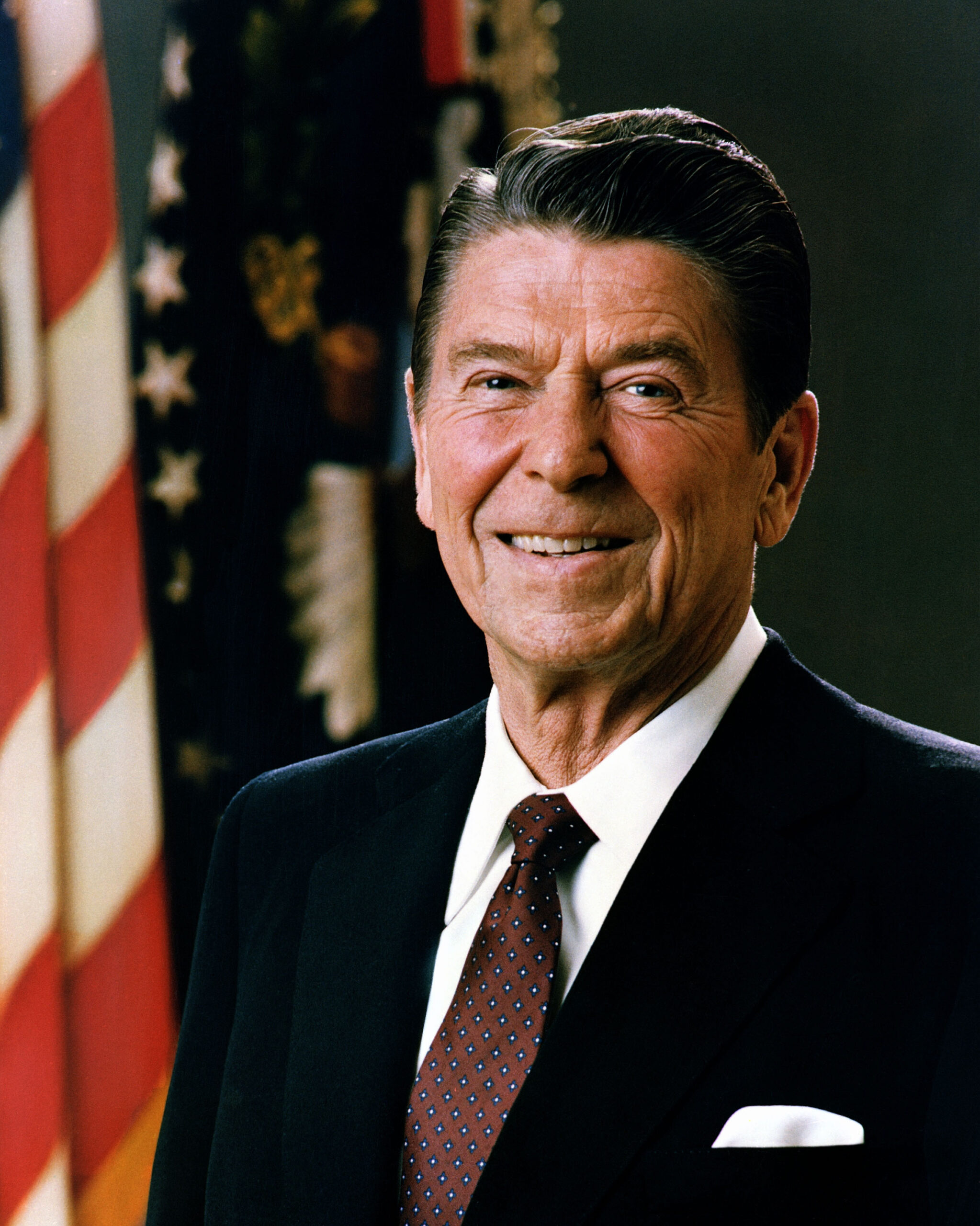
Ronald Reagan, the 40th President of the United States, remains one of the most iconic and influential figures in American history. Born on February 6, 1911, in Tampico, Illinois, Reagan’s journey from a small-town boy to the leader of the free world is a story of ambition, resilience, and an unyielding belief in the American Dream. His presidency from 1981 to 1989 was marked by significant economic policies, a robust stance against the Soviet Union, and a legacy that continues to shape the political landscape of the United States.
Early Life and Career
Ronald Wilson Reagan was born into a modest family in Tampico, Illinois. His father, Jack Reagan, was a shoe salesman, and his mother, Nelle Wilson Reagan, was a devout Christian who greatly influenced his values and beliefs. Reagan’s early life was marked by financial struggles, but his parents instilled in him a strong sense of optimism and perseverance.
Reagan attended Eureka College, a small liberal arts school in Illinois, where he majored in economics and sociology. He was also an active participant in campus activities, serving as the student body president and excelling in sports, particularly football. His time at Eureka helped shape his leadership skills and his passion for public speaking.
After graduating in 1932, Reagan began his career as a radio sports announcer. His deep, resonant voice and charismatic delivery quickly made him a popular figure in the Midwest. However, it was his move to Hollywood in 1937 that would change the trajectory of his life. Reagan signed a contract with Warner Brothers and embarked on a career in acting, eventually appearing in over 50 films during his time in Hollywood.
Hollywood to Politics: The Transition
Reagan’s acting career spanned nearly three decades, but it was not without its challenges. While he was a handsome and capable actor, his performances were often deemed adequate but not exceptional. Despite this, his time in Hollywood provided him with invaluable experience in public speaking and communication, skills that would later become hallmarks of his political career.
In 1940, Reagan married actress Jane Wyman, with whom he had two children, Maureen and Michael (the latter adopted). The marriage ended in divorce in 1948, a rare occurrence in the conservative Hollywood of the time. In 1952, Reagan married actress Nancy Davis, a union that would last until his death. Nancy Reagan played a crucial role in her husband’s life, serving as his confidante and advisor throughout his political career.
Reagan’s political awakening began in the 1950s, during his tenure as the president of the Screen Actors Guild (SAG). His role in SAG, particularly during the turbulent years of the McCarthy era, exposed him to the political issues of the day, including the threat of communism and the importance of free speech. Initially a Democrat, Reagan’s political views began to shift to the right as he became increasingly disillusioned with the policies of the Democratic Party, particularly its approach to the economy and national security.
In 1964, Reagan delivered a speech on behalf of Republican presidential candidate Barry Goldwater. The speech, titled “A Time for Choosing,” was a defining moment in Reagan’s career, catapulting him into the national spotlight and establishing him as a rising star within the Republican Party. The speech highlighted his conservative beliefs, emphasizing the importance of limited government, free-market capitalism, and a strong national defense.
Governor of California
Riding the wave of his newfound political popularity, Reagan ran for governor of California in 1966. He won in a landslide, defeating the incumbent Democrat, Pat Brown. As governor, Reagan implemented a series of conservative reforms that focused on reducing government spending, lowering taxes, and cracking down on student protests and anti-war demonstrations. His tough stance on law and order, coupled with his charismatic leadership style, made him a popular figure among conservatives nationwide.
Reagan was re-elected as governor in 1970, further solidifying his reputation as a strong, principled leader. During his tenure, he balanced the state budget, reformed welfare, and introduced significant changes to California’s educational system. However, his administration was not without controversy. His handling of student protests, particularly the violent clashes at the University of California, Berkeley, drew criticism from both liberals and moderates.
Despite these challenges, Reagan’s success as governor of California set the stage for his eventual run for the presidency. By the time he left office in 1975, he had become a prominent figure in the Republican Party, known for his unwavering commitment to conservative principles and his ability to communicate complex ideas in a simple, relatable manner.
The Road to the White House
After an unsuccessful bid for the Republican presidential nomination in 1976, Reagan remained a powerful force within the party. His message of small government, individual freedom, and a strong national defense resonated with a growing segment of the American population, particularly in the wake of the economic and political turmoil of the 1970s.
In 1980, Reagan secured the Republican nomination and faced off against the incumbent president, Jimmy Carter. The election took place against a backdrop of economic recession, high inflation, and the Iran hostage crisis, which had severely damaged Carter’s popularity. Reagan’s optimistic vision for America, encapsulated in his campaign slogan “Let’s Make America Great Again,” struck a chord with voters who were tired of the country’s perceived decline.
Reagan won the 1980 election in a landslide, carrying 44 states and securing 489 electoral votes. His victory marked a significant shift in American politics, signaling the rise of a new conservative era that would dominate the country’s political landscape for the next decade.
The Reagan Presidency: First Term (1981-1985)
Ronald Reagan was inaugurated as the 40th President of the United States on January 20, 1981. His presidency began with a sense of optimism and a clear mandate to restore America’s economic strength and global standing. However, just 69 days into his first term, Reagan survived an assassination attempt that left him seriously injured. Despite the severity of his wounds, Reagan’s quick recovery and his display of humor and resilience in the face of adversity endeared him to the American public.
Reagan’s economic policies, often referred to as “Reaganomics,” were centered on reducing government intervention in the economy, cutting taxes, and deregulating industries. His administration implemented the largest tax cuts in American history, with the aim of stimulating economic growth and reducing unemployment. While these policies were credited with revitalizing the American economy in the 1980s, they also led to a significant increase in the national debt and widened the gap between the rich and the poor.
On the international front, Reagan took a hardline stance against the Soviet Union, which he famously labeled the “evil empire.” His administration increased defense spending to unprecedented levels, including the controversial Strategic Defense Initiative (SDI), also known as “Star Wars,” which aimed to develop a missile defense system to protect the United States from nuclear attacks. Reagan’s aggressive posture toward the Soviet Union was instrumental in escalating the arms race, but it also played a key role in bringing about the eventual end of the Cold War.
The Reagan Doctrine and Foreign Policy
Reagan’s foreign policy was heavily influenced by his belief in the moral superiority of democracy over communism. The “Reagan Doctrine” articulated his administration’s support for anti-communist movements worldwide, leading to U.S. involvement in conflicts in Central America, the Middle East, and Africa. Reagan provided military and financial support to the Contras in Nicaragua, the Mujahideen in Afghanistan, and anti-communist forces in Angola and Mozambique.
One of the most significant foreign policy achievements of Reagan’s presidency was the improvement of relations with the Soviet Union during his second term. Reagan’s relationship with Soviet leader Mikhail Gorbachev, who came to power in 1985, was crucial in reducing tensions between the two superpowers. The two leaders held a series of summits that culminated in the signing of the Intermediate-Range Nuclear Forces (INF) Treaty in 1987, which eliminated an entire class of nuclear weapons from Europe.
Reagan’s foreign policy was not without controversy, however. The Iran-Contra affair, which came to light in 1986, revealed that members of Reagan’s administration had secretly sold arms to Iran and used the proceeds to fund the Contras in Nicaragua, despite a congressional ban on such aid. The scandal damaged Reagan’s credibility and led to several investigations, but the president himself emerged relatively unscathed, with his approval ratings remaining high.
The Reagan Presidency: Second Term (1985-1989)
Reagan was re-elected in 1984 in one of the most lopsided victories in American history, winning 49 out of 50 states and defeating his Democratic opponent, Walter Mondale, by a wide margin. His second term was marked by continued economic growth, as well as significant developments in U.S.-Soviet relations.
Domestically, Reagan’s second term saw the implementation of several key policies, including the Tax Reform Act of 1986, which simplified the tax code and lowered tax rates. However, his administration also faced growing criticism over the widening income inequality and the mounting national debt. Despite these challenges, Reagan remained a popular and influential figure, known for his ability to connect with the American people and his unwavering commitment to conservative principles.
On the international stage, Reagan continued to pursue a strategy of peace through strength. His negotiations with Gorbachev led to the signing of the INF Treaty, which marked a significant step toward the reduction of nuclear arms and the eventual end of the Cold War. Reagan’s legacy as a peacemaker was cemented by his famous speech at the Berlin Wall in 1987, where he challenged Gorbachev to “tear down this wall.” The wall’s eventual fall in 1989, shortly after Reagan left office, symbolized the collapse of communism in Eastern Europe and the triumph of the democratic ideals that Reagan had championed throughout his presidency.
Post-Presidency and Legacy
After leaving office in 1989, Ronald Reagan retired to his ranch in California, where he remained active in public life, delivering speeches and writing his memoirs. In 1994, Reagan was diagnosed with Alzheimer’s disease, a condition that gradually diminished his public appearances and his ability to communicate. Despite his illness, Reagan continued to be admired and respected by millions of Americans, who remembered him as a leader who had restored their confidence in the nation and played a pivotal role in ending the Cold War.
Reagan passed away on June 5, 2004, at the age of 93. His death prompted an outpouring of grief and reflection on his legacy, with tributes pouring in from leaders around the world. Reagan’s state funeral was attended by numerous dignitaries, including all living former U.S. presidents, as well as foreign heads of state.
Reagan’s legacy is a complex and contested one. Supporters praise him for his role in revitalizing the American economy, restoring national pride, and helping to end the Cold War. Critics, however, argue that his policies exacerbated income inequality, increased the national debt, and contributed to the rise of social and economic challenges that continue to affect the United States today.
Regardless of one’s perspective, there is no denying that Ronald Reagan’s impact on American politics and global affairs was profound. His presidency marked the beginning of a conservative realignment in American politics, and his vision of a strong, confident America continues to resonate with many people around the world.
Conclusion
Ronald Reagan’s life and career are a testament to the power of perseverance, optimism, and a deep belief in the principles of freedom and democracy. From his humble beginnings in Illinois to his role as one of the most influential presidents in U.S. history, Reagan’s journey is a remarkable story of a man who embodied the American Dream and left an indelible mark on the world. His legacy, both celebrated and debated, will continue to shape the course of history for generations to come.


