
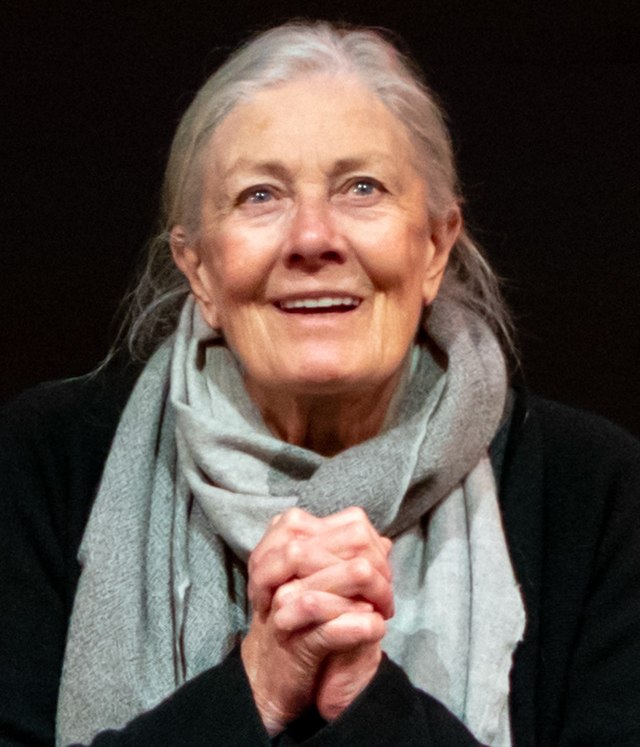
Vanessa Redgrave, a towering figure in the world of performing arts, has had a career that spans decades, encompassing the full spectrum of theatrical and cinematic excellence. Born into a family deeply entrenched in the acting world, Redgrave’s life has been one of extraordinary achievements, political activism, and personal challenges. This article explores her age, journey to fame, and the significant milestones in her life.
Early Life and Family Legacy
Vanessa Redgrave was born on January 30, 1937, in London, England. Her lineage foretold her future in the arts. Her grandfather, Roy Redgrave, was a renowned silent film actor in Australia, while her parents, Sir Michael Redgrave and Rachel Kempson, were both esteemed actors and members of the Old Vic Theatre. Vanessa’s destiny as an actress was almost prophesized at birth. On the day she was born, Sir Laurence Olivier, who was performing on stage with her father, announced her arrival to the audience, suggesting that Vanessa was born for the theater.
The Path to Stardom
Redgrave’s first passion was not acting but ballet. She studied at the Ballet Rambert School for eight years, aspiring to become a professional dancer. However, her tall stature limited her prospects in ballet, leading her to pursue acting. At the age of sixteen, despite suffering from acne and not fitting the conventional mold of beauty at the time, Vanessa decided to follow in the footsteps of her idol, Audrey Hepburn, and become an actress.
In 1954, she enrolled at the Central School of Speech and Drama, where she excelled, winning the Sybil Thorndike Award upon her graduation in 1957. Her stage debut came in 1958, performing alongside her father in “A Touch of Sun.” Vanessa described this experience as a formative trial, as her father was a harsh critic of her performance. Nonetheless, this challenging introduction to the stage set the tone for her future endeavors.
Breakthrough and Cinematic Success
Vanessa Redgrave’s early career was predominantly rooted in theater, particularly in Shakespearean plays. She starred in several notable productions, including “Othello,” “All’s Well That Ends Well,” and “A Midsummer Night’s Dream,” where she played Helena. Her portrayal in Laurence Olivier’s “Coriolanus” earned her considerable acclaim, leading to her inclusion in the Royal Shakespeare Company, where she performed alongside legendary actresses like Judi Dench.
Redgrave’s return to film came in 1966 with “Morgan: A Suitable Case for Treatment,” a role that won her the Best Actress award at the Cannes Film Festival. The same year, she starred in “Blow-Up,” directed by Michelangelo Antonioni, which became an iconic film of the 1960s. These performances solidified her status as a leading actress of her generation.
Personal Life and Relationships
Vanessa Redgrave’s personal life has been as eventful as her professional one. She married director Tony Richardson in 1962, and they had two daughters, Joely and Natasha Richardson, both of whom pursued acting careers. Natasha Richardson was married to actor Liam Neeson until her tragic death in 2009 following a skiing accident.
Redgrave’s marriage to Richardson ended in divorce, and she later entered into a long-term relationship with Italian actor Franco Nero, whom she met on the set of “Camelot,” where she played Guinevere. Their relationship was a significant chapter in her life, although it was tumultuous at times. The couple had a son, Carlo Gabriel Nero, and despite separating for a period, they eventually reunited and married in 2006.
Political Activism
Vanessa Redgrave is not only known for her acting but also for her passionate political activism. Her involvement in political causes began in the 1960s when she became one of the first celebrities to visit Cuba, sparking rumors of a relationship with Fidel Castro. She was an active member of the Workers’ Revolutionary Party and a vocal advocate for the Palestinian cause, a stance that drew both admiration and criticism.
Her activism extended beyond politics into social issues. Redgrave was a staunch opponent of the Vietnam War, participated in numerous protests, and even ran for political office under the banner of the Workers’ Revolutionary Party. Her commitment to these causes was unwavering, even as it sometimes overshadowed her acting career.
Later Career and Recognition
Throughout her career, Vanessa Redgrave has received numerous accolades for her performances. She won the Academy Award for Best Supporting Actress for her role in “Julia” (1977), a performance that remains one of her most celebrated. She has also been nominated for six Oscars, five Emmys, and thirteen Golden Globe Awards. Her theatrical achievements are equally impressive, having won the prestigious Tony Award, and being nominated for multiple Olivier Awards.
In 2018, Redgrave was honored with the Golden Lion for Lifetime Achievement at the Venice Film Festival, a testament to her enduring impact on the film industry.
Tragedy and Resilience
Vanessa Redgrave has faced considerable personal tragedies throughout her life. The death of her daughter Natasha in 2009 was a devastating blow, followed by the loss of her brother Corin and sister Lynn in the same year. These events were profound challenges, but Redgrave’s resilience has been a defining characteristic throughout her life.
Legacy and Continuing Influence
Vanessa Redgrave’s legacy extends beyond her filmography. She has been a trailblazer in using her fame to advocate for causes she believes in, often at great personal and professional risk. Her influence can be seen in the careers of her children and the generations of actors who have been inspired by her performances and her unwavering commitment to her principles.
At the age of 87, Vanessa Redgrave remains a symbol of artistic integrity, political commitment, and personal strength. Her career, marked by critical acclaim and public controversy, reflects the complexities of a life lived fully, both on and off the stage.
Conclusion
Vanessa Redgrave’s life and career offer a compelling narrative of talent, determination, and activism. From her early beginnings in a theatrical family to her rise as one of the most respected actresses of her time, Redgrave’s journey is one of relentless pursuit of excellence in the face of adversity. Her legacy is not only in the roles she has played but in the causes she has championed, making her a true icon of our time.


