
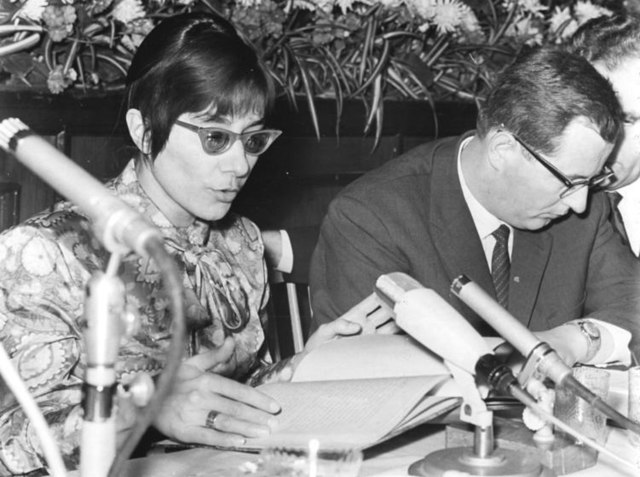
Brigitte Reimann, born on July 21, 1933, in Burg near Magdeburg, in what was then East Germany, remains one of the most compelling literary figures of the German Democratic Republic (GDR). Known for her evocative storytelling, Reimann’s works are a vivid portrayal of life in East Germany during a period of intense social and political change. Her literary career, punctuated by moments of personal struggle and profound reflection, has left an indelible mark on German literature and continues to resonate with readers today.
Early Life and Influences
Brigitte Reimann was born into a middle-class family, the eldest of four children. Her father, Willi Reimann, was a bank employee, and her mother, Elisabeth Besch, came from a family involved in both printing and jewelry manufacturing. Growing up in Burg, Brigitte experienced a childhood marked by both intellectual stimulation and the tumultuous backdrop of World War II. Her early life was heavily influenced by the contrasting worlds of her grandfathers—one a typesetter and editor of a socialist newspaper, the other a former prosecutor and owner of a goldsmith factory. This dichotomy between intellectualism and materialism would later be reflected in her writings.
The Reimann family’s life was upended by the war. Brigitte’s early years were defined by the challenges of the wartime period and the immediate post-war chaos. She witnessed the arrival of the Red Army in Burg in 1945 and the impact of occupation on her hometown, which saw numerous refugees and the commandeering of property, including her grandfather’s. These formative experiences shaped her worldview and imbued her with a deep sense of social justice and empathy, elements that would become hallmarks of her writing.
Formative Years and Early Literary Aspirations
From a young age, Brigitte Reimann showed a precocious talent for writing and a strong inclination towards the arts. At just nine years old, she was already an avid reader and displayed a remarkable imagination and enthusiasm for storytelling. Her passion for literature was further nurtured during her education at a co-educational school, where she not only excelled academically but also participated in numerous extracurricular activities, such as directing plays and writing for the school newspaper.
In December 1947, a significant health setback occurred when Brigitte contracted polio, leading to a lengthy hospital stay. This period of isolation proved pivotal, allowing her to immerse herself in literature and strengthen her resolve to pursue a career in writing. Despite the physical limitations brought on by the disease, which left her with a limp, Reimann’s determination to become a writer only grew stronger. Her writings from this period reveal a young woman grappling with feelings of inferiority and a profound need for recognition and affirmation—needs that would persist throughout her life.
The Path to Professional Writing
Brigitte Reimann’s early adult years were marked by a series of personal and professional explorations. After finishing her secondary education, she aspired to study theater and become a director, a dream cut short due to an injury. Instead, she pursued a two-year course in pedagogy and worked as a primary school teacher, a job she found unfulfilling. This dissatisfaction, coupled with her burgeoning desire to write, led her to leave teaching and briefly work in a bookstore and as a journalist.
Her literary ambitions were soon realized when she began submitting her works to various competitions in East Germany, winning several awards that encouraged her to pursue writing more seriously. In 1950, at just 17 years old, she won her first prize for a play about John Brown at the People’s Theatre of the GDR. These early successes were critical in establishing her reputation as a promising young writer within the socialist state.
Complex Relationships and Personal Struggles
Reimann’s personal life was as turbulent as her professional one. Her first significant romantic relationship was with Klaus Böhlke, which was characterized by intense emotions and a sense of being “used,” reflecting a pattern of tumultuous relationships that would follow her throughout her life. Her early experiences of love were fraught with complexity, marked by alternating feelings of passion, indifference, and resentment.
In 1953, she married Günter Domnik, an engineer with whom she had a deeply passionate yet tumultuous relationship. Their marriage, like many of her personal relationships, was plagued by jealousy, misunderstanding, and frequent conflict, leading Reimann to attempt suicide following one particularly heated argument. This period of intense personal turmoil coincided with her growing literary output, suggesting that writing served as both an outlet for her emotional struggles and a means of asserting her independence and identity.
Despite the difficulties in her personal life, Reimann remained committed to her craft. Her works from this period, such as “The Denouncer” and “The Woman at the Pillory,” reflect her ongoing engagement with themes of betrayal, moral ambiguity, and the human capacity for both cruelty and compassion. These stories often drew on her own experiences and observations, providing a stark commentary on the social and political realities of life in East Germany.
Literary Career and Political Engagement
Brigitte Reimann’s career took a significant turn in the late 1950s and early 1960s when she became more involved in the cultural and political life of East Germany. Her writing increasingly reflected the ideological commitments of the socialist state, and she became an active member of the Writers’ Association of the GDR. Her novel “Ankunft im Alltag” (Arrival in Everyday Life) marked a shift in her focus, depicting the lives of young people in East Germany who, despite their initial skepticism, come to embrace socialism and the values of the GDR.
This period also saw Reimann becoming more outspoken in her political views. She was a member of the Free German Youth (FDJ) and actively participated in its events, using her platform to advocate for the socialist ideals of the state. However, her relationship with the GDR’s political establishment was complex and often contentious. Although she supported the goals of socialism, she was critical of the authoritarian methods employed by the state to achieve them. This tension is evident in her works, which often explore the conflicts between personal desires and social expectations, between individual freedom and collective responsibility.
The Hoyerswerda Years and Bitterfeld Way
In 1960, Reimann moved to Hoyerswerda, a new socialist city, with her second husband, Siegfried Pitschmann, where they became involved in the “Bitterfeld Way,” a cultural initiative encouraging writers to engage with the working class and depict their lives authentically. This period was significant for Reimann, as it allowed her to immerse herself in the lives of ordinary workers and to reflect on the realities of socialist construction in East Germany.
Her novel “Die Geschwister” (The Siblings), published in 1963, is perhaps the best example of this engagement. The book tells the story of a painter, Elisabeth, who tries to persuade her brother Ulli not to flee to the West, reflecting the personal and ideological conflicts faced by many East Germans during this period. The novel also serves as an allegory for the broader struggle of artists in the GDR, who were often caught between their creative impulses and the state’s demands for ideological conformity.
Later Works and Continuing Struggles
Throughout the 1960s, Reimann continued to write prolifically, producing works that explored the complexities of life in East Germany and the challenges of maintaining artistic integrity in a highly politicized environment. Her writing often drew on her personal experiences, blending fiction with autobiography in a way that resonated deeply with her readers.
One of her most ambitious projects was the novel “Franziska Linkerhand,” which she worked on for over a decade and which was published posthumously. The novel, considered her magnum opus, is a semi-autobiographical account of a young architect who struggles to reconcile her creative ambitions with the restrictive realities of life in a socialist state. The book is widely regarded as one of the most important works of East German literature, offering a nuanced and critical perspective on the GDR’s attempts to build a socialist society.
Final Years and Legacy
Brigitte Reimann’s life was tragically cut short when she succumbed to cancer on February 20, 1973, at the age of 39. Despite her relatively short life, her impact on German literature and culture was profound. Her works, characterized by their emotional depth, political engagement, and unflinching honesty, continue to be read and studied today, offering a unique window into the complexities of life in East Germany.
Reimann’s legacy extends beyond her literary contributions. She is remembered as a passionate advocate for the rights of artists and intellectuals in the GDR, and as a writer who refused to compromise her artistic vision despite the pressures of the political regime. Her writings, particularly “Franziska Linkerhand,” remain a testament to her belief in the power of literature to challenge, inspire, and provoke.
Conclusion
Brigitte Reimann’s life and work offer a compelling portrait of a writer navigating the turbulent waters of 20th-century German history. Her story is one of resilience, creativity, and a steadfast commitment to her craft, even in the face of personal and political adversity. As a chronicler of life in East Germany, she provided an invaluable perspective on the experiences of ordinary people and the struggles of artists under socialism. Her works continue to inspire and challenge readers, reminding us of the enduring power of literature to reflect and shape our understanding of the world.
In remembering Brigitte Reimann, we celebrate not just a remarkable writer, but a courageous voice that spoke truth to power and remains relevant in our times. Her life and legacy are a testament to the enduring spirit of artistic integrity and the importance of literature in capturing the human experience.


