
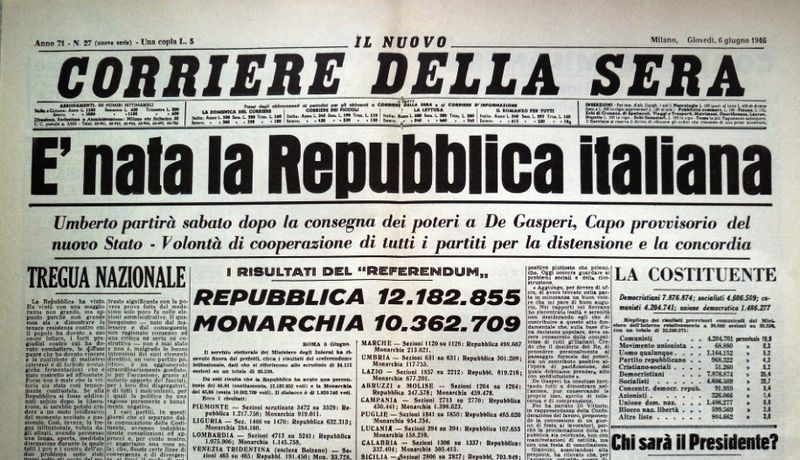
The birth of the Italian Republic, or “La Repubblica Italiana,” marks a significant moment in Italy’s history, symbolizing the nation’s transition from monarchy to a democratic republic. This transformation, which began with the fall of fascism and culminated in a decisive referendum, reflects Italy’s turbulent yet resilient path to becoming a modern state. This article delves into the historical context, key events, and notable figures that have shaped La Repubblica Italiana, exploring its age, fame, and life highlights.
Historical Context: The Road to the Republic
The history of the Italian Republic is deeply intertwined with the events of World War II and the collapse of the fascist regime. Italy, under the rule of Benito Mussolini, had aligned itself with Nazi Germany, leading the country into a catastrophic conflict that devastated the nation both physically and politically. By 1943, Italy was in chaos, with Allied forces invading from the south and the collapse of Mussolini’s government leading to a power vacuum.
On July 25, 1943, Benito Mussolini was deposed and arrested, marking the beginning of the end for the fascist regime. King Victor Emmanuel III, who had ruled Italy since 1900, appointed Marshal Pietro Badoglio to form a new government. However, this government was short-lived, as Italy’s involvement in the war continued to unravel, leading to the eventual occupation of Rome by Allied forces in June 1944.
The fall of Mussolini and the Allied liberation of Rome set the stage for a broader discussion about Italy’s future. The political landscape was fragmented, with strong divisions between the emerging Republican forces and those who supported the monarchy. The National Liberation Committee (Comitato di Liberazione Nazionale or CLN), composed of representatives from various anti-fascist parties, played a crucial role in guiding Italy through this transitional period.
The Referendum of 1946: Choosing the Republic
On June 2, 1946, Italians were called to vote in a national referendum to decide the future of the country: whether to continue as a monarchy or to become a republic. This referendum was a landmark event in Italian history, as it was the first time women were allowed to vote in a national election.
The referendum results were close but clear: 54.3% of voters chose to abolish the monarchy and establish a republic, with a margin of just over two million votes. This decision led to the exile of the House of Savoy, ending a monarchy that had ruled Italy for over eight decades.
The same day, Italians also voted to elect a Constituent Assembly tasked with drafting a new constitution for the republic. The election results reflected the new political dynamics in post-war Italy, with the Christian Democrats (Democrazia Cristiana) emerging as the dominant party, securing 35.2% of the vote. The Italian Socialist Party (PSI) and the Italian Communist Party (PCI) also gained significant support, receiving 20.7% and 20.6% of the vote, respectively. This distribution of power set the stage for the political landscape of the new republic.
Establishing the Italian Republic: Early Challenges
The formation of the Italian Republic was not without its challenges. The immediate post-war years were marked by political instability, economic hardship, and social unrest. The task of rebuilding a nation devastated by war and fascist rule was immense, and the newly established republic faced significant obstacles in uniting a divided country.
The first government of the Italian Republic was a coalition of anti-fascist parties, led by the Christian Democrat leader Alcide De Gasperi. De Gasperi, who served as Prime Minister from 1945 to 1953, was instrumental in guiding Italy through its early years as a republic. His government focused on economic reconstruction, land reform, and addressing the social issues that had plagued Italy for decades.
One of the key decisions made during this period was the adoption of the Italian Constitution, which came into effect on January 1, 1948. The constitution established a parliamentary democracy, with a clear separation of powers between the executive, legislative, and judicial branches. It also enshrined fundamental rights and freedoms for all citizens, reflecting the aspirations of a nation that had endured years of dictatorship and war.
The Cold War Era: Political Polarization
The early years of the Italian Republic coincided with the onset of the Cold War, which deeply influenced the country’s political landscape. Italy became a focal point of the global struggle between communism and capitalism, with the United States and the Soviet Union both vying for influence over the country’s future.
The Christian Democrats, under De Gasperi’s leadership, aligned Italy with the Western bloc, securing significant economic aid through the Marshall Plan and ensuring Italy’s integration into NATO. This alignment with the West was a decisive factor in the 1948 general elections, which saw the Christian Democrats win a landslide victory, defeating the Popular Democratic Front, an alliance of the Communist and Socialist parties.
This period was characterized by intense political polarization, with the Christian Democrats firmly in power and the Italian Communist Party (PCI) becoming the largest opposition force. The PCI, despite its exclusion from government, maintained significant influence through its strong base of support among the working class and intellectuals.
The Cold War also saw the emergence of the so-called “Years of Lead” (Anni di piombo), a period of social and political turmoil marked by widespread terrorism, both from far-left and far-right groups. The most infamous event of this period was the kidnapping and assassination of former Prime Minister Aldo Moro by the Red Brigades in 1978, which shocked the nation and highlighted the deep divisions within Italian society.
Economic Miracle and Social Transformation
Despite the political challenges, the post-war period also witnessed a remarkable economic recovery, often referred to as the “Italian Economic Miracle.” Between the 1950s and 1960s, Italy experienced rapid industrialization and economic growth, transforming it from a predominantly agrarian society into one of the world’s leading industrial economies.
The economic boom led to significant social changes, including urbanization, increased consumerism, and the rise of a new middle class. The expansion of education and the media also played a crucial role in shaping a more modern and dynamic society. However, this period of prosperity also highlighted the deep regional disparities between the industrialized North and the rural South, a division that continues to influence Italian politics today.
Modern Italy: Political Evolution and Challenges
The latter half of the 20th century saw Italy navigating the complex dynamics of post-war reconstruction, Cold War tensions, and the ongoing struggle between political factions. The political landscape was dominated by the Christian Democrats, who remained in power through a series of coalition governments until the early 1990s.
The 1990s marked a significant turning point in Italian politics, with the collapse of the post-war political order amid widespread corruption scandals, known as “Tangentopoli.” The subsequent investigation, known as “Mani Pulite” (Clean Hands), led to the dissolution of many traditional parties, including the Christian Democrats, and the rise of new political forces.
One of the most notable figures to emerge during this period was Silvio Berlusconi, a media tycoon who founded the center-right party Forza Italia. Berlusconi’s dominance of Italian politics throughout the 1990s and 2000s reflected broader trends of media influence and populism, which have continued to shape Italian political life.
The Presidency of the Republic: A Symbolic Role
The President of the Italian Republic, while largely a ceremonial figure, plays a crucial role in ensuring the stability and continuity of the state. Since the establishment of the republic, several presidents have left their mark on the nation’s history.
Enrico De Nicola, the first President of the Italian Republic, served from 1946 to 1948, overseeing the transition from monarchy to republic. His successors, including Luigi Einaudi, Giovanni Gronchi, and Antonio Segni, each navigated Italy through critical moments in its post-war history.
One of the most beloved presidents was Sandro Pertini, who served from 1978 to 1985. A former resistance fighter and socialist, Pertini was known for his strong moral leadership during a time of national crisis, particularly during the Years of Lead.
More recent presidents, such as Giorgio Napolitano (2006–2015) and Sergio Mattarella (2015–present), have faced the challenges of a rapidly changing political and social landscape, including economic crises, immigration issues, and the rise of populist movements.
Conclusion: The Legacy of La Repubblica Italiana
The Italian Republic has a complex and storied history, reflecting the nation’s struggles and triumphs as it transitioned from monarchy to democracy. Over the decades, Italy has faced numerous challenges, from political instability and economic crises to terrorism and social upheaval. Yet, through it all, the republic has endured, evolving and adapting to the changing needs of its people.
Today, La Repubblica Italiana stands as a testament to the resilience and determination of the Italian people. It is a nation that has overcome the shadows of its past to build a democratic society rooted in the values of freedom, justice, and equality. As Italy continues to navigate the challenges of the 21st century, the legacy of its republic remains a powerful symbol of the country’s enduring commitment to democracy and the rule of law.


