
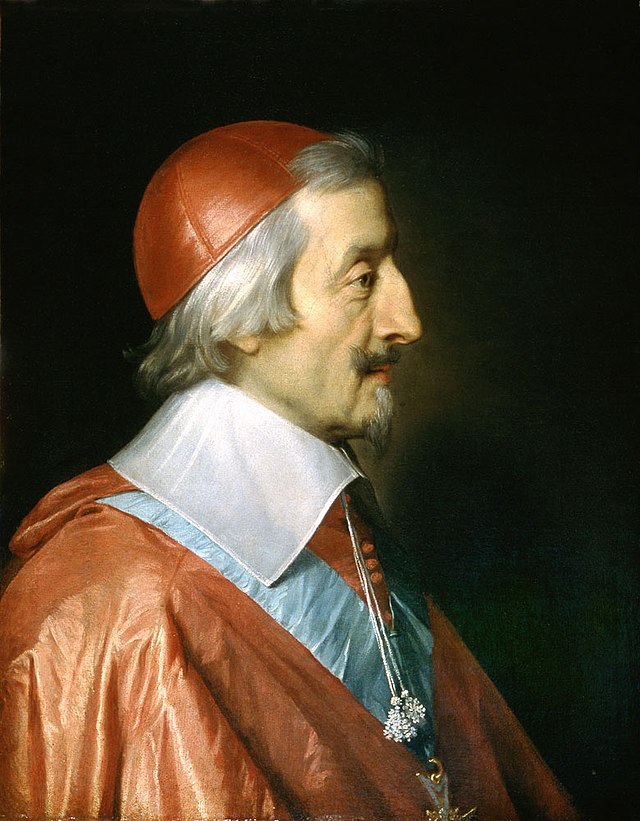
Armand-Jean du Plessis, better known as Cardinal Richelieu, was born on September 9, 1585, in Paris. He rose from relatively humble beginnings to become one of the most powerful and influential figures in French history. As the chief minister to King Louis XIII, Richelieu was instrumental in shaping France into a centralized state and securing its position as a dominant power in Europe. His life and career are a study in political genius, strategic foresight, and the ruthless exercise of power, all of which have left an indelible mark on the course of European history.
Early Life and Family Background
Richelieu was born into a noble family that had fallen on hard times. His father, François du Plessis, Seigneur de Richelieu, was a valiant officer who served under Henry III and Henry IV of France. Despite his dedication, the family’s fortunes had waned, leaving Richelieu’s mother, Suzanne de La Porte, with the responsibility of raising five young children after François’ untimely death.
Richelieu’s early life was marked by the challenges of growing up in a family that was noble in name but struggling financially. At just five years old, he lost his father, a tragedy that would force the family into a precarious situation. Despite these hardships, Richelieu’s lineage afforded him the opportunity to pursue an education at the prestigious Collège de Navarre in Paris.
Initially destined for a military career, Richelieu’s life took a dramatic turn when his elder brother, Alphonse, who was set to become the Bishop of Luçon, fell gravely ill. The family’s ecclesiastical privilege allowed them to pass the bishopric to another family member. To preserve this valuable position, Richelieu was hastily ordained, abandoning his military aspirations to take up the clerical mantle.
Rise to Power: From Bishop to Cardinal
At the tender age of 21, Richelieu was ordained as the Bishop of Luçon. Despite his youth, he quickly distinguished himself as a leader of great rigor and discipline. He was not content to simply occupy the position; he sought to reform and invigorate the clergy within his diocese. His commitment to the Counter-Reformation led him to initiate missions and conversion campaigns aimed at strengthening the Catholic faith, particularly among the Huguenots, French Calvinist Protestants.
Richelieu’s talents were soon recognized beyond his diocese. In 1614, he was appointed as a delegate to the Estates-General, a gathering that brought together representatives from the clergy, nobility, and commoners. Here, Richelieu’s diplomatic skills shone as he mediated between the often conflicting interests of the clergy and the nobility. His success in these negotiations earned him the favor of Queen Marie de’ Medici, the widow of Henry IV and regent for her young son, King Louis XIII.
In 1616, Richelieu was appointed Secretary of State for War and Foreign Affairs, a position that placed him at the heart of French politics. However, his rise was temporarily halted when King Louis XIII, seeking to assert his independence from his mother’s influence, orchestrated the assassination of her favorite, Concino Concini, and exiled her from Paris. Loyal to Marie de’ Medici, Richelieu followed her into exile, but he remained politically active, working to reconcile the queen with her son.
The Cardinal and the King: Shaping French Absolutism
Richelieu’s loyalty to Marie de’ Medici paid off when, in 1620, he successfully brokered a reconciliation between the queen and King Louis XIII. This rapprochement paved the way for his return to power. In 1622, Richelieu was appointed a cardinal, and just two years later, in 1624, he became the chief minister to King Louis XIII, a position he would hold until his death in 1642.
As chief minister, Richelieu was determined to consolidate royal power and diminish the influence of the nobility. He believed that a strong, centralized state was essential for France to assert itself as a dominant power in Europe. His policies were guided by a clear vision: to strengthen the monarchy internally and to elevate France’s position on the international stage.
One of Richelieu’s first major challenges was to deal with the Huguenots, who had established a semi-autonomous state within France. The Huguenots, centered in the fortified city of La Rochelle, posed a significant threat to the unity of the kingdom. Richelieu understood that their military and political autonomy was incompatible with the absolute authority of the king. In 1628, after a protracted siege, Richelieu successfully captured La Rochelle, effectively ending the Huguenot rebellion. This victory was a pivotal moment in the establishment of royal absolutism in France.
Richelieu’s focus on centralizing power extended to curbing the influence of the nobility. He was relentless in his pursuit of those who dared to challenge the king’s authority. Noble conspiracies, such as those led by Gaston d’Orléans, the king’s brother, and Anne of Austria, the queen, were ruthlessly suppressed. Richelieu did not hesitate to execute rebellious nobles or to force even the queen mother, Marie de’ Medici, into exile when she opposed his policies.
Richelieu’s Foreign Policy: The Thirty Years’ War and European Dominance
Richelieu’s domestic policies were inextricably linked to his foreign policy. He recognized that France’s security and influence depended on weakening the power of the Habsburgs, who ruled both the Holy Roman Empire and Spain. The Habsburgs were seen as the principal rivals to French hegemony in Europe.
In 1629, Richelieu personally led French forces in the War of the Mantuan Succession, a conflict that allowed France to assert its influence in northern Italy, a key strategic region. This was a precursor to France’s involvement in the broader Thirty Years’ War, which had begun in 1618 as a religious conflict between Catholics and Protestants but gradually evolved into a struggle for European dominance.
Richelieu’s decision to enter the Thirty Years’ War in 1635 on the side of the Protestant states, despite being a cardinal of the Catholic Church, was a testament to his realpolitik approach to diplomacy. For Richelieu, the overriding goal was to check the power of the Habsburgs and to secure France’s position as the preeminent power in Europe. His intervention was instrumental in turning the tide of the war in favor of the anti-Habsburg coalition.
The war, which ended with the Peace of Westphalia in 1648, significantly weakened the Habsburgs and led to the fragmentation of the Holy Roman Empire into a collection of independent states. Although Richelieu did not live to see the conclusion of the war, his policies laid the groundwork for France’s dominance in Europe, a legacy that would be fully realized under the reign of Louis XIV, the Sun King.
Legacy: The Architect of Modern France
Cardinal Richelieu died on December 4, 1642, at the age of 57, but his legacy endured long after his death. He was succeeded by Cardinal Mazarin, who continued many of his policies and served as a mentor to the young Louis XIV. Richelieu’s vision of a strong, centralized state became the foundation of the French absolute monarchy, which reached its zenith under Louis XIV.
Richelieu’s contributions to French culture were also significant. He was the founder of the Académie Française, an institution dedicated to the preservation and promotion of the French language and literature. The Académie remains one of the most prestigious cultural institutions in France to this day.
Richelieu’s political philosophy was characterized by a pragmatic, often ruthless, approach to governance. He believed that the ends justified the means, and he was willing to employ any tactic necessary to achieve his goals. This made him a controversial figure, both admired and reviled in his own time. His critics accused him of being a tyrant, while his supporters hailed him as a visionary statesman who secured France’s future.
The image of Richelieu as a Machiavellian figure has been immortalized in literature and popular culture, most notably in Alexandre Dumas’ The Three Musketeers, where he is portrayed as a cunning and manipulative antagonist. However, this portrayal, while popular, oversimplifies the complexity of Richelieu’s character and his contributions to statecraft.
The Nuances of Richelieu’s Statecraft
Richelieu’s political genius lay in his ability to navigate the treacherous waters of 17th-century European politics. He understood that the survival and prosperity of the French state required a delicate balance of power, both internally and externally. His policies were not driven by ideology but by a clear-eyed assessment of France’s interests.
Internally, Richelieu’s suppression of the nobility and his centralization of power were essential in creating a modern state. By curbing the independence of the nobility and ensuring that all power flowed from the monarchy, Richelieu laid the groundwork for the development of the absolute state. This centralization of authority was crucial in allowing France to project power on the international stage.
Externally, Richelieu’s foreign policy was characterized by a strategic alliance-building that prioritized France’s interests over religious or ideological considerations. His support for Protestant states during the Thirty Years’ War, despite his position as a Catholic cardinal, demonstrated his commitment to realpolitik. This approach allowed France to emerge from the war as the leading power in Europe, a position it would maintain for much of the 17th and 18th centuries.
Conclusion: Richelieu’s Enduring Influence
Armand-Jean du Plessis, Cardinal Richelieu, remains one of the most important figures in French history. His efforts to consolidate royal power, suppress internal dissent, and position France as a dominant force in European politics have left a lasting legacy. Richelieu’s vision of a strong, centralized state not only shaped the course of French history but also influenced the development of modern statecraft.
Richelieu’s life and career offer valuable lessons in leadership, diplomacy, and the exercise of power. His ability to navigate the complexities of his time with a clear focus on his objectives made him a formidable statesman. While his methods were often harsh, and his actions controversial, there is no denying the impact he had on the history of France and Europe.
Today, Richelieu is remembered not just as a cardinal and a statesman, but as the architect of modern France. His legacy is one of strength, resilience, and the relentless pursuit of a vision that transformed France into one of the most powerful nations in the world.


